Top HubSpot Migration Partners for Enterprise Teams in 2026
How many SaaS applications does your business use? Statista research states that companies around the world use 130 different SaaS applications to keep their business moving. That's a lot of siloed data that never connects, with sales, marketing, and leadership each working from a different version of the truth.
For enterprise teams, the answer is consolidation onto one platform with a single source of truth. That makes choosing from the top HubSpot migration partners one of the most valuable decisions you can make, because the right partner is what turns a complex move into a clean foundation for growth.
The best fit is the partner whose proven experience matches your migration, whether that's a custom-object build, a rebrand-driven replatform, or a compliance-sensitive financial-services migration.
This guide ranks the partners worth a shortlist against the criteria that predict a successful enterprise migration.
In this blog, you will discover:
- What separates an enterprise-grade HubSpot migration partner from a general agency
- The top HubSpot migration partners for enterprise teams in 2026
- How to match a partner to the hardest part of your migration
- The HubSpot capabilities that turn a migration into revenue infrastructure
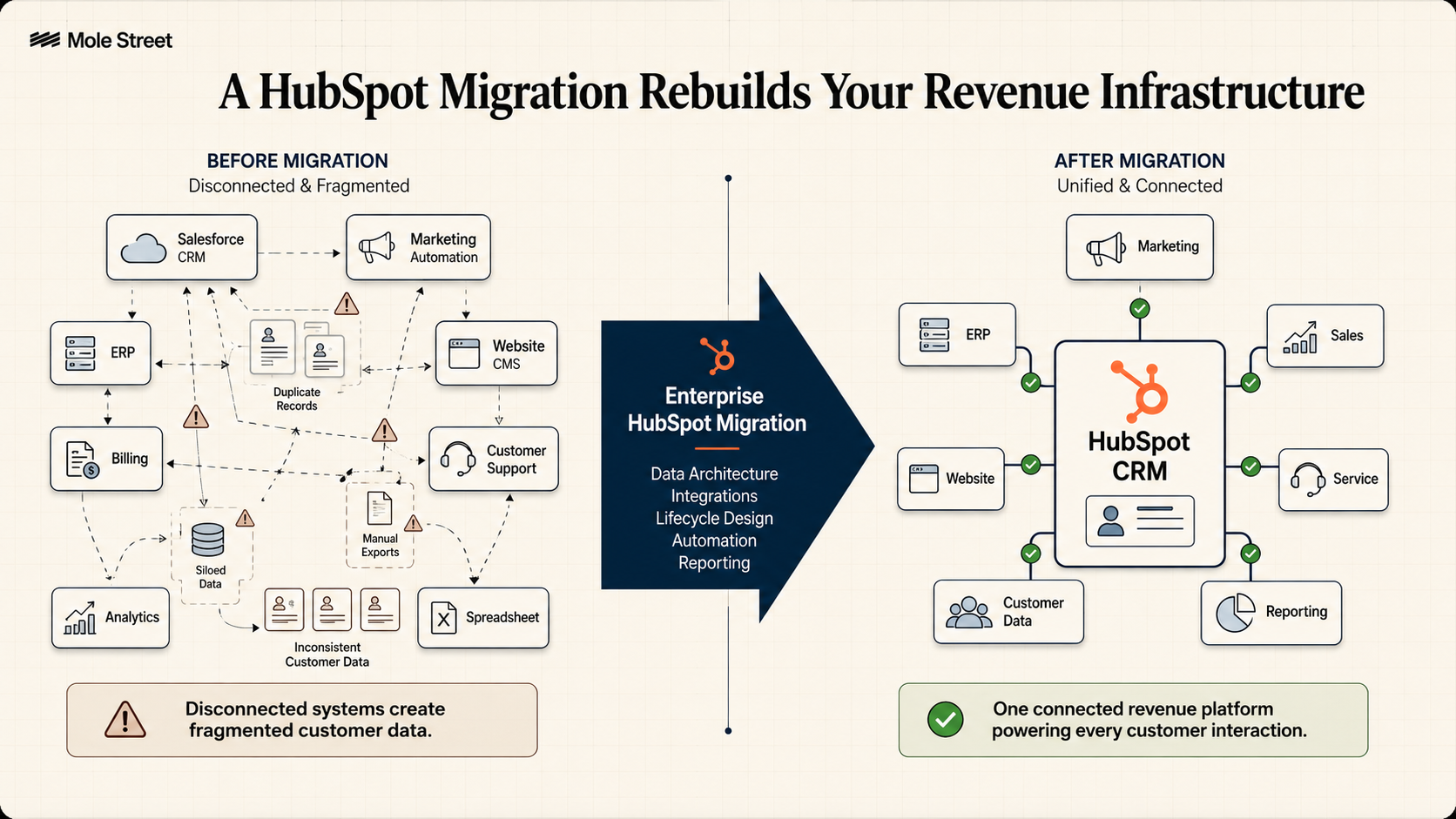
What Makes a HubSpot Migration Partner Right for Enterprise Teams?
The right enterprise HubSpot migration partner holds Elite or Diamond tier, has proven migrations from multiple source platforms, and can rebuild your RevOps layer after the data lands.
This narrows your search, but only slightly. Plenty of HubSpot Solutions Partners hold Elite or Diamond status, so tier alone still leaves you with a long list. To find the right one, you have to look deeper and examine each candidate's actual migration track record.
That deeper look is mostly about what the partner does after the data lands. Moving the raw records, your contacts, companies, and deals, is mechanical, and migration tools handle most of it.
The real work is rebuilding what makes those records usable: how they connect to each other, the pipeline stages they move through, the automations that run on them, and the reports your leadership relies on.
A partner can import every record and still leave you with a system your team works around instead of in. That risk grows when the source data is messy to begin with. In the HubSpot 2026 State of Marketing Report, only 66% of B2B marketers rate their data as high quality, so roughly a third are migrating data they do not fully trust. Copying that across without cleaning and restructuring it solves nothing.
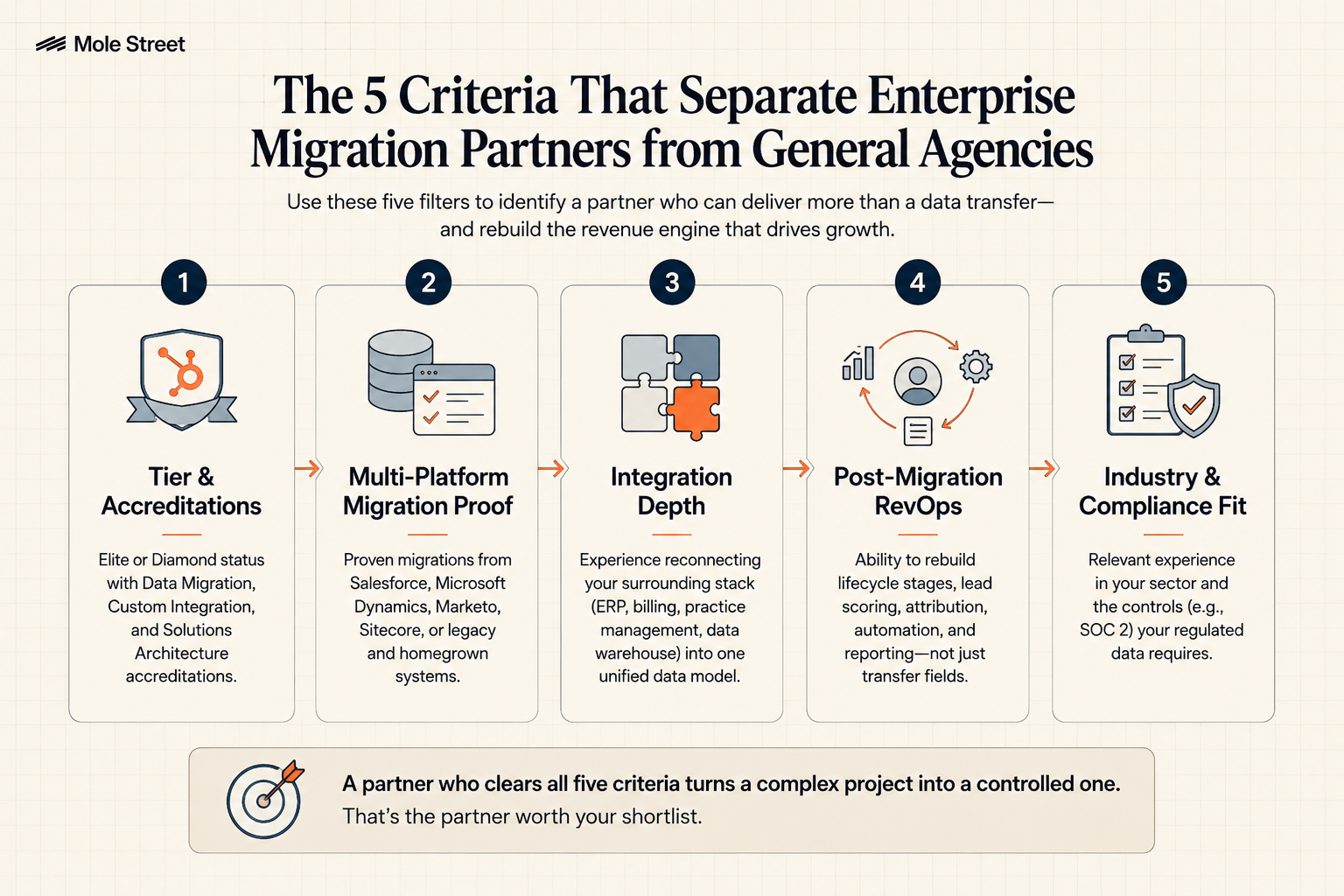
Judge a HubSpot Solutions Partner on five criteria:
- Tier and accreditations: Elite or Diamond status, with specific accreditations in Data Migration, Custom Integration, and Solutions Architecture.
- Multi-platform migration proof: Verified migrations from Salesforce, Microsoft Dynamics, Marketo, Sitecore, or legacy and homegrown systems, not just HubSpot-to-HubSpot moves.
- Integration depth: Experience reconnecting the surrounding stack (ERP, billing, practice management, data warehouse) into one data model.
- Post-migration RevOps: The ability to rebuild lifecycle stages, lead scoring, attribution, and reporting, not just transfer fields.
- Industry and compliance fit: Relevant experience in your sector, and the controls such as SOC 2 that regulated data demands.
A partner who clears all five turns a complex project into a controlled one. That is the partner worth your shortlist.
What Are the Top HubSpot Migration Partners for Enterprise Teams in 2026?
The top HubSpot migration partners for enterprise teams in 2026 are Mole Street, Aptitude 8, New Breed, Huble, SmartBug Media, RevPartners, and Denamico, all Elite HubSpot Solutions Partners. Mole Street leads the list for complex, integration-heavy migrations in regulated industries, where the data is messy, the integrations run deep, and compliance is non-negotiable. Every profile can be verified through the HubSpot Solutions Directory.
1. Mole Street — Best for Complex, Integration-Heavy Migrations in Regulated Industries
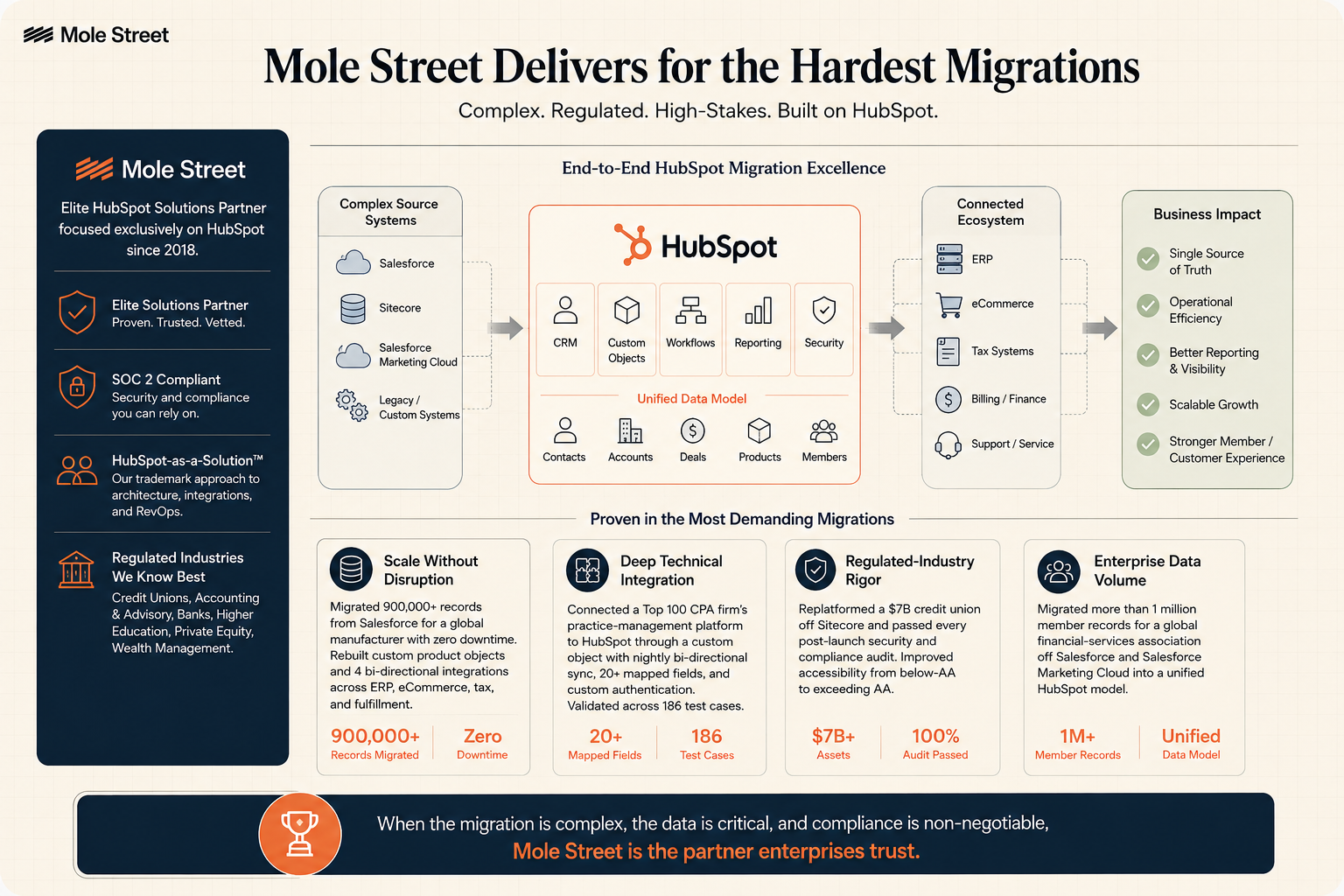
Mole Street is the strongest fit when the migration is technically hard and the industry is regulated. An Elite Solutions Partner focused exclusively on HubSpot since 2018 and SOC 2 compliant, Mole Street works under the trademark HubSpot-as-a-Solution and concentrates on may industries, such as credit unions, accounting and advisory firms, banks, higher education, and private equity and wealth management.
The proof is in the hardest migrations:
- Scale without disruption. Migrated 900,000+ records from Salesforce for a global manufacturer with zero downtime, rebuilding custom product objects and four bi-directional integrations across ERP, eCommerce, tax, and fulfillment (client:
- Deep technical integration. Connected a Top 100 CPA firm's practice-management platform to HubSpot through a custom object with a nightly bi-directional sync, more than 20 mapped fields, and custom authentication, validated across 186 documented test cases.
- Regulated-industry rigor. Replatformed a $7 billion credit union off Sitecore and passed every post-launch security and compliance audit, moving accessibility from below-AA to exceeding AA.
- Enterprise data volume. Migrated more than 1 million member records for a global financial-services association off Salesforce and Salesforce Marketing Cloud into a unified HubSpot model.
Mole Street also designs the migration and any rebrand or go-to-market change as one project, so segmentation, territory design, and pipeline stages reflect the new market position rather than the old one. For complex, compliance-sensitive enterprise migrations, that combination of integration depth and audited controls is the differentiator.
2. Aptitude 8
An Elite partner founded in early 2020 in Atlanta by founder and CEO Connor Jeffers, ranked HubSpot's #2 Global Partner of the Year for 2024.
- Technical, not marketing: positions itself as a technical consulting firm, with every project delivered by an in-house, US-based team of solution architects, developers, and project managers, no white-label or offshore.
- HubSpot-backed: the only partner to have taken investment from HubSpot Ventures.
- Growing capacity: widened its technical bench through a 2024 acquisition of WORQFLOW.
- Core focus: "GTM engineering," building custom-coded automations and multi-system integrations through Operations Hub.
A common shortlist name when the migration is really a systems-integration problem with heavy custom-object and API requirements.
3. New Breed
An Elite partner founded in 2002 in Burlington, Vermont and led by CEO Patrick Biddiscombe, one of the oldest firms in the ecosystem.
- Decorated: the only Elite partner to hold all eight HubSpot accreditations and win North America Partner of the Year three times.
- Track record: reports 500-plus completed implementations across a team of roughly 50 strategists, developers, designers, and media specialists.
- Method: engagements open with a RevOps workshop that maps current processes and produces a systems roadmap before any build begins.
- Published results: 811% ROI for The Flybook, 220% year-over-year marketing-sourced pipeline growth for Electrosonic.
A fit for teams that want the new CRM and a demand-generation engine delivered together.
4. Huble
An Elite, ISO 27001 and ISO 9001 certified partner with more than 15 years in the ecosystem, named HubSpot's Global Partner of the Year for 2024.
- Global footprint: offices in the UK, US, Canada, Germany, France, Belgium, Singapore, and South Africa, with 175-plus specialists working to one delivery model rather than a network of affiliates.
- Migration frameworks: documented processes for Salesforce, Microsoft Dynamics, Marketo, Pardot, Eloqua, and homegrown systems.
- Named clients: Avison Young (consolidated four siloed CRMs into HubSpot), Knight Frank, AirPlus International, and the British Council.
- Emerging focus: data governance and AI readiness through HubSpot's Data Hub, with engagements planned around 95%-plus user adoption.
Most relevant for businesses consolidating CRMs across several countries.
5. SmartBug Media
An Elite partner founded in 2007 in Irvine, California, which describes itself as HubSpot's most decorated Elite Partner.
- Awards: three North America Partner of the Year wins in seven years.
- Scale and structure: a distributed team of 250-plus specialists, grown through the 2023 acquisition of Canadian agency Globalia and earlier Chair 10 Marketing, now run as specialized divisions for digital transformation (Globalia) and paid media (Point Success Media).
- Distinctive capability: a sizable e-commerce practice built on Shopify and Klaviyo, less common among enterprise HubSpot partners.
- Named clients: Hootsuite, Kansas State University, California Olive Ranch.
Worth considering when marketing, service, advertising, and online revenue all need to keep running through the transition.
6. RevPartners
An Elite partner founded in 2021 in Atlanta by CEO Brendan Tolleson, built around a productized delivery model.
- Subscription model: sells "RevOps as a Service" structured around a proprietary Revenue Maturity Model rather than one-off project scopes.
- Certifications: reached Elite tier faster than any other firm and reports 700-plus HubSpot certifications, plus the only partner to hold both HubSpot Elite and Clay Elite Studio status.
- Transparent pricing: ranges from a self-guided product at $999 to fully scoped onboarding.
- Recent change: acquired by B2B marketing agency Walker Sands in June 2026 to expand its RevOps and GTM engineering capabilities.
Built for mid-market teams that want a fast, structured, predictably priced migration.
7. Denamico
A Diamond partner based in Minneapolis, among the first firms worldwide to earn all five HubSpot CRM accreditations.
- Accreditations: CRM Implementation, Custom Integration, Solutions Architecture Design, Data Migration, and Onboarding.
- Method: works to a defined "ABCs to ROI" methodology focused on complex implementations and migrations.
- Source-system range: documented migrations from Salesforce, Microsoft Dynamics, NetSuite, Oracle, Marketo, SugarCRM, Zendesk, and legacy environments such as AS400.
- Vertical depth: particular strength in manufacturing, including custom Epicor ERP integrations, with one published migration reporting 6,500-plus hours saved annually.
A strong option for organizations leaving an older, uncommon, or heavily customized source system.
How Do You Choose Between HubSpot Migration Partners?
Choose the partner whose proven experience matches the hardest part of your specific migration, then verify it against their HubSpot Solutions Directory profile, G2, and Clutch reviews.
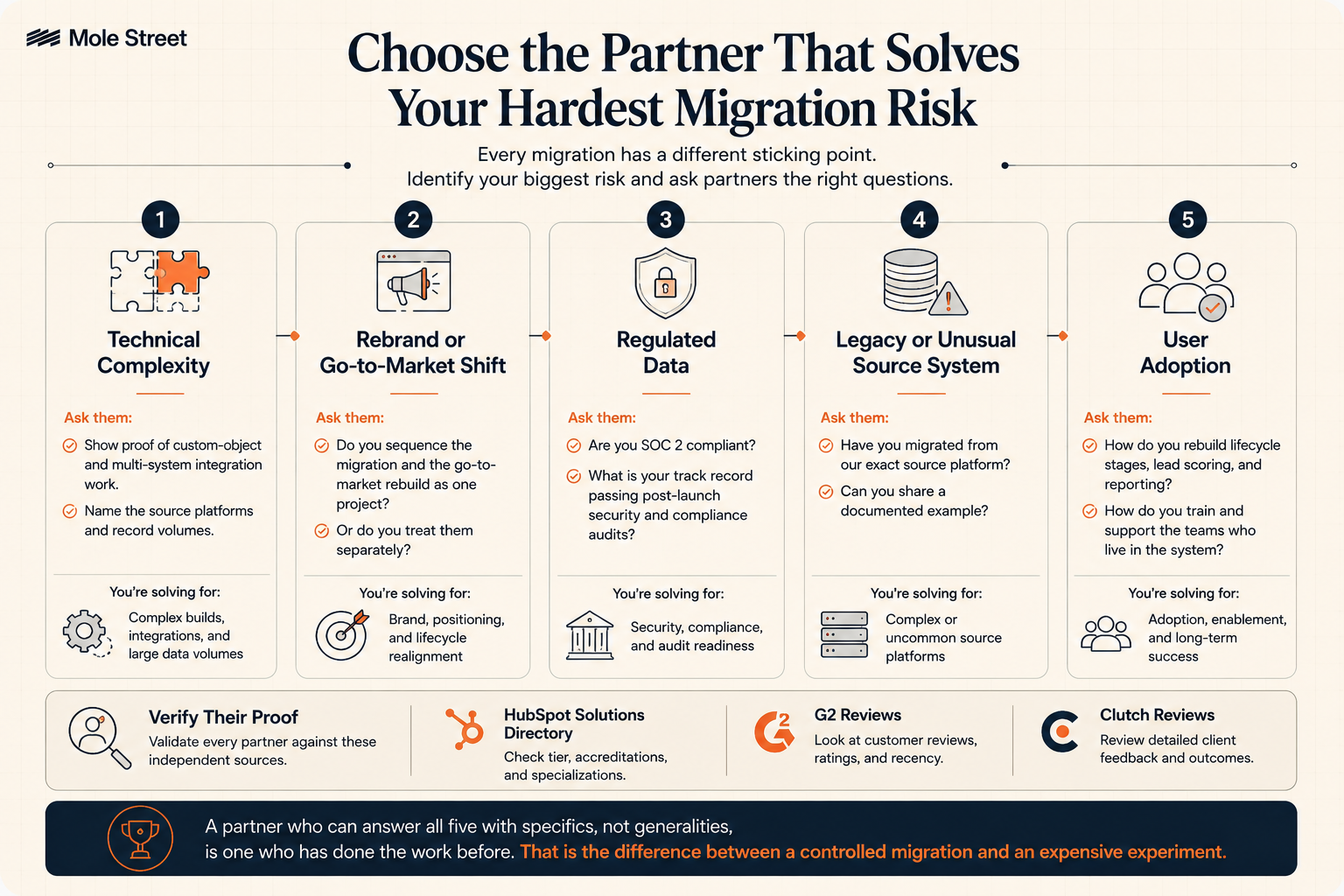
Every migration has a different sticking point, so before you talk to partners, work out the single hardest part of yours. Then aim your questions at that risk:
- If the risk is technical complexity: ask for proof of custom-object and multi-system integration work, with named source platforms and record volumes.
- If the risk is a rebrand or go-to-market shift: ask whether they sequence the migration and the go-to-market rebuild as one project, or treat them separately.
- If the risk is regulated data: ask about SOC 2 compliance and their track record passing post-launch security and compliance audits.
- If the risk is a legacy or unusual source system: ask for a documented migration from that specific platform, not a generic case study.
- If the risk is adoption: ask how they rebuild lifecycle stages, lead scoring, and reporting, and how they train the teams who have to live in the system.
A partner who can answer all five with specifics, not generalities, is one who has done the work before. That is the difference between a controlled migration and an expensive experiment.
What Does a Complex HubSpot Migration Actually Involve?
A complex HubSpot migration involves rebuilding the revenue model, not just transferring records. The records are the easy part. The work that determines success happens in how the new system is architected. It is the reason 78% of salespeople in HubSpot's research say their CRM improves alignment between sales and marketing only when it is set up to do so.
A strong partner uses HubSpot's enterprise capabilities to turn raw data into infrastructure:
- Custom objects that model your actual business, such as policies, accounts, jobs, or engagements, instead of forcing everything into contacts and deals.
- Custom contact and deal properties that tag every record with originating source, owner, and lifecycle stage so reporting is accurate from day one.
- Rebuilt lifecycle stages and lead scoring that reflect the new go-to-market motion rather than copying the old one.
- Native and custom integrations connecting CRM, marketing automation, ERP, billing, and the data warehouse into one model the business can actually report on.
- Attribution and pipeline reporting that survives the move, so the board sees continuity instead of a reporting gap the quarter you switch.
This is the difference between a migration that ends at go-live and one that becomes the platform for the next five years of growth.
The Right Partner Turns Your Migration Into a Growth Platform
The partner you choose does more than move your data. They decide whether your team ends up with a CRM it trusts and can help your sales, marketing, and service operations as a cohesive unit that uses the same data.
When this happens, your business is able to operate with greater agility and execute tasks with greater accuracy. The competitive edge is significant enough that choosing the right HubSpot migration partner becomes one of the most important decisions in the project.
To do this correctly, ensure that they:
- Hold the right credentials: Elite or Diamond tier, with accreditations in Data Migration, Custom Integration, and Solutions Architecture.
- Can prove migrations like yours: documented moves from your specific source system, with named platforms and record volumes.
- Show real integration depth: experience reconnecting your wider stack, such as ERP, billing, and your data warehouse, into one model.
- Rebuild, not just transfer: lifecycle stages, lead scoring, attribution, and reporting set up to reflect how you sell now.
- Fit your industry: relevant sector experience and the compliance controls, such as SOC 2, that your data requires.
Mole Street has a wealth of experience executing migrations with maximum accuracy across many verticals, including banks, credit unions, accounting and advisory firms, higher education, and private equity.
Get in touch with a member of our team to talk through your source systems, your timeline, and what a clean migration would look like for your business.
Want to Speak to a Specialist About a Migration? Book Your Free Consultation.
Frequently Asked Questions
What HubSpot tier should an enterprise migration partner have?
Elite or Diamond tier. These are HubSpot's two highest partner levels and indicate both the certified headcount and the accreditations (Data Migration, Custom Integration, Solutions Architecture) that complex enterprise migrations require.
How long does an enterprise HubSpot migration take?
It varies by complexity. Fast-track mid-market migrations can target around six weeks, while enterprise migrations involving custom objects, multiple integrations, or a rebrand typically run a quarter or more. The timeline is driven by integration count and data quality, not record volume alone.
Can a HubSpot partner migrate us from Salesforce or Microsoft Dynamics?
Yes. The partners best suited to this have documented migrations from multiple source platforms, including Salesforce, Microsoft Dynamics, Marketo, Sitecore, and legacy or homegrown systems. Ask for proof of multi-platform migration experience specifically.
Does SOC 2 compliance matter when choosing a migration partner?
For regulated industries such as financial services, credit unions, and accounting, yes. SOC 2 compliance signals that the partner has audited controls for handling sensitive data during the migration, which is a baseline requirement for many enterprise procurement teams.
Should we migrate during a rebrand or wait until after?
Migrating during a rebrand is often more efficient, because the lifecycle model, segmentation, and pipeline stages can be rebuilt to reflect the new go-to-market position in one project rather than being reworked twice. It requires a partner who can sequence both together.
By: Harry Maule