HubSpot

How to Choose a HubSpot Solutions Partner in 2026: A Buyer's Guide

15 min read
How to Choose a HubSpot Solutions Partner in 2026: A Buyer's Guide

The HubSpot partner ecosystem is about to nearly triple. According to IDC research commissioned by HubSpot, it will grow from $13.7 billion in 2025 to $36 billion by 2029. More partners, more specializations, more firms calling themselves experts.

For the marketing leader, COO, or CFO who has to pick one, that growth is a problem disguised as a luxury. Search "top HubSpot consulting partners 2026" and you get a long list of firms that look identical to each other. Every one of them is "results-driven" and “prioritizes your success.”

You’ve heard it all before, and none of it tells you which partner will still be improving your data model two years from now. That’s why we’ve put together this blog to help understand how to cherry pick the best HubSpot partner based on your individual needs.

In this blog, you will discover:

  • HubSpot partner tiers explained: how the four tiers (Gold, Platinum, Diamond, Elite) actually work, and why Elite alone is not enough
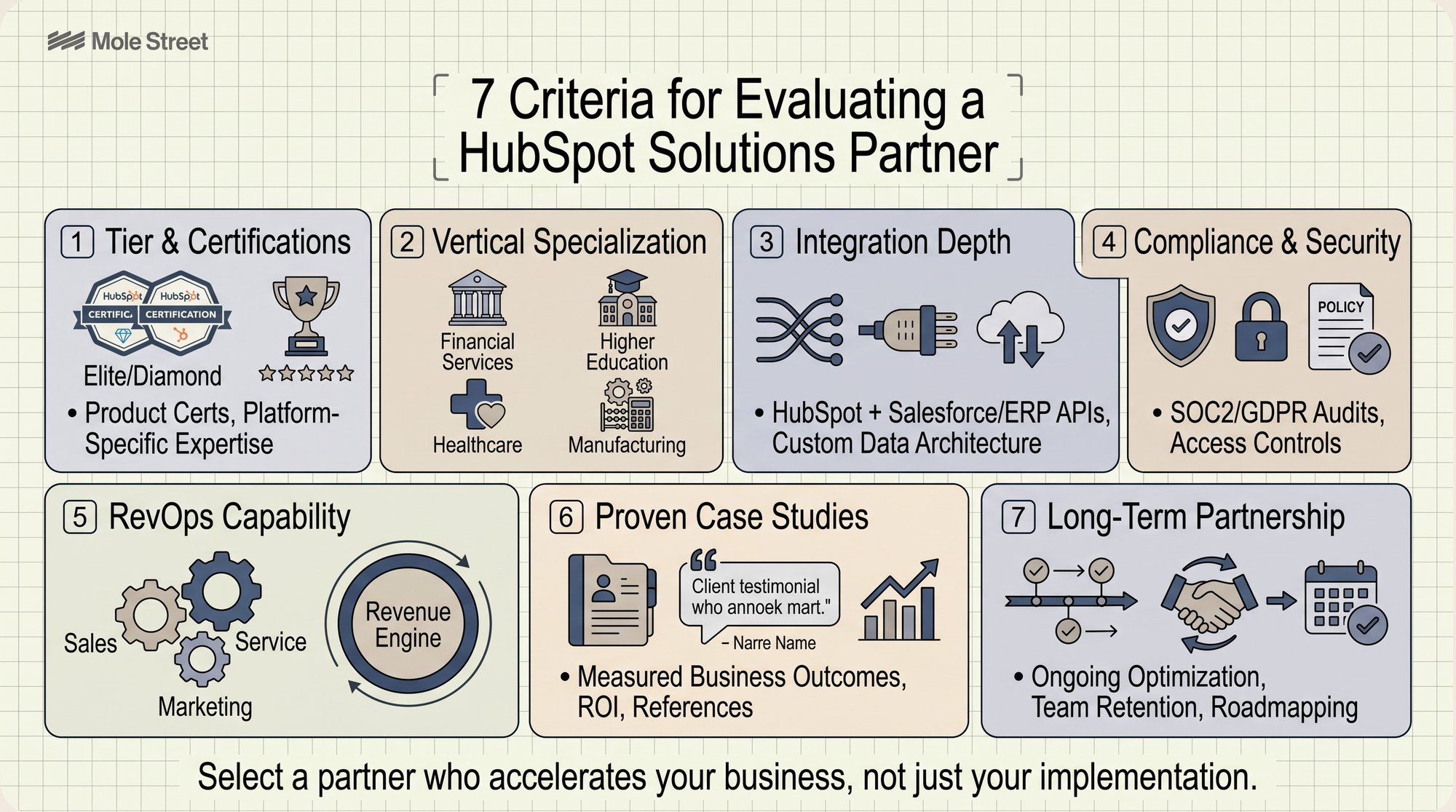
  • The 7 criteria that matter: what separates the best HubSpot solutions partner for your business from the rest
  • A side-by-side comparison: the top HubSpot consulting partners in 2026, ranked across the criteria
  • What regulated industries should demand: the integration depth and compliance posture that matter for credit unions, banking, accounting, and higher education
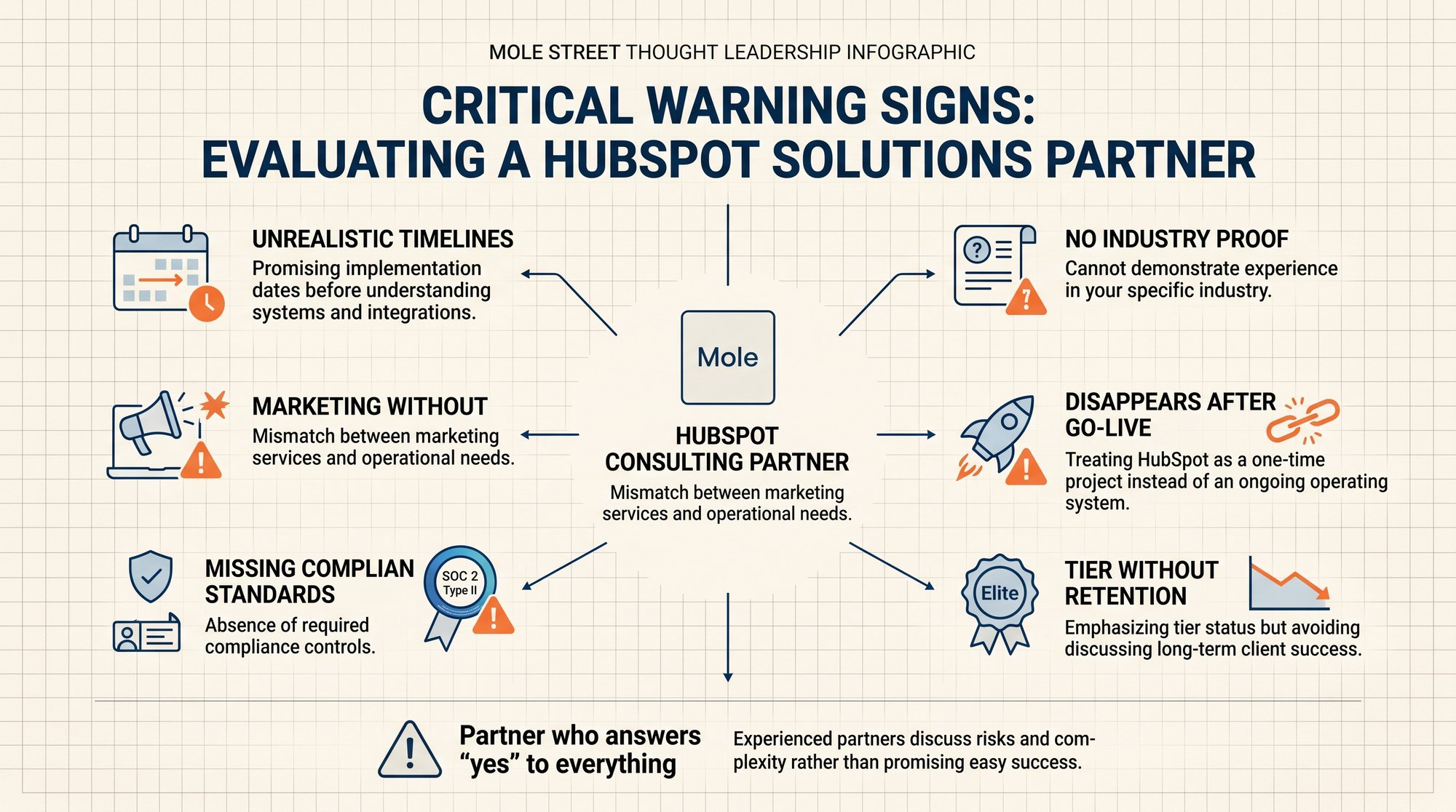
  • The red flags to avoid: the warning signs that a partner will stall your rollout
Create_a_Mole_Street-style_edi_Nano_Banana_2_85824

Quick answer: To choose the best HubSpot solutions partner in 2026, start with tier. Elite and Diamond partners have proven retention and scale. Then evaluate seven criteria: certification level, vertical specialization, integration depth, compliance posture (SOC 2 Type II), RevOps capability, named client case studies, and whether the firm operates as a long-term partner or a one-time onboarder. Tier gets a firm onto your shortlist. The other six criteria decide which partner actually fits your business.

Why does choosing the right HubSpot partner matter?

Your company operates on crucial data that lives at the center of every sales, marketing, and service decision.

Choosing the wrong HubSpot partner can lead to a poor implementation that fragments that data across disconnected objects, stalls user adoption, and leaves you paying enterprise prices for a system your team fails to adopt. 

All of this leads to poor data quality, which comes with a heavy price. IBM's Institute for Business Value found that more than a quarter of organizations lose over $5 million a year to poor data quality, and 7% lose $25 million or more.

The same research found 43% of COOs now rank data quality as their single most significant data priority.

Consider the cost in concrete terms. You buy Marketing Hub and Sales Hub Enterprise. Six months later, sales still works leads out of a spreadsheet and marketing cannot attribute a single closed deal, because the pipeline and data model were never built around how you actually operate. You are paying enterprise prices for a glorified contact database.

That is the difference a partner makes. A good one builds HubSpot around your operation. A poor one forces your operation around a default setup. 

HubSpot partner tiers explained: Gold, Platinum, Diamond, and Elite

HubSpot ranks its solutions partners across four tiers (Gold, Platinum, Diamond, and Elite) based on how much HubSpot they sell, how well they retain clients, and how many certifications they hold. Tier is the quickest way to size up a partner's scale and track record, but it tells you nothing about whether they fit the build you actually need.

How are HubSpot partner tiers earned?

HubSpot ranks partners on three criteria:

  • how much HubSpot software they sell and manage
  • the recurring subscription revenue that generates, and
  • how many clients stick with them year after year.

The more a partner sells, manages, and keeps, the higher the tier. HubSpot tracks this with a "points" system, but the dollar figures below are the clearest way to understand the scale behind each tier.

Here is what each tier actually signals to a buyer.


Create_a_Mole_Street-style_edi_Nano_Banana_2_25199 (1)

HubSpot Gold Partner: the entry tier

A capable smaller or newer partner, often a boutique, that has sold a modest amount of HubSpot (roughly $2,200 a month in client subscriptions). Fine for a straightforward setup.

HubSpot Platinum Partner: an established step up

An established partner with more clients and more HubSpot sold (around $6,500 a month in client subscriptions), but not yet operating at large scale.

HubSpot Diamond Partner: real scale plus a retention bar

A partner managing significant HubSpot revenue (around $19,000 a month in client subscriptions) that has to prove its clients stay. HubSpot requires Diamond partners to keep at least 75% of their client subscription revenue year over year.

HubSpot Elite Partner: the top tier

A partner with major scale (around $42,000 a month in client subscriptions), at least 100 certified employees, and a track record of keeping 80% or more of client revenue year over year. Elite is invite-only, and fewer than 1% of partners ever get there.

What makes Elite and Diamond different from the lower tiers?

Two things separate Diamond and Elite from Gold and Platinum, and neither is about size.

  • Their clients have to stay. To reach Diamond or Elite, a partner must keep most of its clients paying for HubSpot year after year (at least 75% for Diamond, 80% for Elite). If clients quit, the partner loses the tier. It is the clearest sign their work actually holds up over time.
  • Elite cannot be bought or earned alone. HubSpot has to personally invite a partner to join, even after they have met every requirement. Fewer than 1 in 100 partners ever make it.

How to choose a HubSpot partner: the 7 criteria that matter

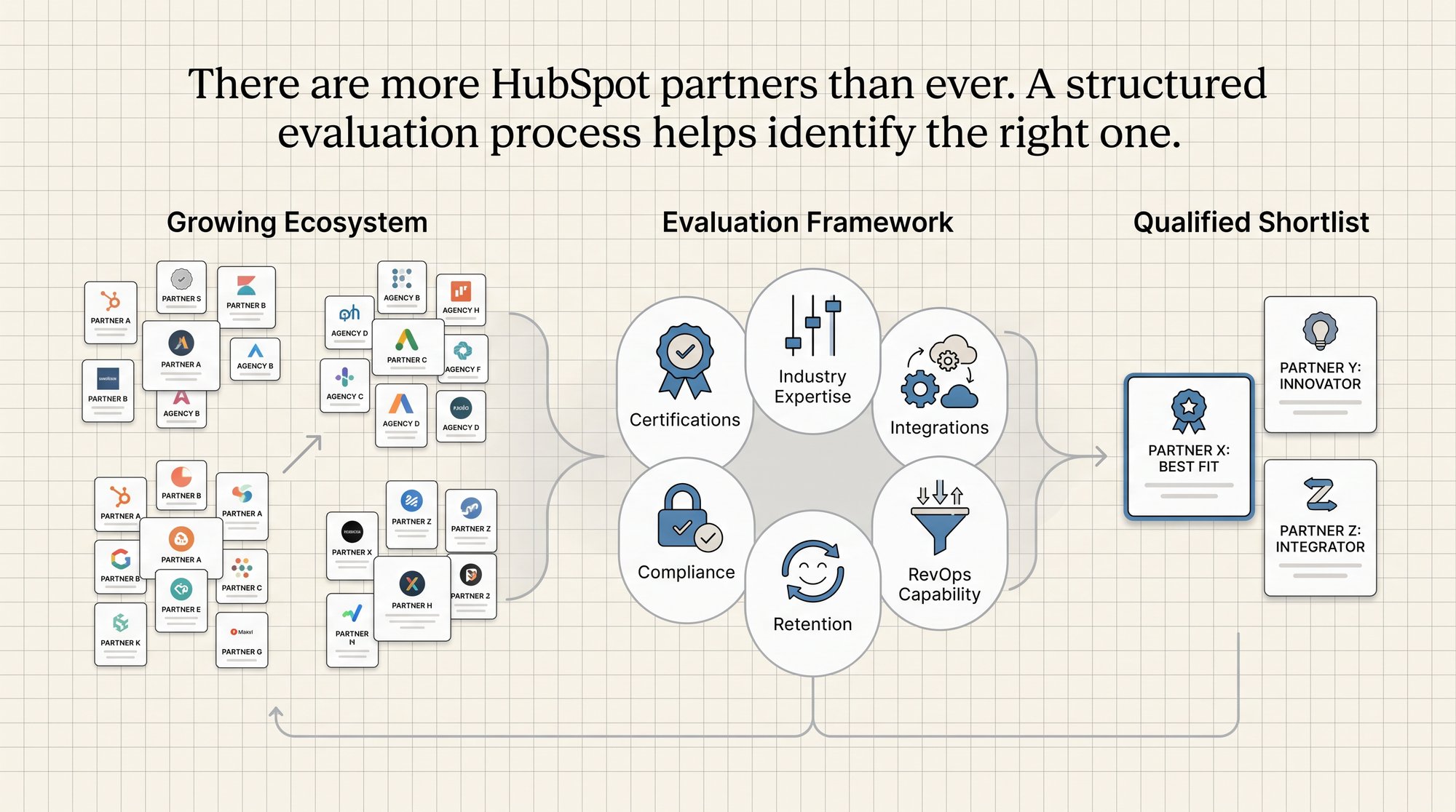
The best HubSpot implementation partner for your business is the one that scores highest across seven criteria. As a rule of thumb, start with their tier to get a quick read on their scale and experience. From there, dig into the other six criteria to see which partner actually fits your needs.

1. Tier and certification level

Start here, but read it correctly. Elite and Diamond tell you the firm has scale and retention. Then check the specific certifications relevant to your build (Data Migration, RevOps, CMS, specific hub implementations). A large headcount of generalists is not the same as deep certification in the work you need.

2. Vertical specialization

A partner who has built HubSpot for ten credit unions already knows what a share draft account is, how NCUA rules shape member communication, and how a core banking system exports data. A horizontal partner learns all of that on your budget. Specialization compresses your timeline and de-risks the build.

3. Integration depth

This is the criterion that separates marketing-led partners from true RevOps partners. Ask what they integrate beyond the marketing stack. Can they connect HubSpot to a core banking platform like Symitar, a connectivity layer like Kinective, an accounting ERP, or a custom data warehouse? Surface-level partners sync your forms. Serious partners architect the data model that ties your operational systems to your CRM.

4. Compliance posture

For regulated industries, this is non-negotiable. SOC 2 Type II means an independent auditor verified the partner's security controls over time, not just at a single point. If a partner handles your member, client, or patient data and cannot produce a SOC 2 Type II report, that is the end of the conversation.

5. RevOps capability versus marketing-only

Many HubSpot partners are inbound marketing agencies that also do onboarding. That is fine if you need campaigns. It is a mismatch if you need pipeline architecture, lead routing, forecasting, and a single source of truth across sales, marketing, and service. Ask whether they think in campaigns or in revenue operations.

6. Proven case studies with named clients

Anonymous "a leading financial services firm" case studies are a yellow flag. Named clients you can recognize, and ideally reference, are proof. Ask for case studies in your vertical with the client named and the outcome specified.

7. Long-term operating model versus one-time onboarding

HubSpot is not a project you finish. It is a system you operate. A partner who disappears after go-live leaves you to maintain a build you do not understand. Ask what the relationship looks like in month 13. The retention requirement behind the Elite tier exists precisely because the best partners stay.


Create_a_Mole_Street-style_tho_Nano_Banana_2_26701


Comparing the top HubSpot consulting partners in 2026

The top HubSpot consulting partners in 2026 are all Elite-tier, which is exactly why tier alone cannot decide your shortlist. They differ on specialization, vertical depth, and operating model. Here is an honest comparison of six leading partners.

Partner HubSpot Tier Core strength Vertical focus Best fit for
Mole Street

Elite Integration depth + RevOps for complex builds Credit unions, banking, accounting, PE, higher ed Regulated, multi-system implementations needing SOC 2 Type II
SmartBug Media Elite Inbound marketing + RevOps retainers General B2B

Implementations bundled with ongoing marketing
New Breed Elite Demand gen + Salesforce-to-HubSpot migrations General B2B / SaaS Migrations where marketing attribution leads
Aptitude 8 Elite Custom development, CPQ, technical engineering Enterprise / SaaS Heavy custom build and complex quoting needs
RevPartners Elite Productized RevOps-as-a-service General B2B / SaaS Fast, packaged RevOps deployment

Huble Elite Global enterprise multi-hub rollouts Enterprise (international) Large, multi-region implementations

What should regulated industries look for in a HubSpot partner?

Regulated industries should choose a HubSpot partner based on two things above all: how well they connect HubSpot to your existing systems, and whether they meet your compliance requirements (like SOC 2 Type II).

Many HubSpot partners sell themselves on marketing and campaign work. For a regulated business, that should not be the deciding factor.

Now, here’s why…

In a typical SaaS company, the data lives in modern tools that connect easily. In a credit union, bank, or accounting firm, it lives in older core systems that were never designed to share data with a CRM.

The real work is connecting those systems cleanly, without breaking the compliance rules that govern your data. When evaluating HubSpot Partners, ask each one if they have specific experience in your field. They should have case studies, results, and testimonials to give you an insight into their expertise in your vertical.

Red flags to avoid when choosing a HubSpot partner

The clearest red flags are not about what a partner lacks. They are about what a partner promises too easily.

Watch for these:

  • They quote a timeline before understanding your systems. A partner who promises "live in 30 days" before asking what you integrate with is selling a template, not a build.
  • They cannot name a client in your vertical. Vague references to "leading firms" usually mean there are none to name.
  • They lead with marketing campaigns when you asked about data. A mismatch in what they sell versus what you need will compound for years.
  • No SOC 2 Type II report, in a regulated industry. This is not negotiable. If they cannot produce it, stop.
  • They disappear after go-live. If the proposal has no operating or optimization phase, you are buying a one-time setup, not a partnership.
  • Tier without retention context. A partner who lists their tier but dodges questions about client retention may be selling fast and supporting poorly.

One more, quieter signal. If every answer is a yes, push harder. A partner who has done complex work will tell you what is hard about your project, not just what is possible.

Create_a_Mole_Street-style_tho_Nano_Banana_2_58217

Is Mole Street One of The Best HubSpot Solutions Partners?

Mole Street is an Elite HubSpot Solutions Partner, a status held by the top 1% of HubSpot Solutions Partners globally. The company is SOC 2 Type II compliant and specializes in complex, regulated, multi-system environments, where HubSpot needs to be architected as a connected revenue engine rather than configured as a marketing tool.

To be specific, Mole Street will consolidate your data so your sales, marketing, and service teams can operate as one cohesive unit, allowing them to march in unison toward your shared goals.

The company has experience across a whole range of verticals, specializing in the following:

  • Credit Unions
  • Accounting Practices
  • Private Wealth & Equity Firms
  • Banks
  • Higher Education
  • EdTech
  • Testing Providers
  • Non-profits
  • Professional Organizations
  • Tourism Boards
  • Commercial Landscaping
  • Manufacturing

To see the results we have delivered across industries like credit unions, banking, and accounting, visit our case studies page.

Frequently asked questions

What is a HubSpot Solutions Partner?

A HubSpot Solutions Partner is an agency or consultancy certified by HubSpot to sell, implement, and manage the HubSpot platform for clients. Partners are ranked across four tiers (Gold, Platinum, Diamond, Elite) based on revenue, retention, and certifications.

What is the difference between Elite and Diamond HubSpot partners?

Elite is the highest tier and is invite-only, requiring roughly 2,100 sourced points, 80% gross revenue retention, and at least 100 user certifications. Diamond sits one level below, with around 950 sourced points and a 75% retention floor. Fewer than 1% of partners reach Elite.

How much does a HubSpot implementation cost?

It depends almost entirely on scope, not on the partner's tier. A basic onboarding can run a few thousand dollars, while a complex multi-hub build with custom integrations and data migration can reach six figures. The variable is integration complexity, not the partner badge.

How long does a HubSpot implementation take?

A standard implementation often takes 6 to 12 weeks. Complex builds involving legacy system integration, data migration, and custom objects can take several months. Be skeptical of any partner promising a fixed timeline before reviewing your systems.

Can I switch HubSpot partners after onboarding?

Yes. You own your HubSpot portal and data regardless of which partner built it. A new partner can audit the existing setup, fix what is broken, and take over ongoing management. This is common when a first partner did a shallow build.


Want to Take The First Step Forward to a Unified Tech Stack?