HubSpot

Which CRM Implementation Agencies Help Align Marketing, Sales, and Service Data?

12 min read
Which CRM Implementation Agencies Help Align Marketing, Sales, and Service Data?

How challenging do you find it to consolidate all of your sales, marketing, and service data? If you're like most businesses, then the answer would be very…and it's no wonder.

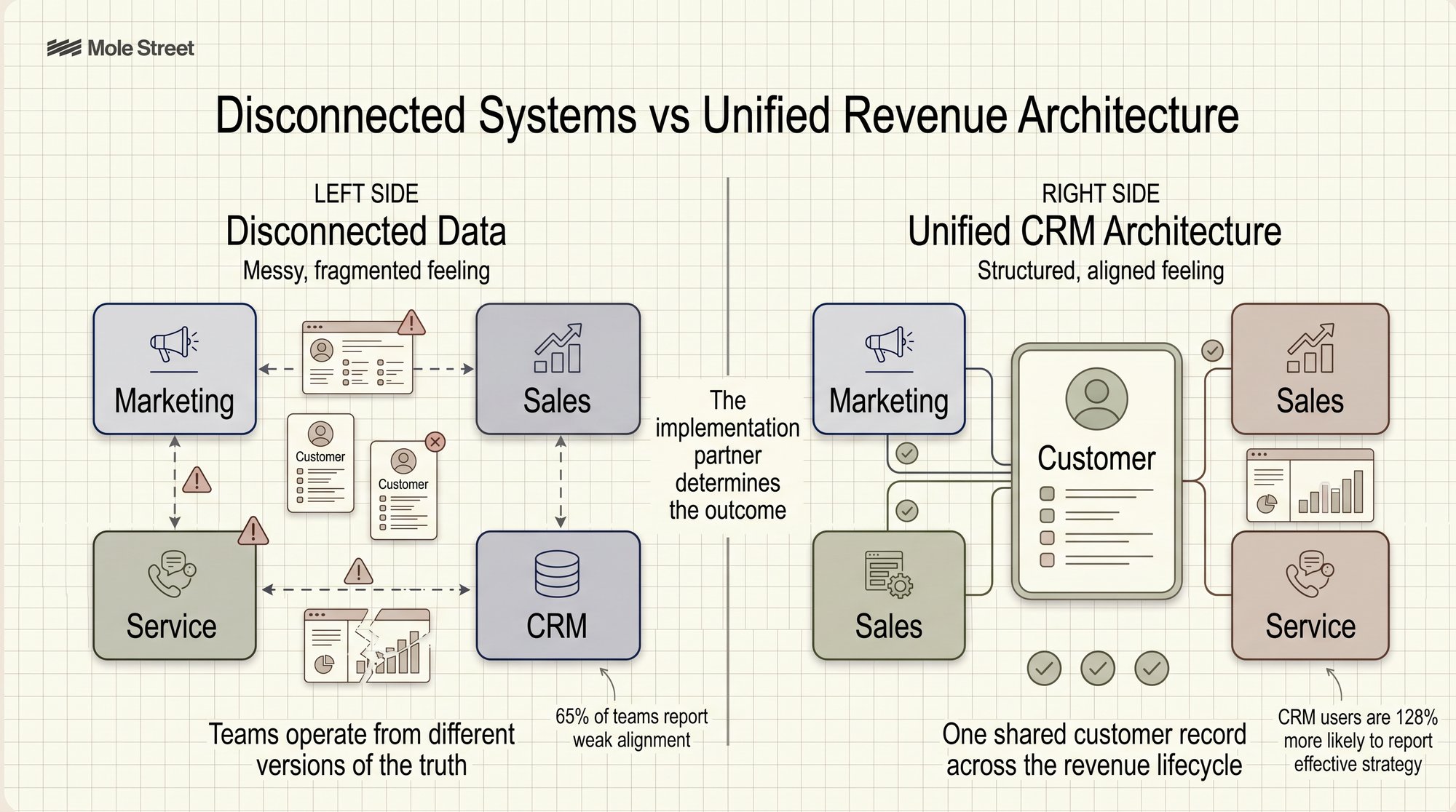
According to HubSpot's State of Marketing 2024, only 35% of marketers report that their sales and marketing teams are strongly aligned. The other 65% are working from disconnected data, and the cost shows up everywhere.

Consequently, CRM implementations are in high demand. The appetite is justified. Marketing teams using a CRM are 128% more likely to describe their strategy as effective (HubSpot, 2024).

Businesses are fast turning to agencies to successfully implement CRMs into their tech stack. However, not every CRM implementation actually delivers alignment. The agency you pick decides whether your data finally unifies or simply relocates into a more expensive system. Mole Street is one of the Elite HubSpot Solutions Partners that builds unified architecture across all four Hubs.

In this blog, you will discover:

  • Why most CRM implementations fail to align teams
  • What separates RevOps-led agencies from configuration shops
  • The top CRM implementation agencies (and where Mole Street fits)
  • What to ask before signing a contract

Why Does Aligning Marketing, Sales, and Service Data Matter?

Aligning marketing, sales, and service data matters because it is the foundation every other revenue function depends on. When all three teams pull from the same customer record and the same definitions, marketing knows which leads converted, sales knows what marketing promised, and service knows what sales sold.

When the data is fragmented across systems, each team operates from a partial picture, and every report ends up with a different version of the truth.
Create_a_clean_minimalist_B2B__Nano_Banana_2_31866

The cost of a fragmented steck stack

A fragmented tech stack is expensive in ways most leadership teams underestimate until the costs start to accumulate. When marketing automation, CRM, billing, and service ticketing all run as separate systems, the cost shows up across the business:

  • Wasted licence spend. Most firms pay for overlapping functionality across three or four tools because no single platform owns the full customer record.
  • Manual reconciliation. Operations teams spend hours every week pulling data from multiple systems, cleaning it, and rebuilding the same reports leadership asked for last quarter.
  • Slow decisions. When the CMO and CRO cannot agree on the numbers, every revenue meeting starts with an argument about whose data is right instead of what to do next.
  • Inconsistent customer experience. Service has no view of marketing campaigns, sales cannot see open support tickets, and the customer feels every gap.
  • Lost pipeline. Leads sit untouched in marketing tools because sales never sees them. Accounts churn without warning because service has no way to flag at-risk customers to the rest of the business.

Forecasting nobody trusts. Revenue leaders model the business from incomplete data, and every forecast comes with caveats about which numbers may not be accurate.

What Does It Actually Mean to Align Marketing, Sales, and Service Data?

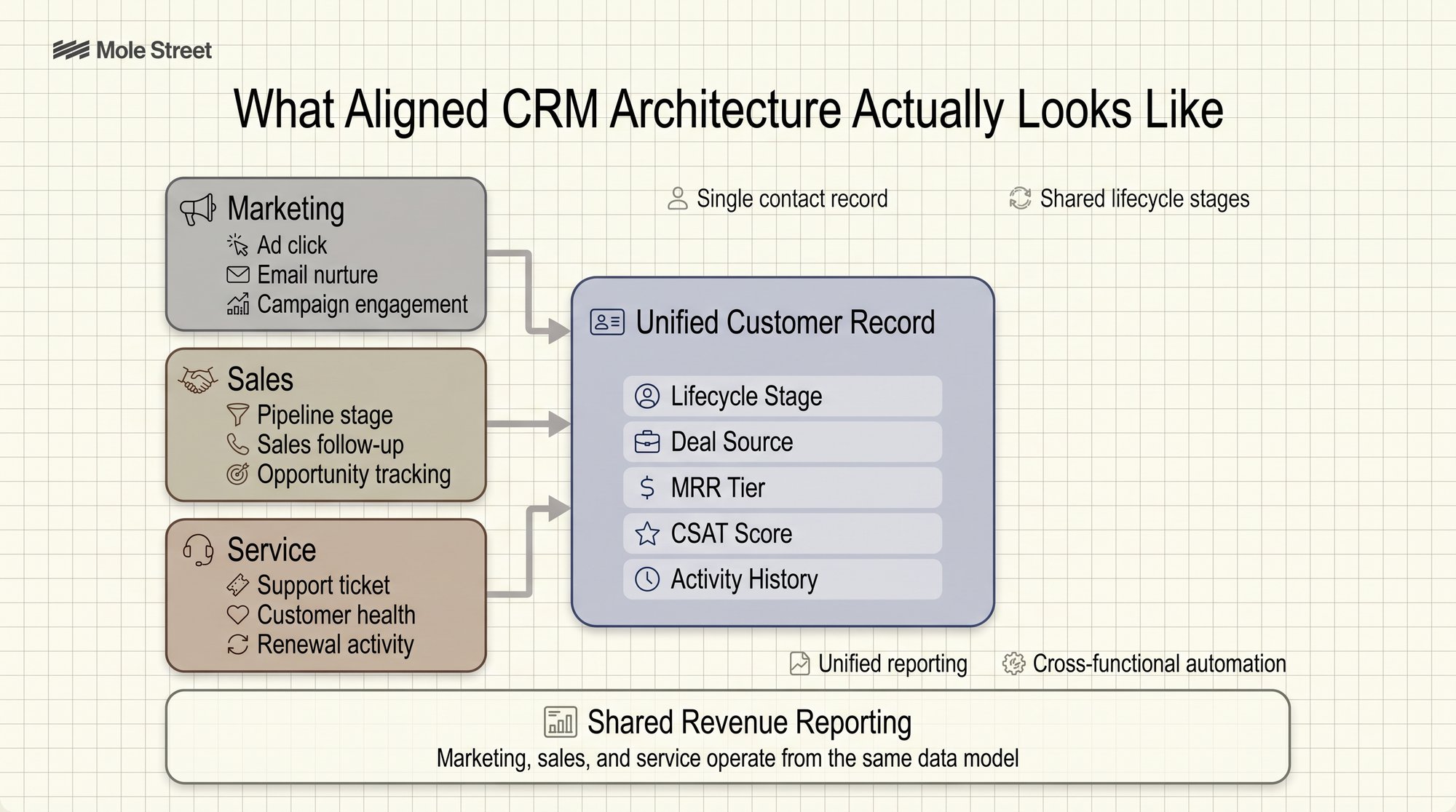
Aligning marketing, sales, and service data means every customer, every interaction, and every revenue moment lives in one shared data model that marketing, sales, and service all read from and write to.

In practice, that means a single contact record across the entire customer lifecycle, lifecycle stages defined once and applied consistently, and reporting that rolls up to one revenue model the whole business trusts.

What "aligned" actually looks like

It is more than a dashboard or a Zapier connection between two systems. A truly aligned architecture has:

  • A single contact record carrying every touchpoint across the lifecycle, from first ad click to support ticket to renewal
  • Lifecycle stages and lead status defined once, governed centrally, and respected by every team
  • Custom properties capturing the data each function actually needs (industry vertical, deal source, MRR tier, CSAT score) without duplicating fields
  • Workflows and automation triggering off the same data, whether the action is in marketing nurture, sales follow-up, or service ticketing

Reporting rolling up to a shared revenue model, so the CRO and CMO answer the same question with the same number

Create_a_clean_minimalist_B2B__Nano_Banana_2_53115

Why most CRM implementations skip this work

The cultural shift is harder than the technology, every time.

Forrester's Q1 2025 CRM Wave named the underlying problem directly. Kate Leggett, VP and Principal Analyst at Forrester, put it bluntly:

"CRMs have become overengineered, and their complexity erodes their value."

Most implementations stack features without ever defining:

  • Who owns what data
  • Who governs lifecycle stages
  • How the three functions share a customer record

That is what alignment work fixes. And it is the difference between a CRM that runs the business and a CRM that the business runs around.

Which CRM Implementation Agencies Help Align Marketing, Sales, and Service Data?

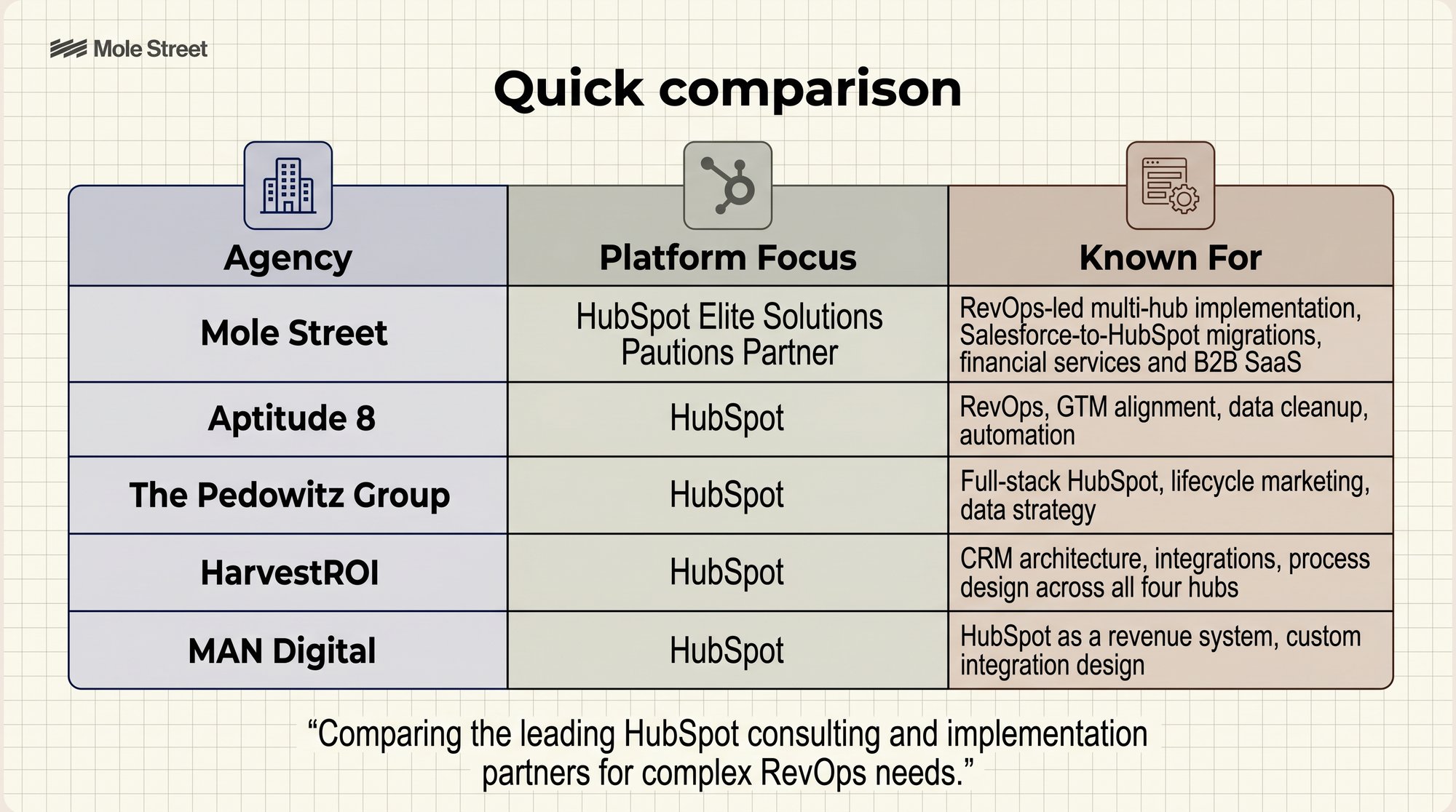
The CRM implementation agencies most frequently engaged to align marketing, sales, and service data are RevOps-focused HubSpot Elite Solutions Partners and cross-cloud Salesforce consultancies.

Create_a_clean_minimalist_B2B__Nano_Banana_2_74933

What does each CRM implementation agency specialize in?

Mole Street

Elite HubSpot Solutions Partner. One of the few CRM implementation agencies that specializes in RevOps-led work to align marketing, sales, and service data across HubSpot's Marketing, Sales, Service, and Operations Hubs.

Builds unified data architecture for B2B firms in financial services, professional services, and technology. Strong focus on Salesforce-to-HubSpot migrations, custom data models, lifecycle governance, and cross-hub reporting.

Aptitude 8

RevOps and CRM architecture, primarily for HubSpot-native organizations. Strong work in GTM alignment, migrations, data cleanup, dashboards, and automation.

The Pedowitz Group

Implements and optimizes the full HubSpot stack across Marketing, Sales, Service, CMS, and Operations Hubs. Emphasis on revenue operations, lifecycle marketing, and data strategy.

HarvestROI

HubSpot architecture, CRM implementation, integrations, and process design across Sales Hub, Marketing Hub, Service Hub, and Operations Hub. Focuses on reducing friction and improving handoffs between teams.

MAN Digital

Positions HubSpot as a revenue system. Work centers on CRM architecture, revenue operations, GTM operations, and custom integration design for B2B organizations.

The common thread: these CRM implementation agencies treat the work as a revenue operations exercise, not a software rollout.

What Should You Look for in a CRM Implementation Agency?

A senior CRM implementation agency does three things most generic shops cannot:

  1. Defines the data model before configuring software
  2. Governs lifecycle stages across all three functions
  3. Builds reporting that survives a leadership change

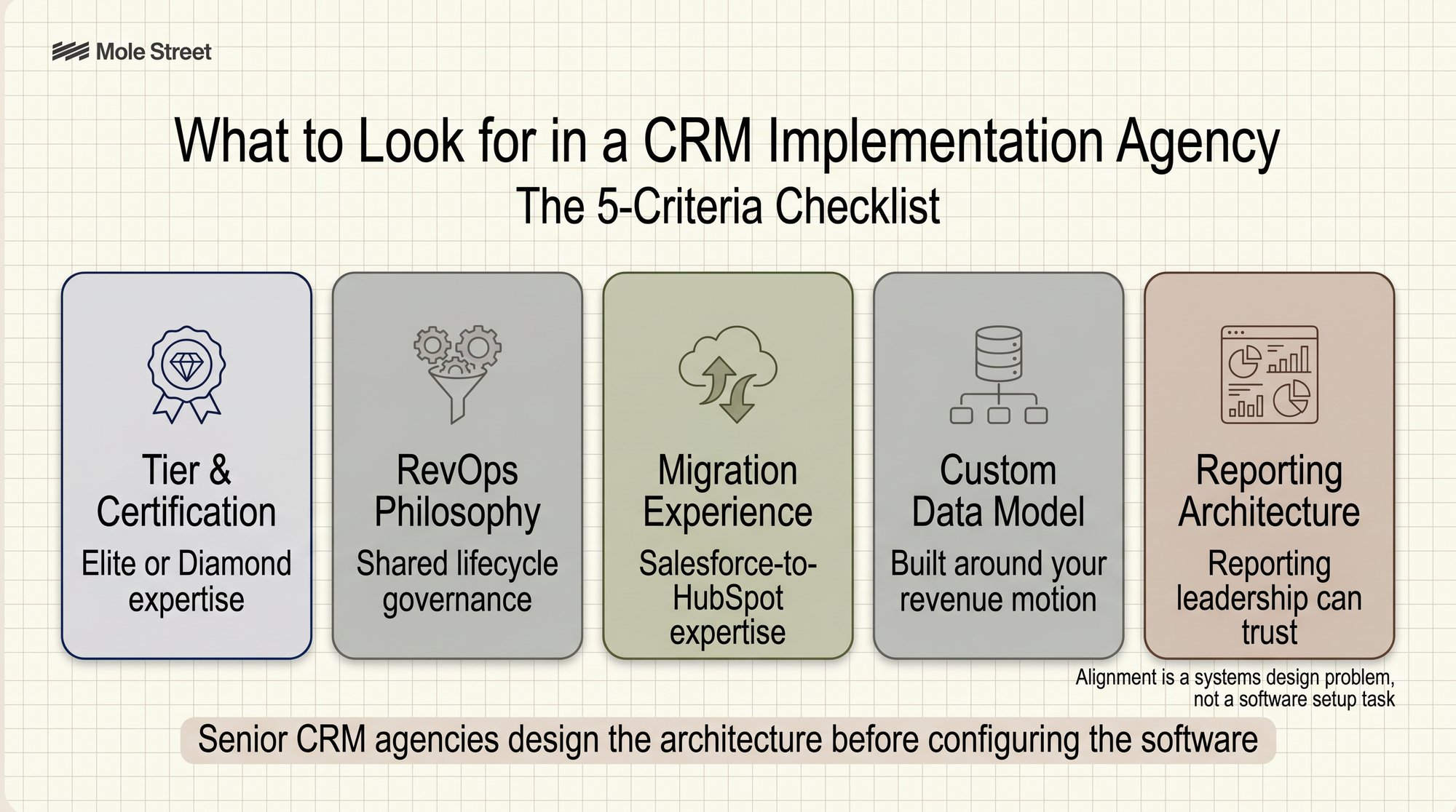
The five-criteria checklist

Before signing a contract:

  1. Tier and certification. HubSpot Elite or Diamond tier (or Salesforce Crest/Summit) signals depth across multi-hub work.
  2. RevOps philosophy. Ask how they govern lifecycle stages, lead status, and source attribution. If the answer is "however the customer wants," chaos is what gets inherited.
  3. Migration experience. Especially for Salesforce-to-HubSpot moves, where day-one decisions determine whether the new CRM unifies the teams or simply relocates the silos.
  4. Custom data model design. Senior CRM implementation agencies design the model around your revenue motion. Generic shops apply the same template every time.
  5. Reporting architecture. Ask to see a customer dashboard the agency built. If it shows funnel metrics in isolation rather than tying marketing source to closed-won revenue and customer health, the agency does not actually align marketing, sales, and service data.
Create_a_clean_minimalist_B2B__Nano_Banana_2_47068

How Does Mole Street Approach Marketing, Sales, and Service Alignment?

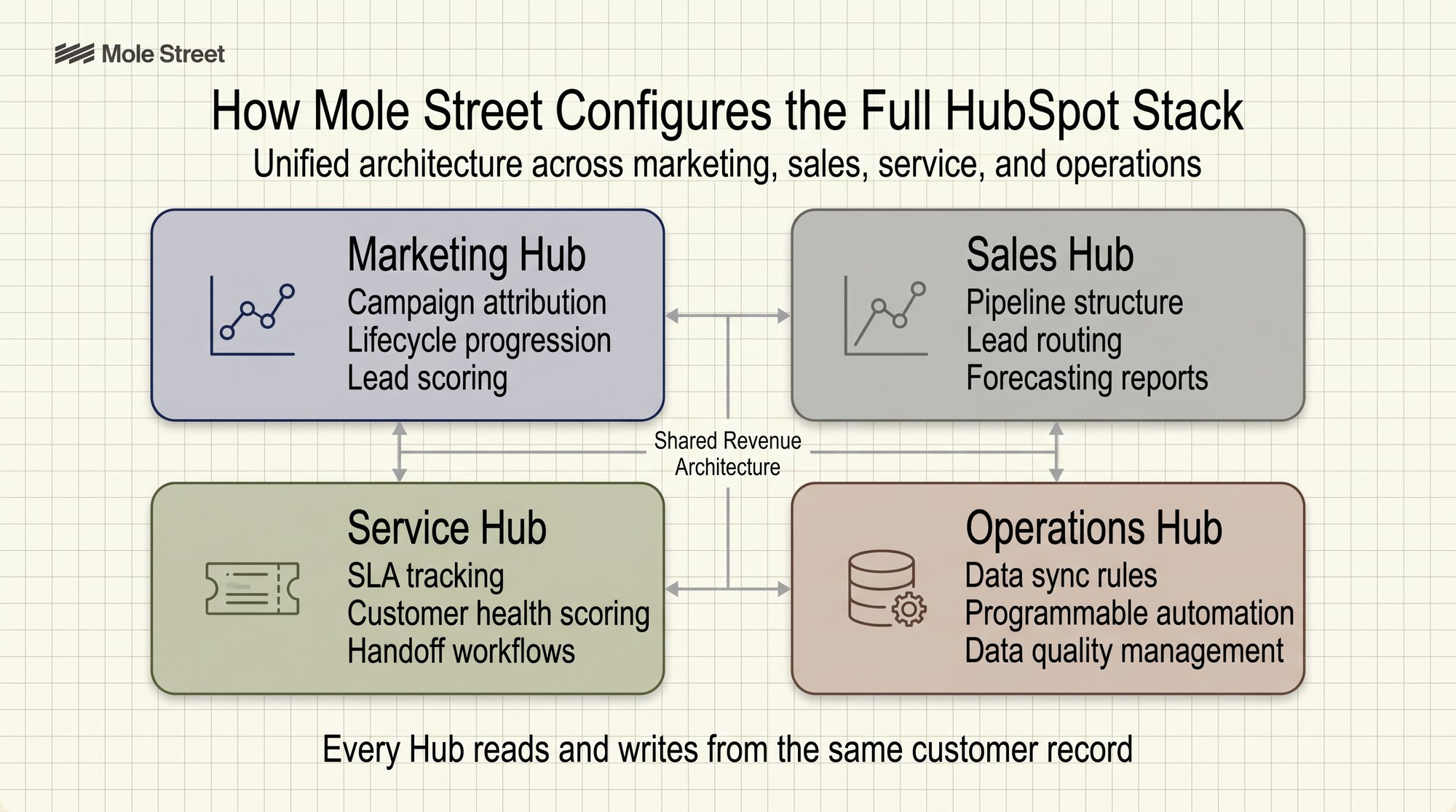
Mole Street builds CRM architecture as a single revenue system, starting with the data model, defining lifecycle governance, then configuring all four HubSpot Hubs to read and write from that shared foundation.

Why firms hire Mole Street

Mole Street is an Elite HubSpot Solutions Partner. Elite is HubSpot's highest tier, awarded to a small number of partners globally based on multi-hub depth, customer outcomes, and certification across the full platform.

What separates Mole Street from most CRM implementation agencies is the sequencing of the work:

  • Most shops start with configuration. They open HubSpot, set up pipelines, and wire integrations on day one.
  • Mole Street starts with the data model. The team documents how revenue actually moves through the business, maps where data lives today, identifies the broken handoffs, and designs the unified architecture before anyone touches a HubSpot screen.

That sequencing is the difference between a CRM that genuinely aligns marketing, sales, and service data and a CRM that imports the old silos under new branding.

Where Mole Street goes deepest

Mole Street's work concentrates in verticals where data alignment carries the highest stakes:

  • B2B financial services (banks, credit unions, wealth management, fintech)
  • Professional services (consulting, accounting, law, advisory)
  • B2B technology and SaaS

In each, the team brings deep familiarity with the data model patterns, lifecycle definitions, compliance considerations, and reporting requirements that senior buyers in those industries actually need. Mole Street has run Salesforce-to-HubSpot migrations, multi-entity rollouts, and post-merger CRM consolidations across all three.

How does Mole Street build a unified CRM architecture?

Mole Street engagements follow four stages, each designed to lock in alignment before the next one starts:

  1. Audit. Map every system holding customer data, document where revenue moments live, and identify the gaps preventing a unified view.
  2. Design. Define the contact, company, and deal data model. Set custom properties for lifecycle stage, deal source, and revenue-motion-specific metrics. Govern who creates, edits, and consumes each property.
  3. Configure. Build out Marketing, Sales, Service, and Operations Hubs against the shared data model.
  4. Govern. Build the dashboards leadership actually trusts and train the operations team to keep the model clean after go-live.
Create_a_clean_minimalist_B2B__Nano_Banana_2_91933

The Right CRM Implementation Agency Treats Alignment as the Architecture

Most CRM implementations fail because the agency jumps straight to setting up the software without first asking how all your customer information should be organized.  The result is a more expensive tool that still has marketing, sales, and service working from disconnected data.

The CRM implementation agencies worth hiring do the opposite. They start by deciding what data goes where, who owns each piece of it, and how every team will use it. Once that foundation is in place, the CRM does what it was bought to do: bring marketing, sales, and service onto one shared view of every customer.

Frequently Asked Questions

How long does a multi-hub HubSpot implementation take?

Most multi-hub HubSpot implementations run 12 to 20 weeks for mid-sized B2B organizations. Timeline depends on data migration complexity, custom object requirements, and integrations with billing, BI, and support systems.

What is the difference between a HubSpot Diamond and Elite Solutions Partner?

Elite is HubSpot's top partner tier, requiring the highest revenue contribution, customer count, and certification depth. Elite-level CRM implementation agencies typically have stronger multi-hub experience and dedicated specialists across Marketing, Sales, Service, and Operations Hubs. Diamond is the second tier.

Should a firm migrate from Salesforce to HubSpot to align marketing, sales, and service data?

Migration makes sense when Salesforce has become a sales-only tool and marketing or service operates in disconnected systems. The decision should be based on data model fit and total cost of ownership, not platform preference. A senior CRM implementation agency will evaluate both options before recommending a move.

How does HubSpot Operations Hub support the work to align marketing, sales, and service data?

Operations Hub manages data sync, custom programmable automation, data quality rules, and integration with external systems. It is the layer that keeps the unified data model clean across Marketing, Sales, and Service Hubs over time.

What is RevOps and why do CRM implementation agencies talk about it?

RevOps (revenue operations) is the discipline of unifying marketing, sales, and customer success operations under a single data model and reporting structure. RevOps-led CRM implementation agencies build systems designed to align marketing, sales, and service data from day one rather than retrofitting alignment after the software is configured.

Can a CRM implementation actually fix sales-marketing alignment problems?

A CRM implementation can solve the data and process side of misalignment but not cultural problems on its own. Successful implementations from senior CRM implementation agencies pair technical configuration with lifecycle governance, shared definitions, and cross-functional reporting that forces marketing, sales, and service to operate from the same numbers.

Want to Take The First Step Forward to a Unified Tech Stack?