Imagine this. It’s the first board meeting after go-live, and marketing and sales have each brought a lead report. The numbers do not match. Marketing counts a qualified lead one way, sales counts it another, and the platform was built to one of those definitions without either team being told. Everyone assumes the software is broken. It is not. It did exactly what the requirements asked, and the requirements were never reconciled.
This is a common way for enterprise implementations to fail. It starts in requirements gathering, and the damage appears after go-live, when it is most expensive to fix. This article covers six requirements-gathering failures, what each costs once the data model is built, and the control that catches each one.
How Do Requirements Gathering Failures Derail Enterprise Marketing Platform Implementation?
Requirements gathering fails when different teams give conflicting or incomplete answers and nobody reconciles them, which leaves the requirements fragmented. The build then commits the data model to one team’s definition of a shared concept without the other teams knowing.
Moreover, the platform matches its specification, but the specification was contradictory or incomplete, and the gap only becomes visible when reporting is attempted across functions. The six failures below produce this, and each has a control that catches it during discovery.
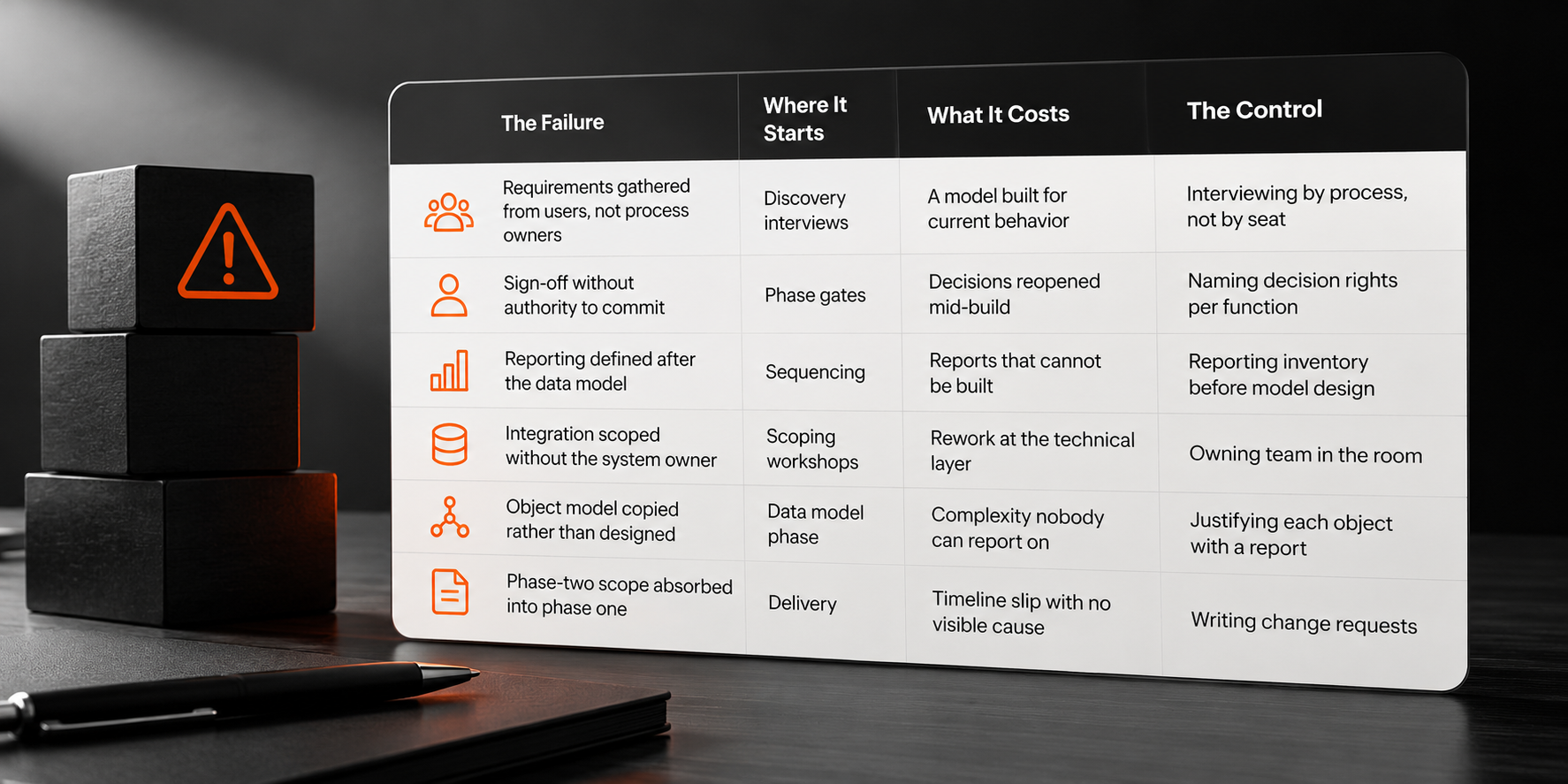
The 6 Requirements-Gathering Failures
1. Requirements Gathered From Users Rather Than Process Owners
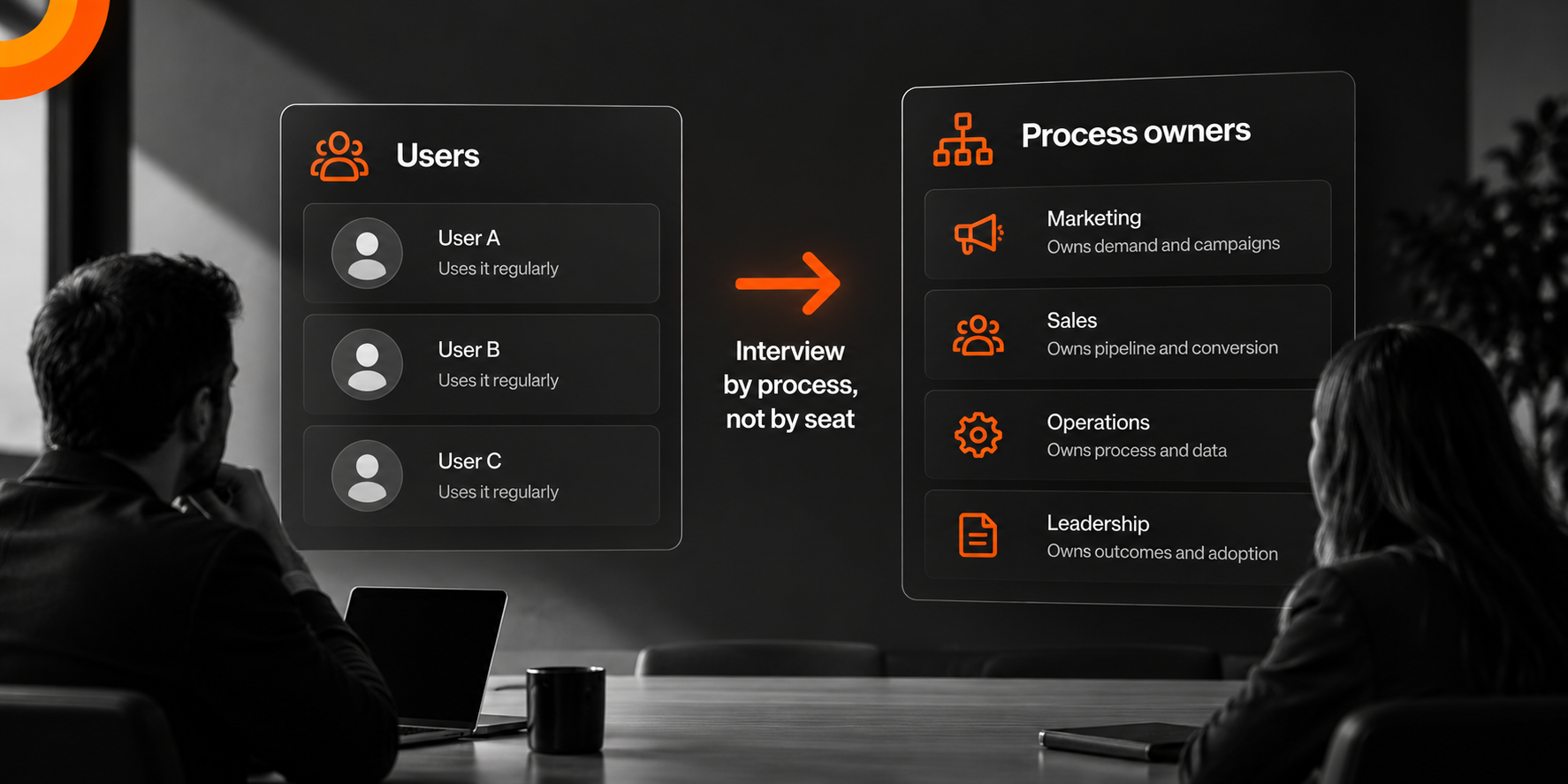
It starts with a reasonable instinct. Requirements gathering begins with the people who use the system today, because they know it best. The problem is that in a low-adoption environment, the people using the system are the ones the current system suits.
Blue & Co.’s Dynamics instance had 5-7 consistent users among 60+ directors. Interviewing those users would have produced requirements describing a system that worked for 7 people and had already failed for 50.
What it costs: a data model optimized for current behavior rather than the process the business truly runs. Adoption does not improve because nothing changes for the people who were not asked. For how that gap is closed in practice, see how CRM implementation consultancies connect marketing, sales and service data.
The control: interviewing by process rather than by seat. Identify who owns each step of the revenue process, including the steps currently executed outside the system entirely, and interview the owner whether or not they log in today. Run this during discovery before any model design.
2. People Who Sign Off Without Authority to Commit Their Function
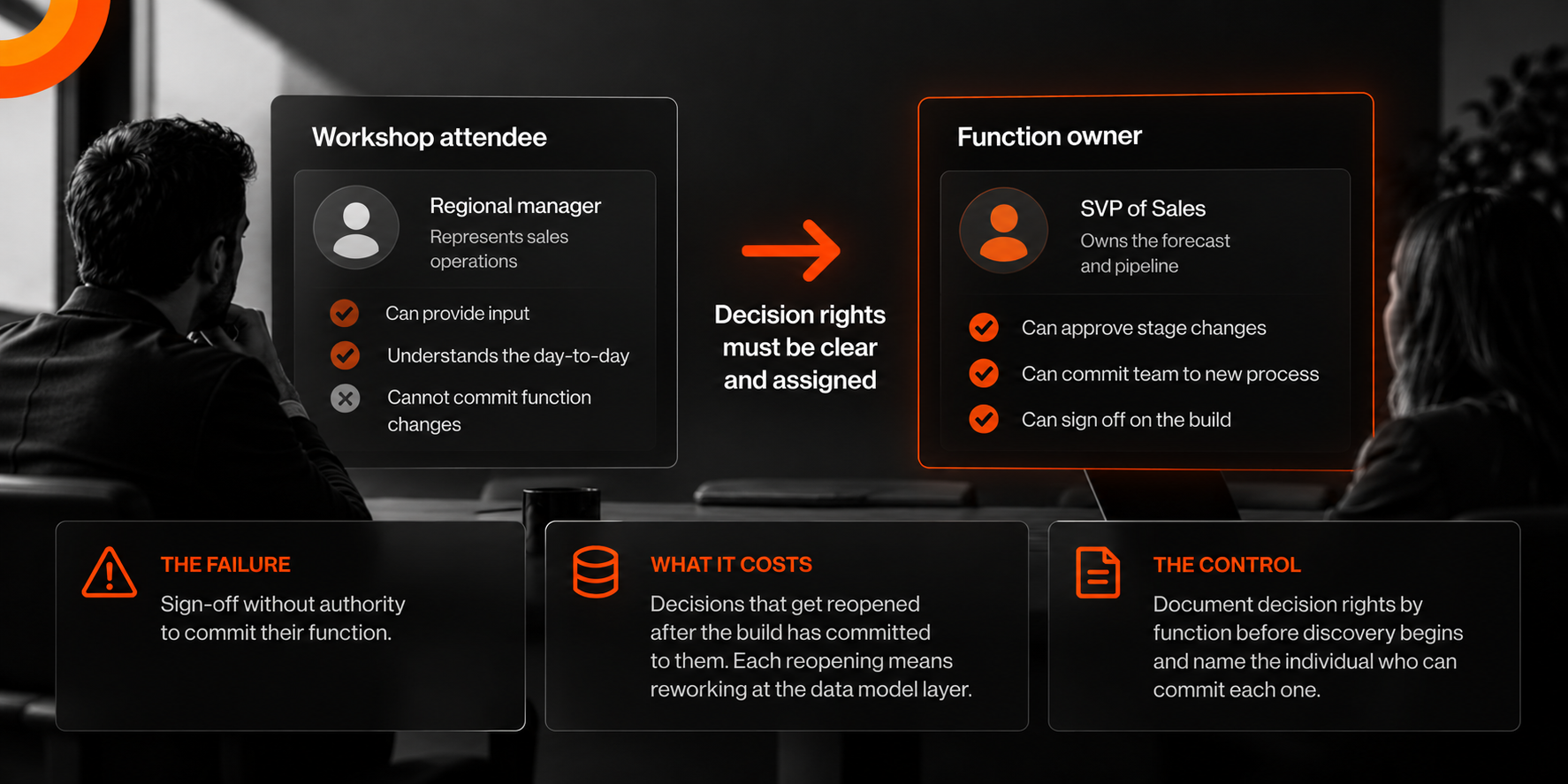
Authority is the variable here, and it is frequently assumed rather than established. The person who attends the workshop is often not the person who can retire a pipeline stage, change a lifecycle definition or commit their team to a new process.
This shows up most sharply in pipeline consolidation. Opportunity stages accumulate over years, and reducing 20 stages to 7 requires someone who owns the forecast to agree that 13 stages are going away. A regional manager cannot make that call, and neither can a workshop attendee delegated to represent sales operations.
What it costs: decisions that get reopened after the build has committed to them. Each reopening means reworking at the data model layer, which is the most expensive layer to change.
The control: documenting decision rights by function before discovery begins and naming the individual who can commit each one. If that person cannot attend, the decision is stalled. A workshop that produces decisions nobody can enforce has produced nothing.
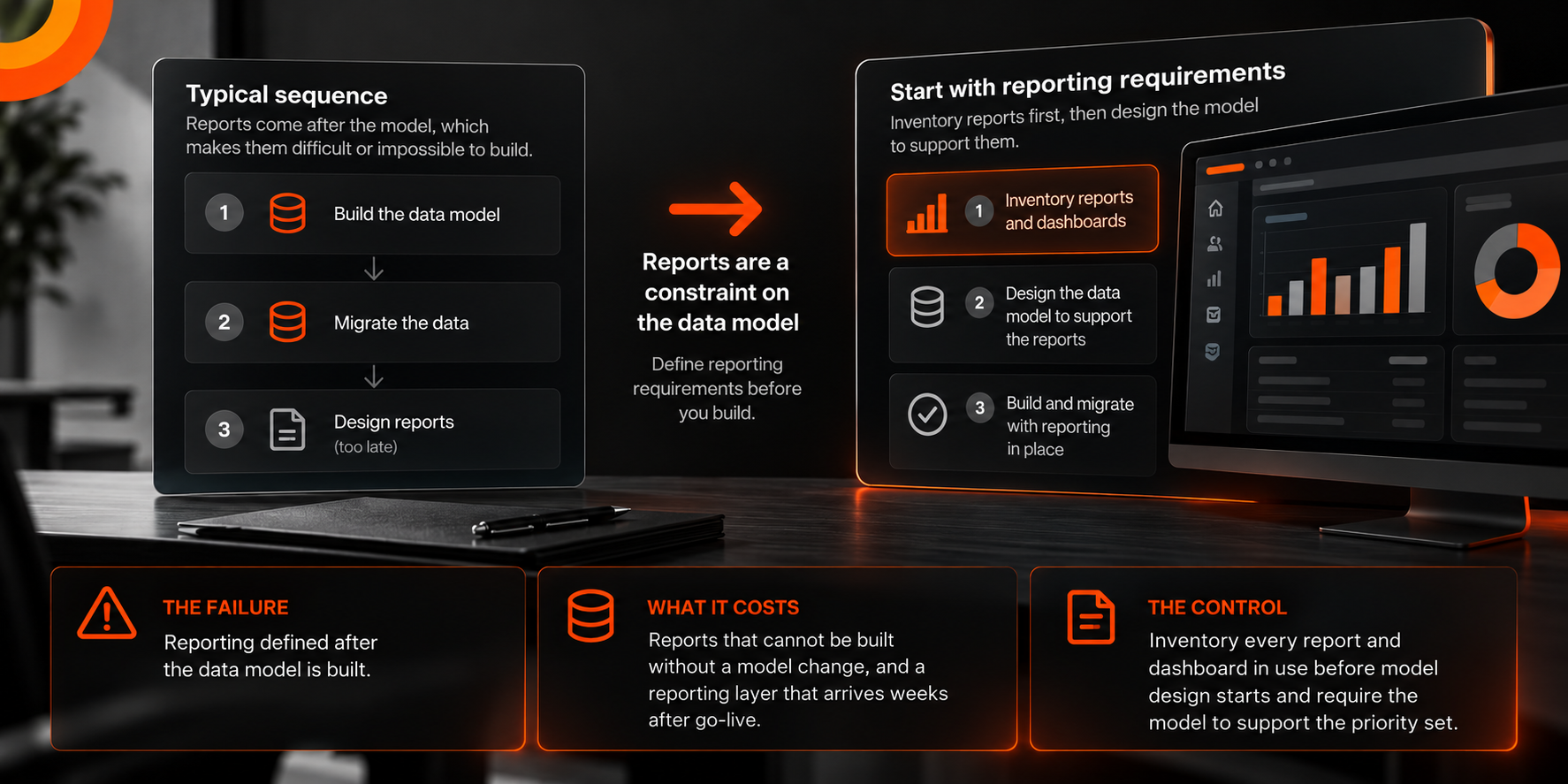
3. Reporting Requirements Defined After the Data Model Is Built
The cause is the order of work, and it feels natural. Build the model, migrate the data and then design reports. That sequence fails because a report is a constraint on the data model rather than an output of it.
If leadership needs revenue by service line and originating partner, both must exist as structured properties with values captured at the right moment. Deciding after the model is built means retrofitting fields and backfilling values that were never recorded.
Pinnacle Bank replaced 60+ monthly PDF scorecards with live dashboards. Those 60+ scorecards were the reporting requirement, and they were knowable at the start. The West Virginia Department of Tourism (WVDT) rebuild achieved a 60% reduction in quarterly reporting preparation time, with the reports specified as inputs to the design.
What it costs: reports that cannot be built without a model change, and a reporting layer that arrives weeks after go-live, during the window when adoption is being established.
The control: inventorying every report and dashboard in use before model design starts and requiring the model to demonstrably support the priority set.
4. Integration Requirements Scoped Without the Owning System’s Team in the Room
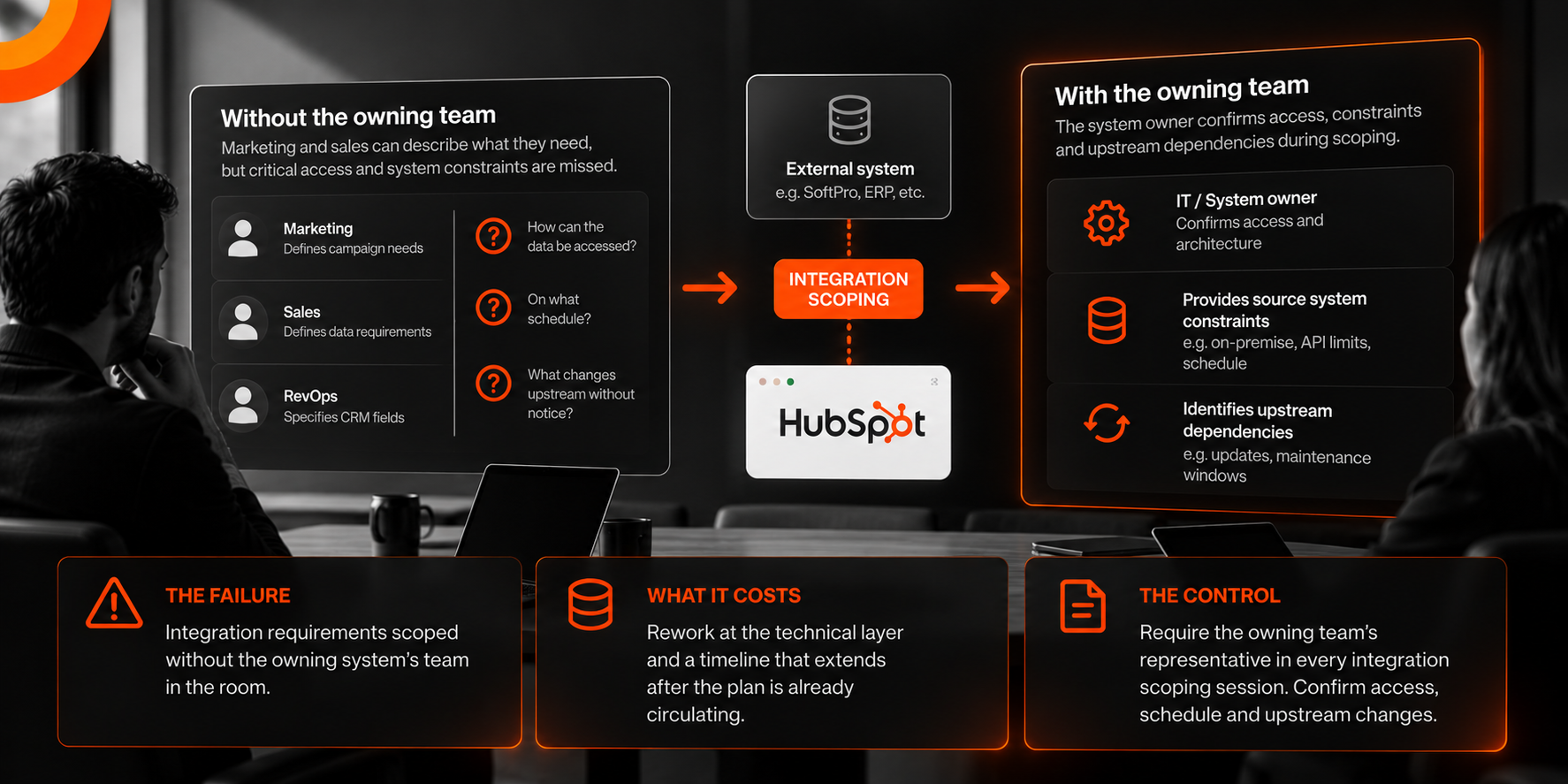
Access is what gets missed when the owning team is absent, and it often limits the integration more than data structure does. Marketing and sales can describe what they need from a system without knowing whether it can be reached.
Weissman’s closing data sits in SoftPro, an on-premise system. The designed architecture routes it through a data warehouse, Power BI and Power Automate into HubSpot daily, rather than through a direct connection, because one was not available. That is an IT-owned fact, and no amount of marketing-side requirements gathering produces it.
Hill, Barth & King’s integration rebuild ran four testing rounds with 186 documented test cases across a system serving 20,000+ clients. Testing at that volume has to be scoped with the owning team, because they know what can break. For a related failure, see what causes data silos in credit union integrations.
What it costs: rework at the technical layer and a timeline that extends after the plan is already circulating.
The control: requiring the owning team’s representative in every integration scoping session, with a specific brief to answer three questions: How can the data be accessed? On what schedule? What changes upstream without notice?
5. Requirements Carried Over From the Old System Without Being Re-Examined
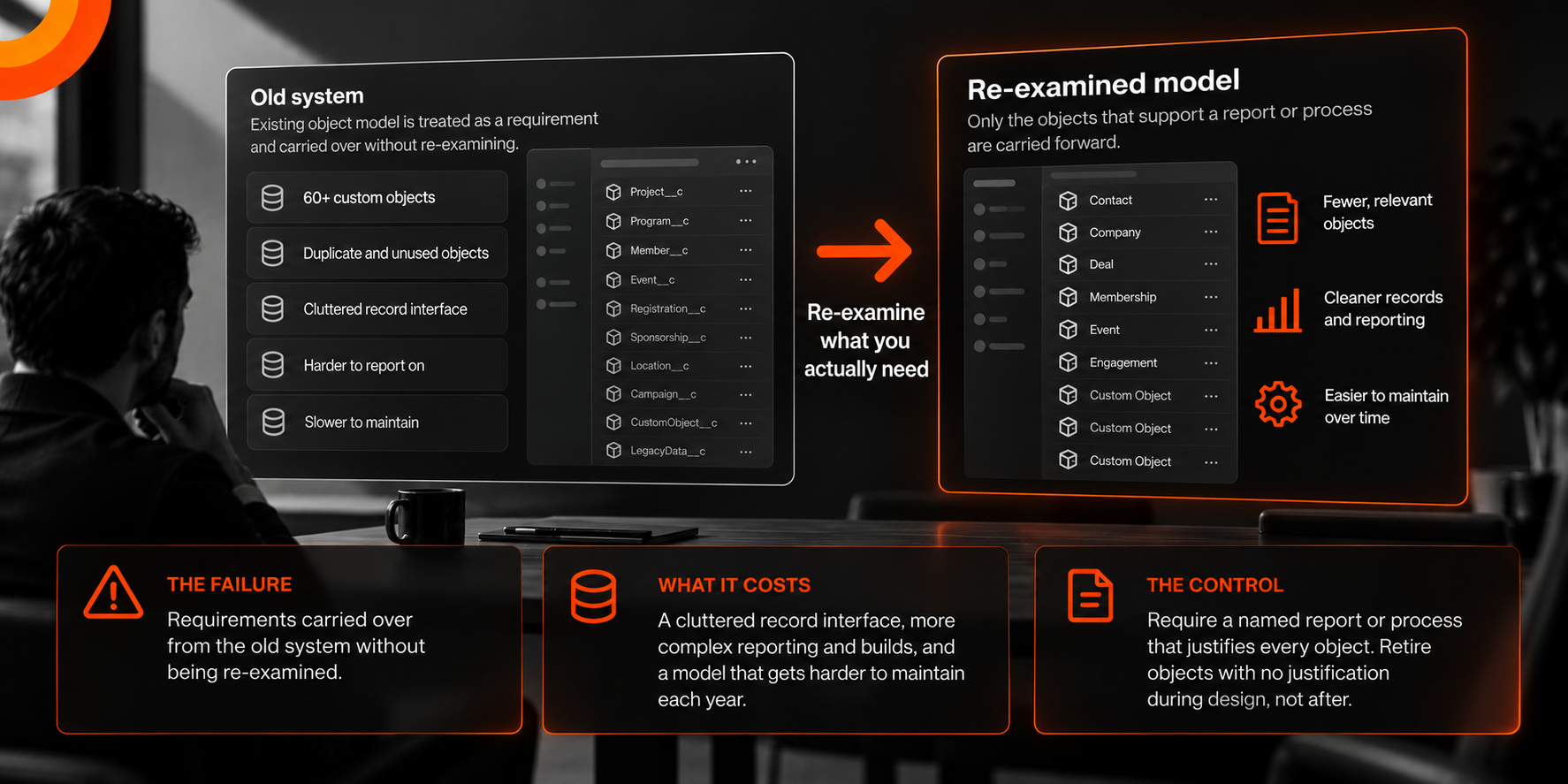
Compared with the failures above, this one is an act of omission rather than a wrong decision. The existing object model gets treated as a requirement. Replicating it feels safe, because it carries everything forward and does not ask anyone to decide what should be left behind.
West Virginia Department of Tourism arrived with Salesforce carrying 60+ custom objects, which the rebuild reduced to fewer than 10. The Global Association of Risk Professionals’ (GARP) enterprise build settled on nine data objects with real-time syncing for an association serving 150,000 members across 190 countries. Pinnacle Bank’s banking relationship structure needed three custom objects.
Objects like these accumulate because adding one is easy and removing one requires a conversation nobody has.
What it costs: three things that compound. Users face a cluttered record interface with objects and properties that are not populated. Anything reading the data, whether a report, an API call or a GraphQL query, must traverse a more complex object graph, which makes every downstream build slower to write and slower to run. And the model gets harder to maintain each year it survives because nobody remembers which objects are still needed.
The control: requiring a named report or process that justifies every object carried forward. Objects with no justification are retired during design, not after.
6. Scope Added After Requirements Gathering Closes, Without a Change Request
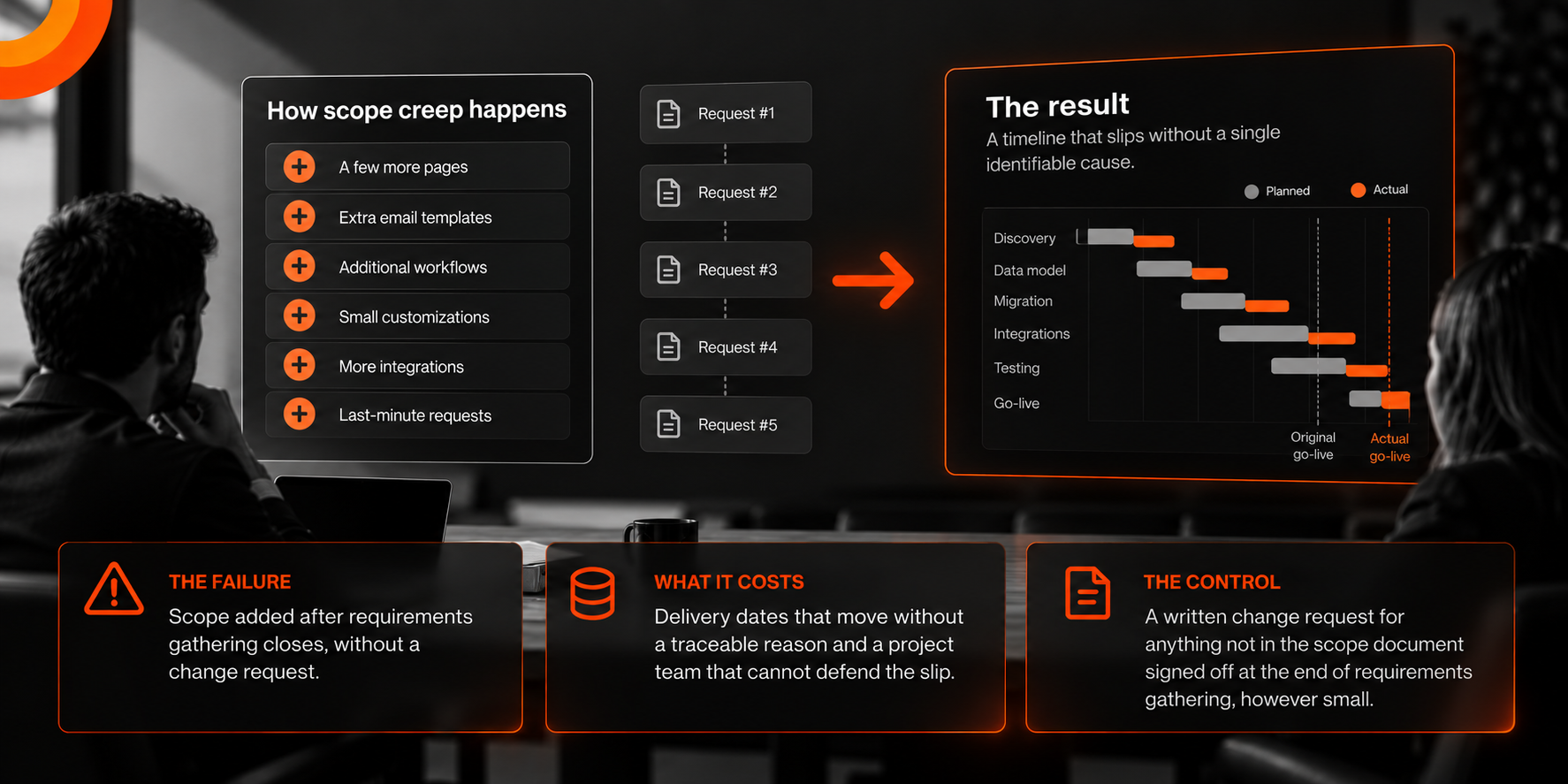
Scope creep in enterprise implementations is a sequence of small additions rather than a single large one. Each is individually reasonable, and none is logged.
GARP’s migration carried 2,500+ website pages, 129 Marketing Cloud email templates and 21 journeys rebuilt as HubSpot workflows. At that scale, absorbing “just a few more templates” repeatedly would produce a timeline that slips with no single identifiable cause, which makes it hard to manage and hard to explain to a steering committee.
What it costs: delivery dates that move without a traceable reason and a project team that cannot defend the slip because every individual addition was agreed in good faith.
The control: a written change request for anything not in the scope document signed off at the end of requirements gathering, however small. The purpose is a record that explains the timeline when someone asks, not paperwork for its own sake.
What Does a Reconciled Requirements-Gathering Process Look Like?
Reconciliation is a distinct step, and it is often missing. Requirements gathering and requirements reconciliation are different activities, and a process that only does the first produces a tidy document full of contradictions.
A reconciled process adds three things:
- A definitions register. Every shared term has a single agreed meaning and a named owner, such as qualified lead, active client, closed-won or service line.
- A conflict log. Where two functions give different answers, record both, then record the decision and who made it. Unresolved conflicts stay visible rather than being settled by whoever specifies first.
- A sign-off gate with named individuals. These are individuals rather than roles, and each has the authority to commit their function.
These are short documents, not extra meetings. The definitions register for a mid-sized implementation is usually a single page.
Who Should Own Requirements Reconciliation?
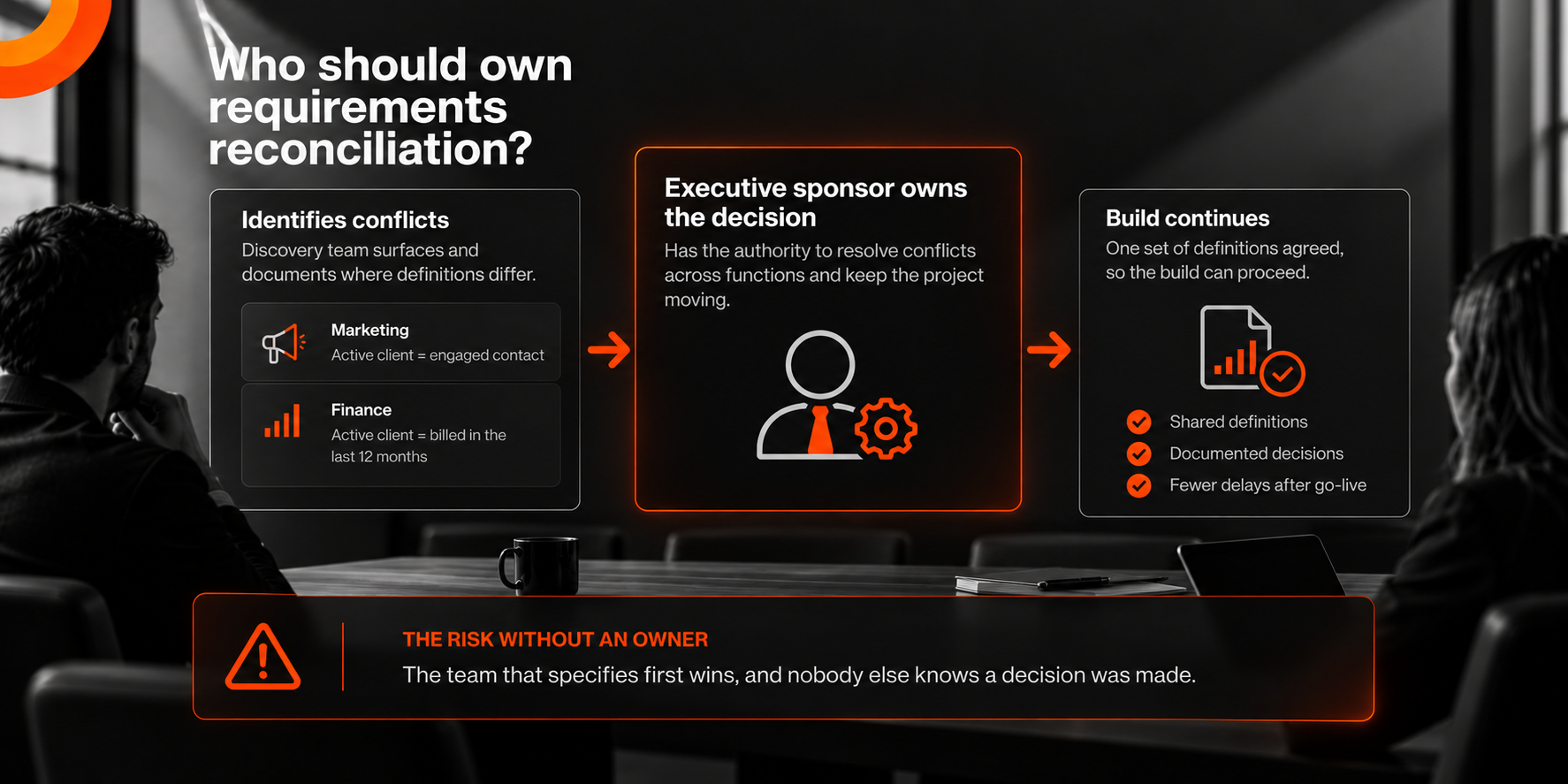
Reconciliation needs an owner with the standing to force a decision, which is why it rarely works when delegated to the project manager. A project manager may identify that the marketing and finance teams define an active client differently. Resolving that conflict requires someone with authority over both teams.
In practice, the effective owner is an executive sponsor with a standing agenda item, supported by whoever runs discovery. The sponsor does not resolve every conflict personally. They make clear that unresolved conflicts stop the build, which is usually enough for the functions to resolve them.
Implementations without that escalation route settle conflicts by default. The team that specifies first wins, and nobody else knows a decision was made.
Reconciling Shared Definitions Before the Build Is What Prevents Implementation Delays
Implementation delays come from definitions that were never agreed during requirements gathering. Therefore, everyone involved has to agree on one set of definitions before the build starts. It’s a small task that can help you avoid a model rebuild after go-live, saving time, investment, and human capital to fix.
Enterprise marketing platforms are mature products. The configuration work is well understood, the integration patterns are established and most technical obstacles have a documented solution. Few implementations slip because something could not be built; they slip because what was built rested on definitions the organization had not agreed.
Marketing’s definition of a qualified lead and the sales team’s definition can coexist indefinitely in a business, with each team reporting its own number. Nobody notices the gap until a single platform forces both definitions into one field, and somebody chooses, usually without telling the other team. That choice is a decision about how the business describes itself, so a project team cannot make it, and it keeps getting deferred to a phase where it costs far more to resolve.
Frequently Asked Questions
How long should requirements gathering take on an enterprise implementation?
There is no fixed duration, and the right measure is completeness. Discovery is finished when the definitions register is signed off and the conflict log is empty, not when the calendar says so.
Who should sign off on implementation requirements?
Named individuals with authority to commit their function, not role titles or delegates. Anyone signing off on a pipeline stage change must be able to enforce that change with their team.
What is the most common cause of implementation delay?
A common cause is decisions reopened after the build has committed to them. The underlying cause is usually sign-off from someone without the authority to make the decision stick.
Can requirements be fixed mid-project?
Yes, but the cost rises sharply once the data model is built. A definition changed during discovery costs a conversation. The same change after migration costs a model revision, a data backfill and a reporting rebuild.
How do you handle two teams that will not agree on a definition?
Escalate it to an executive sponsor with a deadline attached, and make it clear that the build is blocked until it is resolved. Unresolved definition conflicts do not disappear; they are settled by whichever team specifies first, which is the worst available outcome because nobody else knows a decision was made.
Should requirements be gathered before or after selecting the platform?
Before, at least for the reporting requirements and the definitions register. Platform selection is easier and better evidenced once you know what must be reportable, and those requirements survive the selection decision either way.
Harry Maule is the Demand Gen Manager at Mole Street, an Elite HubSpot Solutions Partner and SOC 2 compliant technology consultancy. He writes on CRM architecture and data migration, as well as revenue reporting for financial services, accounting and professional services organizations.