What Causes Data Silos in Credit Union Integrations?

15 min read
What Causes Data Silos in Credit Union Integrations?

A member takes out an auto loan on Monday. On Wednesday, your marketing platform emails them an auto loan offer. The information existed the whole time, but your marketing team couldn't see it.

That gap has a name: a data silo. The data was there, sitting in the loan system, but it never reached the platform running your campaigns. So, marketing acted on a partial picture, and the member got a message that made your credit union look like it wasn't paying attention.

Here is the part most credit unions get wrong. The problem is almost never a lack of member data. Credit unions hold enormous amounts of account, transaction and behavioral data. The problem is that the data cannot be identified, joined, refreshed and used by marketing fast enough to matter. Silos come from missing identity, missing governance, slow refresh and no way to measure the outcome.

This guide covers what causes those silos when you integrate a marketing platform, how silos damage your marketing and how to plan cleaner member data flows that close them.

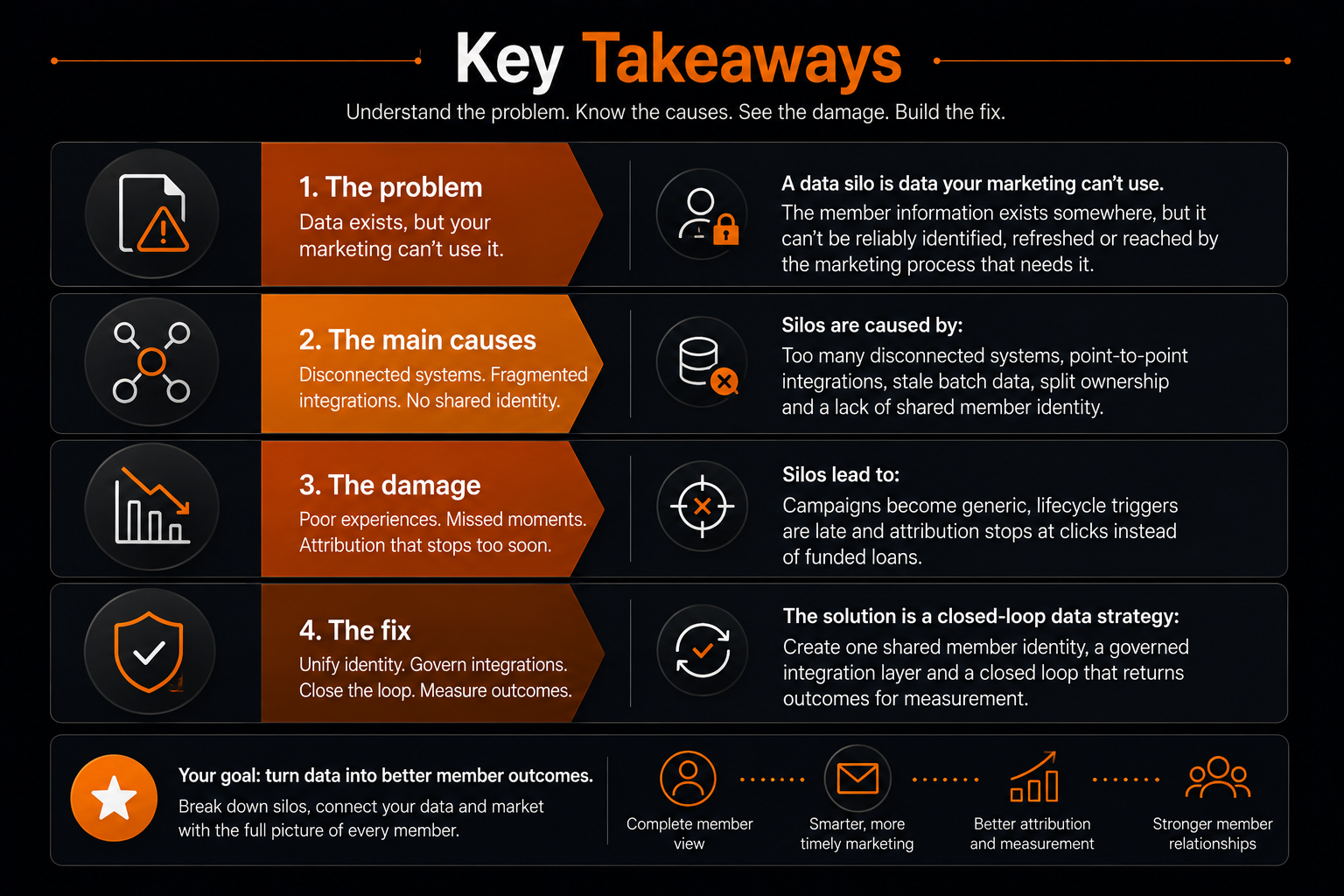
Key Takeaways:

  • The problem: A data silo is data your marketing can't use. The member information exists somewhere, but it can't be reliably identified, refreshed or reached by the marketing process that needs it.
  • The main causes: There’s an excess of disconnected systems, point-to-point integration, stale batch data and split ownership and a lack of shared member identity.
  • The damage: Campaigns become generic, lifecycle triggers are late and attribution stops at clicks instead of funded loans.
  • The fix: Create one shared member identity, a governed integration layer and a closed loop that returns outcomes for measurement.
ChatGPT Image Aug 26, 2026, 01_37_15 PM

What Is a Data Silo in a Credit Union?

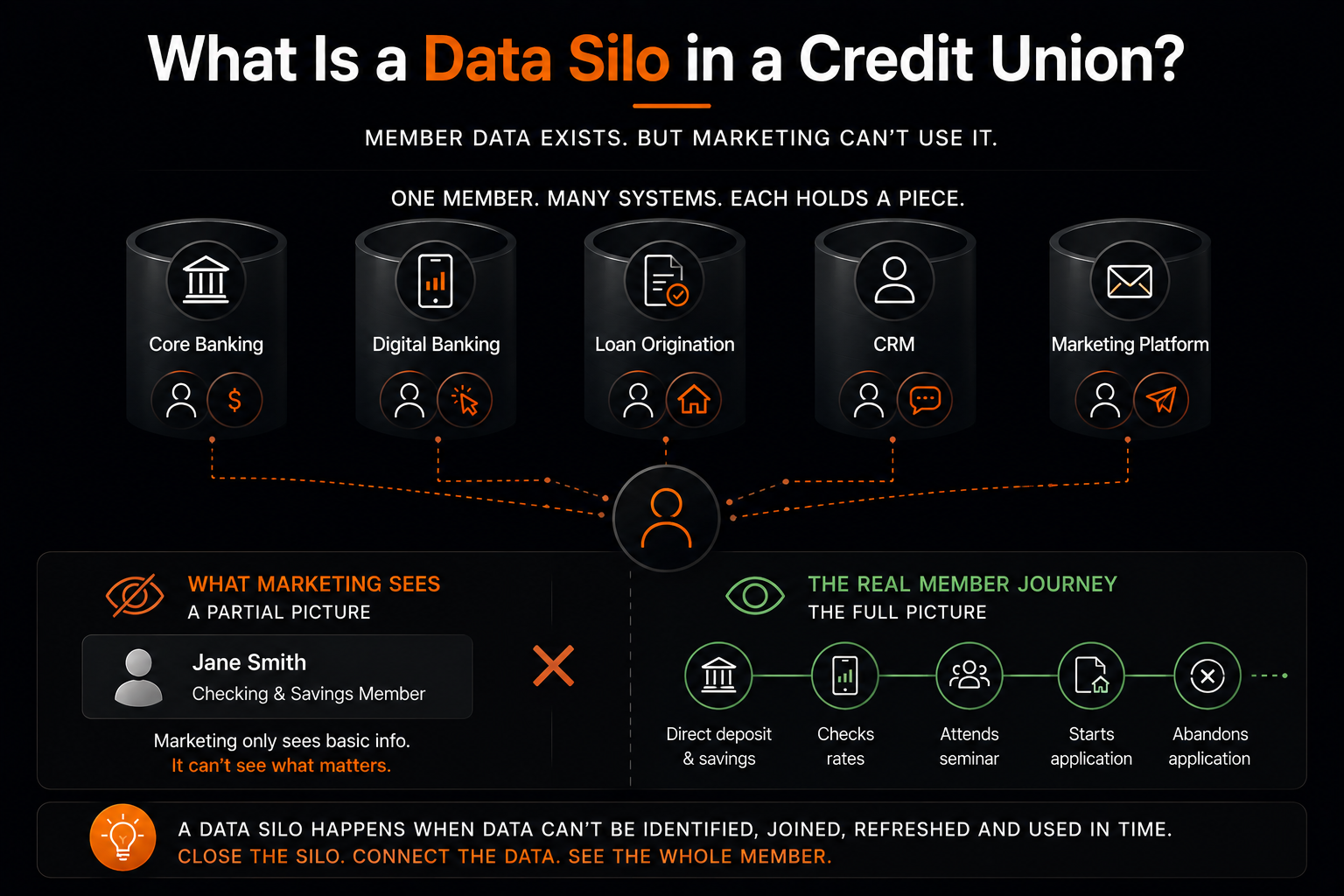
A data silo is member data that exists somewhere in your systems but cannot be reliably identified, joined, refreshed and used by the marketing process that needs it. The test is usability. Data can sit in a perfectly good system, and yet, it’s still siloed if marketing can't reach it in a usable form when it matters.

In a credit union, one member's life is spread across a lot of systems. The core holds their accounts and product ownership. Digital banking holds their behavior. The loan origination system holds their applications. The CRM holds staff interactions. The marketing platform holds email engagement. Each system knows its own slice, but they don’t know the whole person.

Consider a member who has direct deposit and a savings account, checks mortgage rates inside digital banking, attends a first-time homebuyer seminar logged in the CRM and starts but abandons a mortgage application in the loan system. Yet, an email platform that holds only a name, an address and the customer’s current products just sees "checking and savings member" and nothing more. It cannot tell that this person is actively shopping for a mortgage.

The silo there is the failure to move that application state to the same person, make it available in time and let marketing combine it with everything else it knows.

ChatGPT Image Aug 27, 2026, 10_49_29 AM

What Causes Data Silos During Marketing Platform Integrations at Credit Unions?

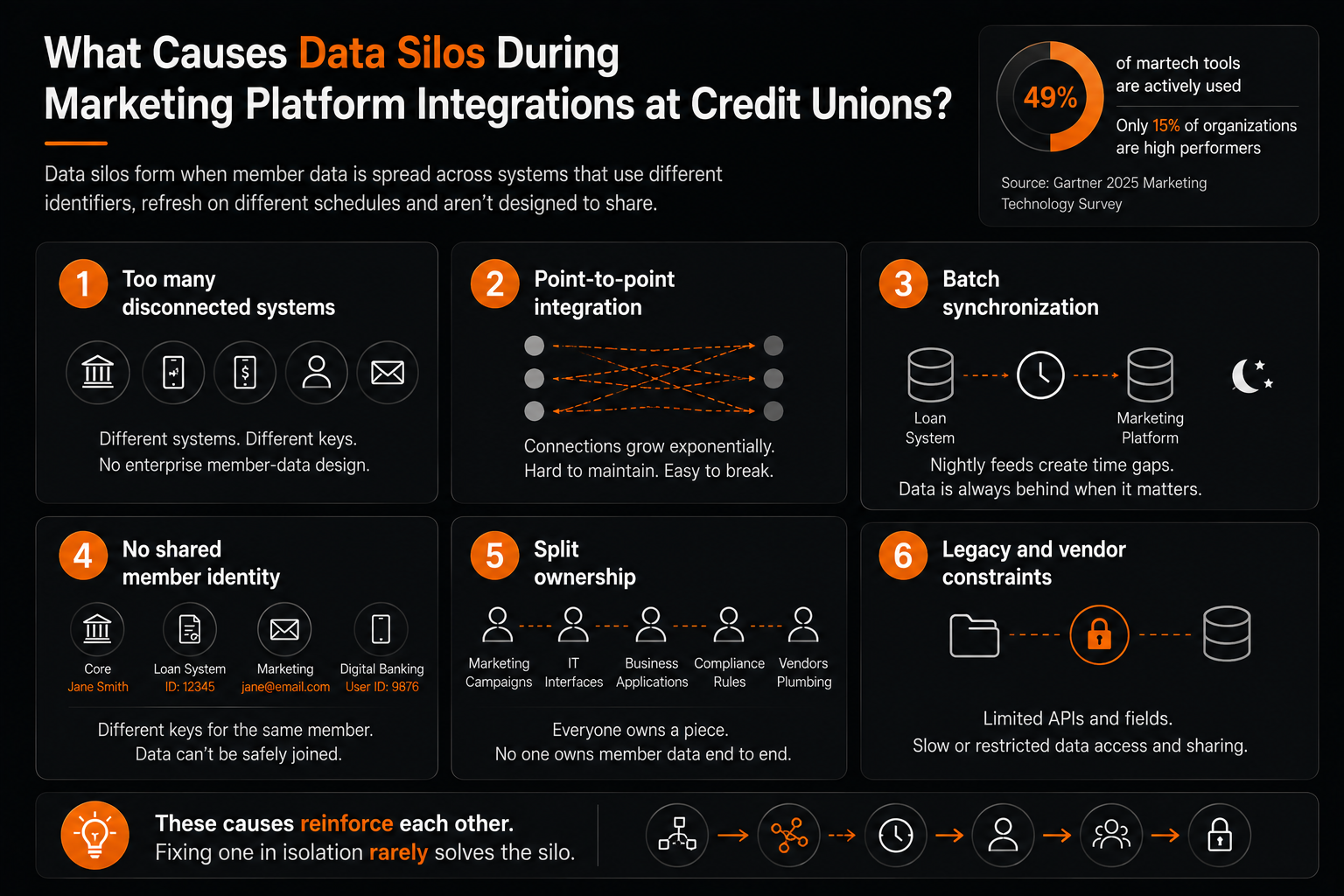
Data silos form when member data is spread across systems that use different identifiers, refresh on different schedules and aren’t designed to share, so adding a marketing platform surfaces the gaps rather than closing them. Each cause below reinforces the others.

Marketing stacks have also grown sprawling. According to Gartner's 2025 Marketing Technology Survey, only 49% of martech tools are actively used, and just 15% of organizations qualify as high performers. Every disconnected tool is one more place for member data to get stranded.

Too many disconnected systems

Each platform is bought at a different time for a different job, and each has its own record key, schema and refresh schedule. A credit union adds a loan system for lending, a digital platform for member experience and a marketing platform for campaigns. Every project succeeds on its own terms, but nobody scopes "funded mortgage status flows to marketing." The result is local optimization with no enterprise member-data design.

Point-to-point integration

When you wire each system directly to another, the connections grow faster than the systems. Ten systems can require up to 45 direct connections, versus ten to a shared hub. Each link is mapped and monitored on its own, so changing one field in the core can break several downstream feeds, and no single person can map them all.

Batch synchronization

A nightly feed creates a time silo. A member starts a HELOC application at 10am and abandons it minutes later, but if the loan system only exports overnight, the 11am campaign eligibility check still sees no application, and the member gets a generic loan email that evening. The correct profile arrives at 2am, long after the moment to act has passed.

No shared member identity

This is the most fundamental silo, because moving data faster does not help if the receiving system cannot tell who the data belongs to. The same member is "Jane Smith" in the core, an applicant ID in the loan system, an email address in the marketing tool and a user ID in digital banking. Until a shared key ties those together, marketing cannot safely treat them as one person, and the member fractures into several partial records.

Split ownership

Marketing owns the campaigns, IT owns the interfaces, the business units own the applications, compliance governs permitted use and vendors own parts of the plumbing. When every team is responsible for its own piece, but no one owns "member data for marketing" end to end, the flow can fail, despite every team believes its own system is working. McKinsey found that only 37% of marketing leaders reported successful collaboration both within marketing and across functions.

Legacy and vendor constraints

Some systems expose only scheduled files or a limited set of fields, which makes certain data slow or hard to reach. Filene's work with credit unions found that API-capable environments integrated more smoothly, while others ran into vendor and data-sharing limits. This intensifies silos, but it rarely creates them on its own. Architecture and ownership decide whether the constraint becomes a permanent silo.

ChatGPT Image Aug 27, 2026, 10_53_41 AM

How Do Data Silos Hurt Credit Union Marketing?

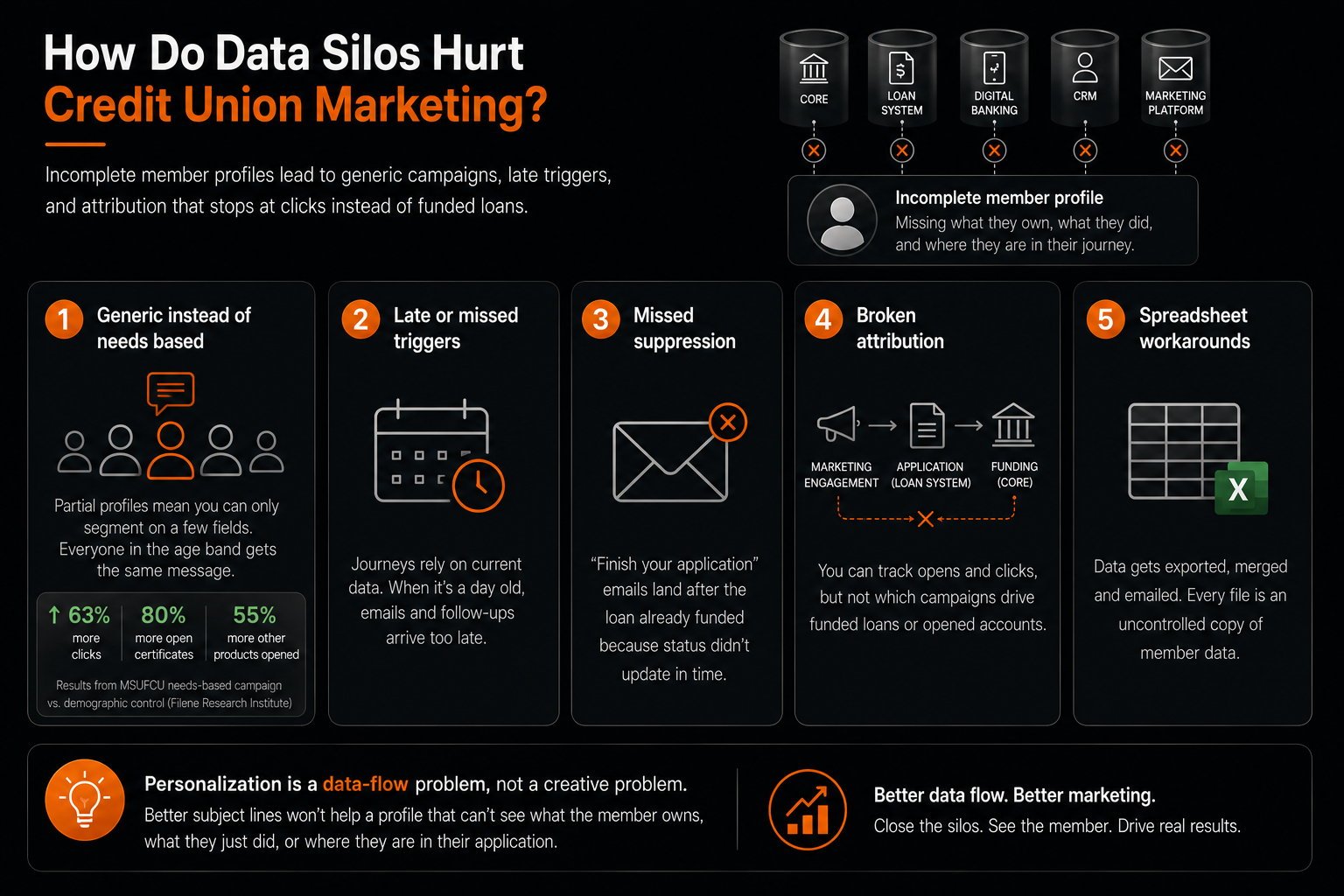
Data silos leave you with incomplete member profiles, so campaigns are generic, lifecycle triggers fire late and attribution stops at clicks instead of funded loans. The cost is not abstract. It shows up in every number your marketing team reports:

Generic instead of needs based

With a partial profile, you can only segment on a few fields in the marketing tool, so everyone in the age band gets the same message. The gap that this creates is measurable. In a test reported by Filene Research Institute, Michigan State University Federal Credit Union sent a needs-based campaign built from account and transaction data against a demographically targeted control. The needs-based group produced 63% more clicks, 80% more open certificates and 55% more other products opened. That difference is the cost of siloed data.

Late or missed triggers

Lifecycle journeys depend on current data. When the data is one day old, the onboarding email, loan follow-up or abandoned-application nudge arrive after the member has already moved on.

Missed suppression

A "finish your application" email lands after the loan already funded because the funding status never reached the campaign system in time.

Broken attribution

This is the one that quietly caps your budget. A marketing architecture can send an audience but cannot receive the outcome. Campaign engagement lives in the marketing platform. The application lives in the loan system. And the funding lives in the core. When those never reconnect, marketing can optimize opens and clicks, but it cannot tell which campaign produced a funded loan or an opened deposit.

Spreadsheet workarounds

When there is no clean path to the data, a marketer exports a list and merges it by hand, and every one of those files is an uncontrolled copy of member data sitting outside your systems.

This is why personalization is really a data-flow problem more than a creative problem. Better subject lines and dynamic first names do nothing for a profile that cannot see what the member currently owns, what they just did or where they are in an application. It’s also why marketing automation so often underdelivers at credit unions: the platform is only as good as the data it can reach, and it’s the root of the personalization gaps that most credit unions fight.

ChatGPT Image Aug 27, 2026, 10_58_03 AM

How Do You Prevent Data Silos and Build Cleaner Member Data Flows?

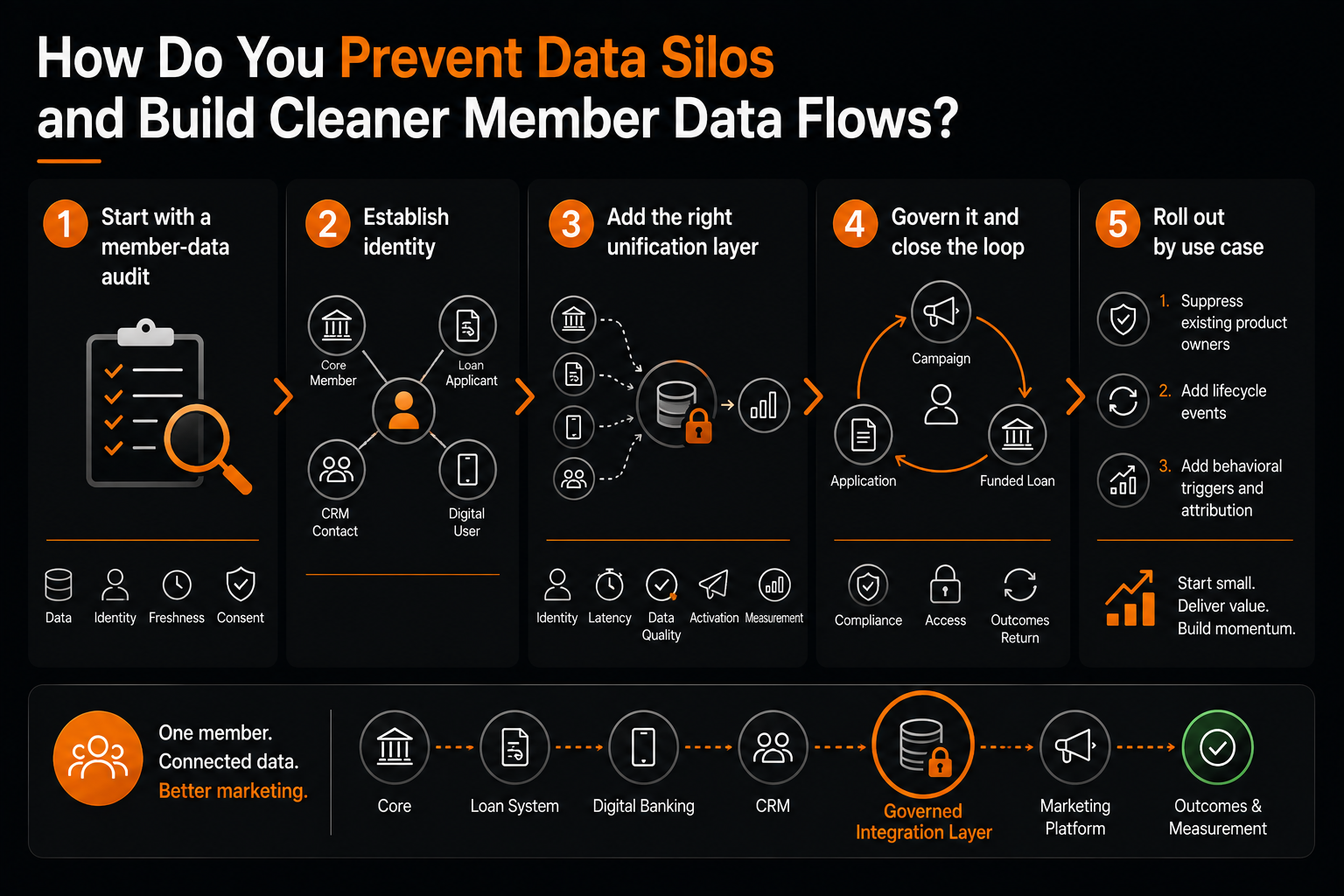
You prevent silos by designing the member data flow before you pick the connector. Give every member one shared identity and route your systems through a governed integration layer. Then, close the loop so that outcomes return for measurement. Five moves will get you there:

1. Start with a member-data audit, not a vendor demo

For every marketing-relevant field and event, capture what it means, which system owns it, what identifies the person, what interface is available, its current versus required freshness and what consent applies. Filene's implementation work is blunt on this: credit unions that discover their data requirements late in a project hit delays and bottlenecks.


2.  Establish identity before you add more campaign logic

Establish identity before you add more campaign logic. Build a shared key that ties the core member number, the loan applicant ID, the CRM contact and the digital user ID to one enterprise person. Think of it as a key ring, not a single magical record. Match records on stable, exact identifiers, the core member number first, rather than treating email as the universal key, because emails change and two people can share one. And mind the credit union wrinkle: a member number is not always one human being. Joint accounts, households and co-borrowers mean you must model the person, membership, account and household separately.


3. Add the right unification layer

This can be an integration hub, a data warehouse, a customer data platform (CDP) or a CRM like HubSpot. The label matters less than whether the architecture solves five things: identity, latency, data quality, activation and closed-loop measurement. One rule holds across all of them: do not dump raw core transactions into the marketing layer.

Publish the calculated attributes that marketing needs, a direct deposit flag, a balance band, a mortgage intent signal and an application stage. Keep the detail in a controlled store. Connect systems through one governed layer rather than a web of point-to-point links, the same hub-and-spoke logic that governs clean CRM data flow.


4. Govern it and close the loop

Move member data through a compliant path that honors opt-outs, limits access to what marketing needs and never forces a fallback to spreadsheets. Then, make outcomes flow back – campaign to application to funded loan – so you can finally measure ROI instead of clicks. This is where partner and platform selection matters and where the credit union HubSpot integrations that Mole Street builds are designed to land: around a shared member identity, a compliant flow and closed-loop attribution.


5. Roll out by use case, not "360-degree view" as a project

Trying to integrate every field before marketing gets value is how you end up in a multi-year program. Start by suppressing existing product owners and then add lifecycle events such as application abandonment and funded loan onboarding. Then, add behavioral triggers and closed-loop attribution. Let each use case set its own latency: a monthly propensity model can run nightly, but an abandoned application cannot. For the technical detail of connecting a core system to a CRM, see our guide on integrating a credit union core with HubSpot.

ChatGPT Image Aug 27, 2026, 11_04_31 AM

Fixing Data Silos Boils Down to One Shared Member Identity

A data silo is not a lack of data, and it is not an old core. It is the absence of three things: a common identity every system agrees on, a governed flow that keeps the data current and compliant and a loop that returns the outcome so that you can measure it.

Put those in place, give your systems a reason to agree on who the member is, connect them through one governed layer and close the loop back to funded loans. Marketing will stop working from a slice of the member and start working from the whole person. Campaigns will become relevant because the profile is complete. Triggers will fire on time because the data is current. And you can finally connect a message to a funded loan because the outcome comes back.

That is what cleaner member data flows buy you: a credit union that understands its members.

Frequently Asked Questions


Is a data silo the same as a data integration problem?

They're related but not identical. A data silo is the result of member data being trapped where marketing can't use it. Poor or missing integration is one of the main causes. You close the silo by fixing the integration, identity and data flow together.

Is a CDP the same as a CRM?

No. A CRM manages contacts, campaigns and service interactions. A customer data platform specializes in unifying data from many sources into a single profile and activating it. Some credit unions use a CRM like HubSpot as the unifying layer, while larger stacks add a dedicated CDP or a warehouse.

Do credit unions need a data warehouse to fix data silos?

Not always. Smaller stacks can unify member data through a CRM and disciplined integration. A warehouse becomes valuable when you have many systems to reconcile, a lot of transactional history or a need for one analytical source to feed every report.

Does the Gramm-Leach-Bliley Act require members to opt in before their data can go into a marketing platform?

Not in the way it's often assumed. Under Regulation P (the privacy rule now codified at 12 CFR Part 1016), a credit union can share member data with a service provider that markets the credit union's own products on its behalf without the ordinary opt-out, provided it gives the required notice, has a contract limiting the provider's use of the data and maintains the required safeguards. Members retain opt-out rights for certain other third-party sharing, and the credit union must honor opt-outs and protect the data. Confirm the specifics for your setup with compliance.

Can HubSpot unify member data for a credit union?

Yes, when it's integrated correctly. HubSpot can hold a unified member profile built on a shared member key, with member and account attributes flowing in through the core's API or middleware, so marketing works from one current view rather than a partial one.

Want to Take The First Step Forward to a Unified Tech Stack?