Websites were mainly static, the industry operated at a slower pace and the importance or accessibility of data consolidation hadn’t yet reached the forefront. Things are a bit different now. Much different. Businesses yearn for efficiency, strive for agility, and seek access to data seamlessly across the organization.
This is all because the modern day customer demands faster experiences. These new expectations have fossilized the enterprise CMS for many organizations, exposing a growing gap between what companies need and what these platforms are built to deliver. But what’s truly startling is the financial cost to run these large, monolithic, behemoths.
Most CFOs focus on the licensing fee, zeroing in on the numbers and assuming it represents the bulk of the expense. But take a step back, and a more complete picture emerges: one that includes mounting infrastructure costs, ongoing development retainers, disruptive upgrade cycles, and the revenue lost to slow marketing execution.
In this blog, we’ll break down the hidden costs of enterprise CMS platforms and show why they often take up far more budget and limit growth more than most CFOs expect.
Licensing Is Just the Tip of the Iceberg
The licensing cost will be one of the main topics of conversation when evaluating a CMS. Many businesses are weary of its financial implications, and rightly so. These platforms are expensive and will require a lot of financial investment.
According to Gartner, 75% of CMOs are under pressure to cut martech costs and prove ROI (2023). Yet many organizations continue to spend seven figures over three years without realizing how much of that goes toward the systems surrounding the license. In reality, this is only the tip of the iceberg.
Hidden Cost #1: Hosting & Infrastructure
Enterprise CMS platforms are resource-intensive. They require robust infrastructure, redundancy, CDNs, security, and 24/7 monitoring. Here’s what it really costs to keep an enterprise CMS online:
That $350K AEM license? Add $100K for managed hosting. You’re at $450K/year before you’ve built a single page.
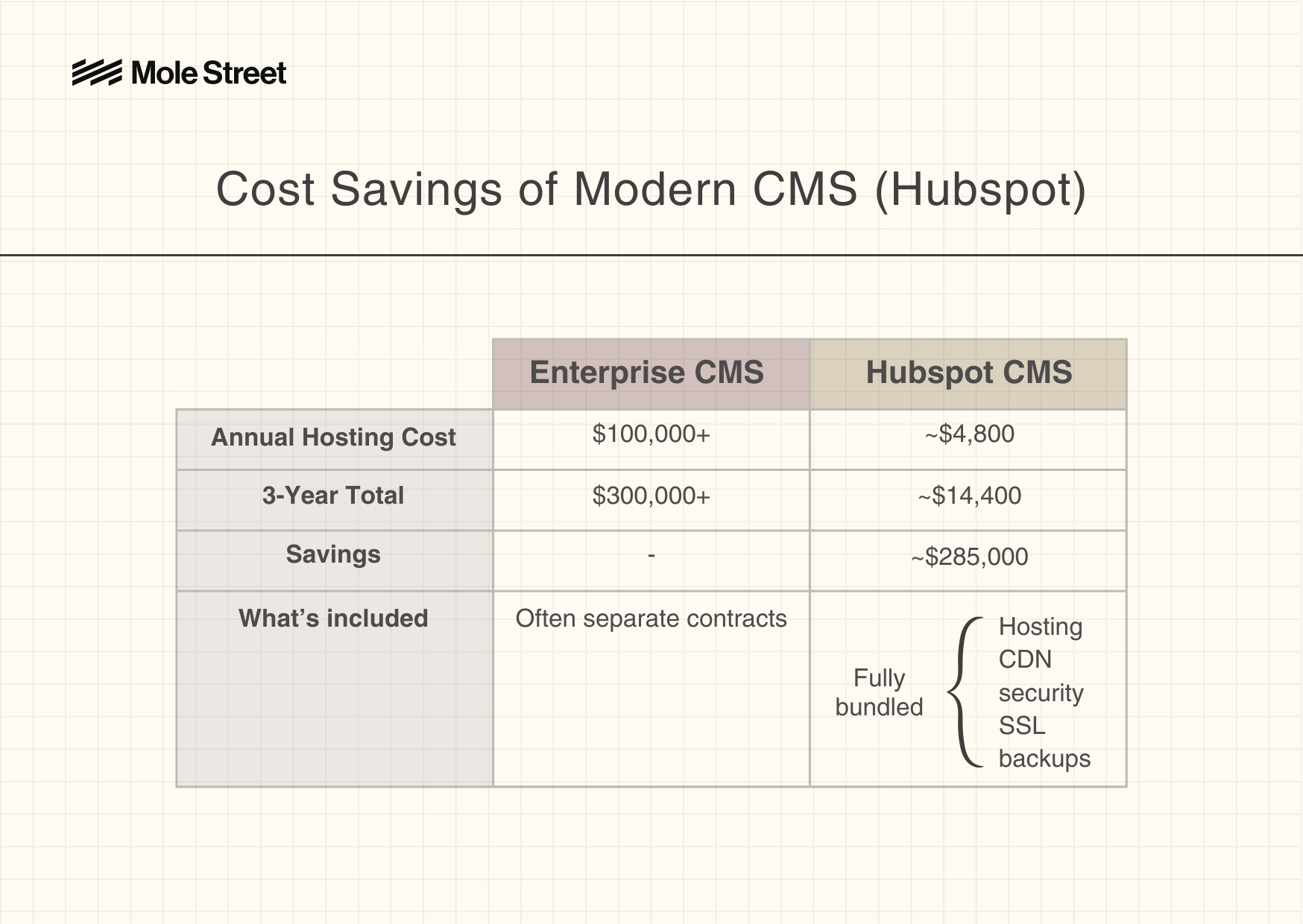
Cost Savings of a Modern CMS (HubSpot)
While enterprise platforms break infrastructure into separate (and expensive) line items, modern CMS platforms like HubSpot take a very different approach. Here’s how the costs compare:
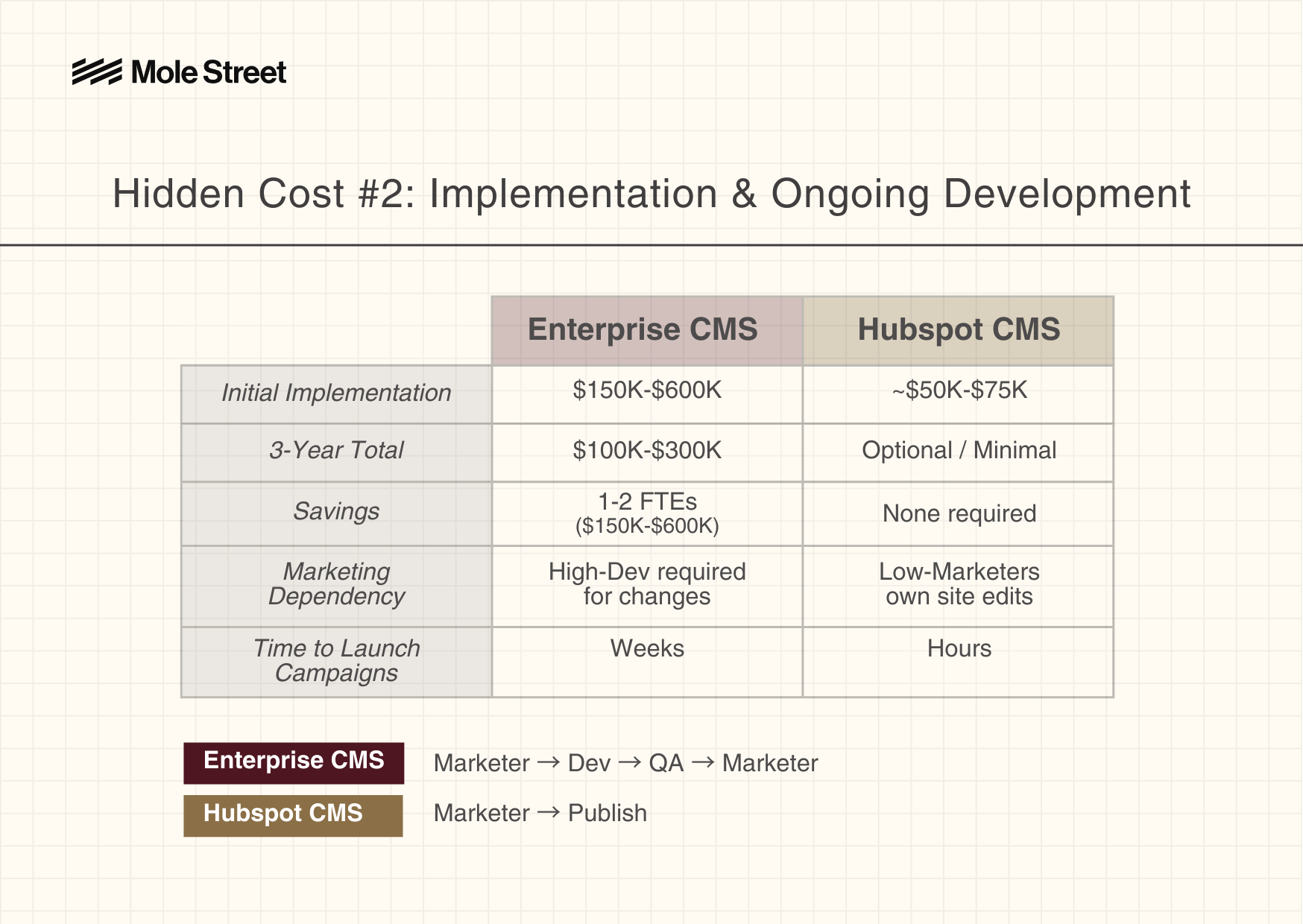
Hidden Cost #2: Implementation & Ongoing Development
Once you purchase your enterprise CMS, the next challenge is implementation, often a complex, resource-intensive process that requires specialized expertise. But the costs don’t end there. Ongoing maintenance, updates, and routine changes continue to strain your budget over time. So how does this compare to a platform like HubSpot?
Once you price in the costs of implementation & development, the total cost begins to rise far beyond the initial license fee. Therefore, businesses should revise alternatives like HubSpot offer greater agility with significantly lower long-term costs.
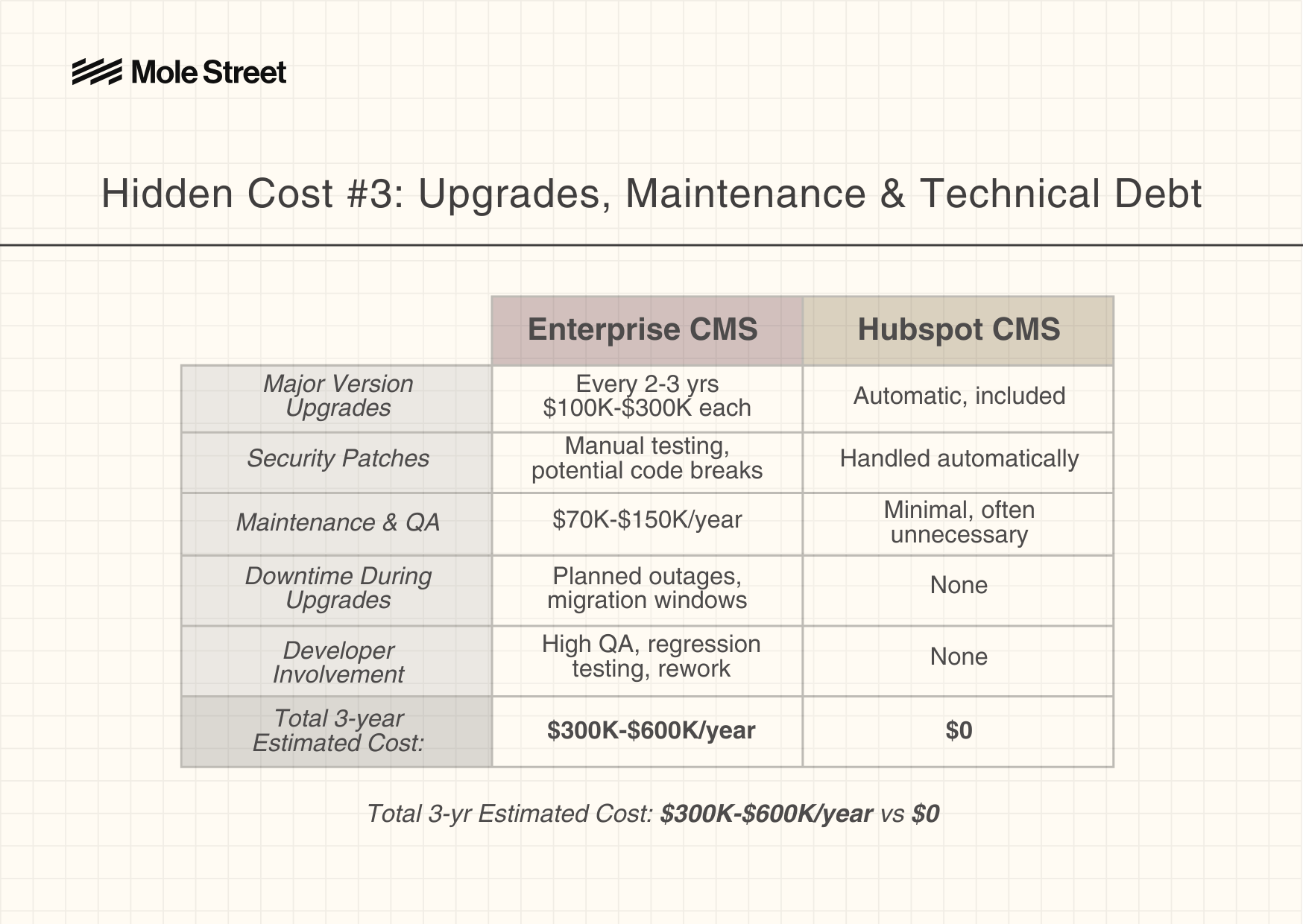
Upgrades on enterprise CMS platforms aren’t optional and they’re never simple. Every 2–3 years, teams face six-figure upgrade projects that require testing, code rewrites, migration planning, and developer support. Even routine patches can trigger regressions or break integrations, adding more unexpected cost.
Research highlights that technical debt consumes up to 40% of IT capacity in large organizations (McKinsey & Company, 2023), slowing innovation and draining resources from growth initiatives.
Modern CMS platforms like HubSpot handle upgrades automatically. This rewards you with a range of benefits, including no patches, no testing cycles, and no downtime. New features are deployed continuously, with zero lift from your team.
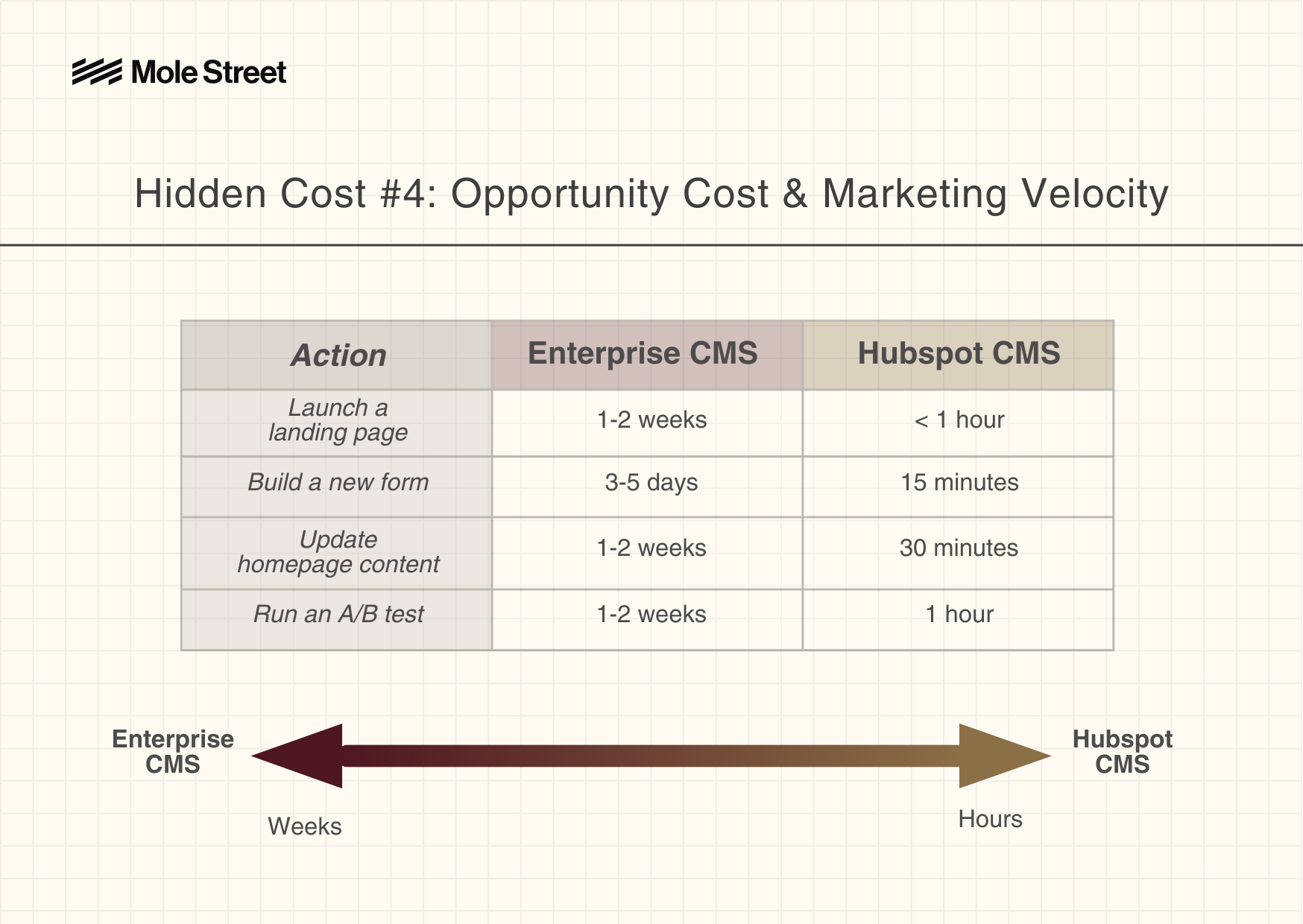
The cost of enterprise CMS isn’t always on the invoice. Sometimes, it shows up in slower campaigns, missed windows, and fewer experiments. Because marketers rely on developers to create pages, build forms, or launch tests, simple tasks can take days, or even weeks.
Speed is mandatory in sales and marketing. If you can react to market shifts faster than your competitors, you gain a clear advantage in capturing demand and driving growth.
HubSpot provides you with this agility by allowing marketers to launch pages, publish content, build forms, and run campaigns without waiting on developers.
And we haven’t even discussed HubSpot’s seamless go-to-market capabilities, where you can align sales and marketing teams, automate outbound motions, and connect seamlessly with prospecting tools.
According to Forrester (2024), just 35% of B2B marketing leaders expect their budgets to grow by more than 5% in 2025, with most anticipating a modest increase of only 1% to 4%. In a flat budget environment, the high ongoing costs of legacy CMS platforms become increasingly difficult to defend.
Total Cost of Ownership: Enterprise CMS vs. HubSpot
Licensing. Infrastructure. Implementation. Development. Upgrades. These all have individual costs but together, they compound into a total investment far greater than most teams plan for. Here’s how a typical 3-year total cost of ownership (TCO) compares:
The total potential cost of an enterprise CMS adds up to a whopping $2.46 over three years. What’s more, this doesn’t even factor in the cost of missed opportunities caused by the limitations of an enterprise CMS.
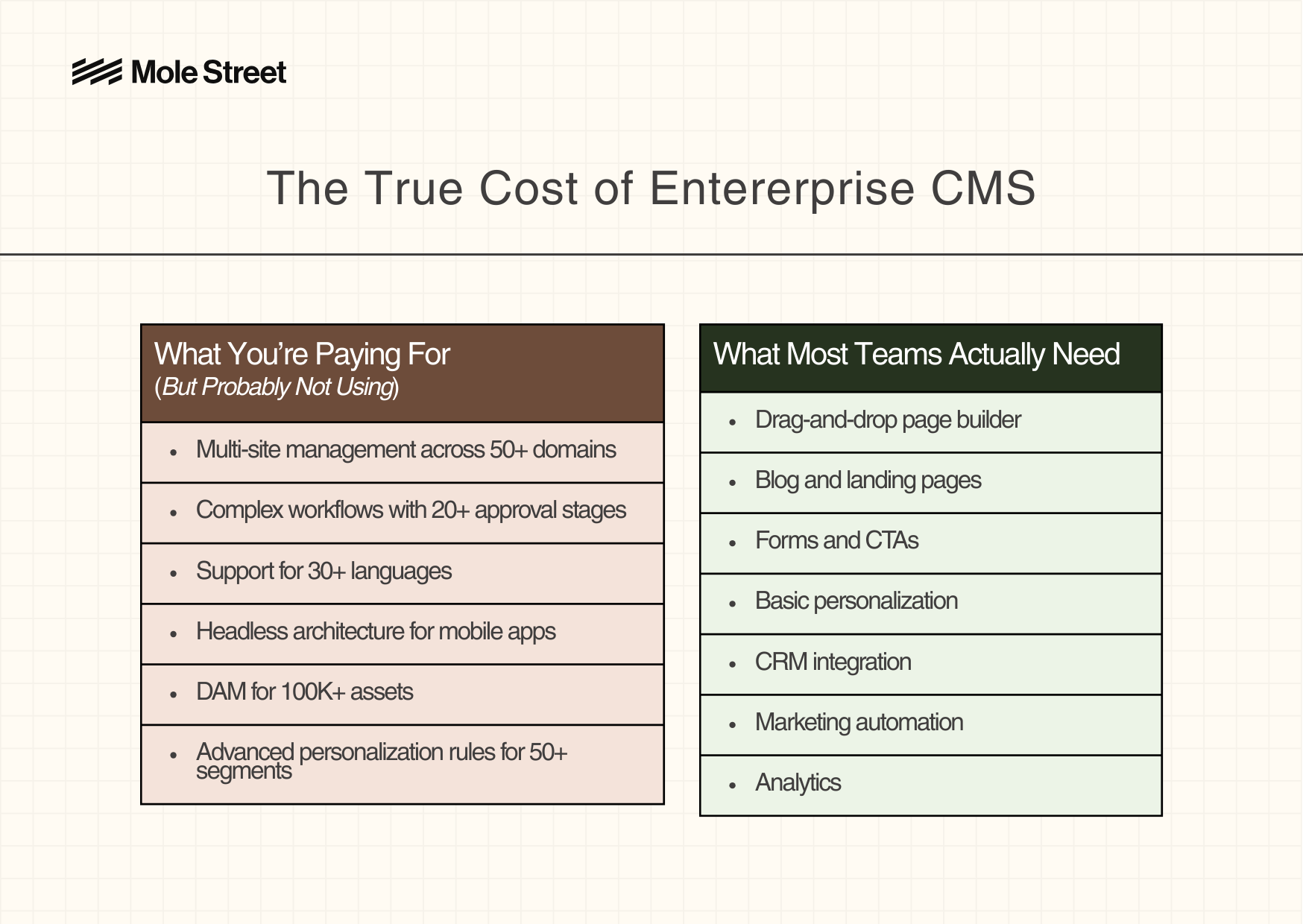
What Enterprise CMS Features Do Most Companies Actually Use?
Most companies only use a handful of core features in their enterprise CMS, such as a page builder, blog, forms, basic analytics, CRM integration, and simple personalization. Here’s how enterprise CMS features compare to what most teams truly need in practice.
Rethinking the Real Cost of Enterprise CMS
Enterprise CMS were designed for a different era and one where it could meet the demands of most businesses. We’re now in 2026 and the digital landscape is faster, more efficient, and more cutthroat.
Smaller businesses operating with one to three websites no longer need the weight of legacy systems built for global enterprises. What they need is speed, flexibility, and a platform that matches how modern marketing teams actually work without the excessive cost.
Where many go wrong is the false assumption that licensing fees represent the full cost of an enterprise CMS. Lift up the hood and you’ll find layers of hidden expenses such as hosting, development, upgrades, and delays that can push total costs as high as $2.6 million over three years.
Replatforming to HubSpot will not only reduce those costs significantly, but also give your team the speed and autonomy needed to execute faster and drive more growth.
How much faster could you achieve your goals with the right platform?
Want to Speak to a Specialist? Book a Strategy Call Now.
.png?width=1748&height=1240&name=1%20(1).png)
.png?width=1748&height=1240&name=2%20(1).png)
.png?width=1748&height=1240&name=9%20(1).png)
.png?width=1748&height=1240&name=4%20(1).png)