What commodity do most credit unions have in abundance but can't access, that has the capacity to transform growth? Data. Read any online business article and you’ll see publications stating that data is the new oil and how crucial it is to generating growth.
These proclamations are backed by hard evidence. Forward-thinking credit unions have developed a newfound superpower that sits at the core of their growth strategy: the ability to extract and utilize data to create exceptional member experiences through a comprehensive understanding of their members’ preferences, needs, and wants.
This allows you to align your services to their behaviours with pinpoint accuracy, a prerequisite for any credit union that wants to capture the interests of the younger generation. According to McKinsey & Company (2025), winning over younger, digitally savvy customers could represent a $5 billion to $10 billion revenue opportunity for credit unions.
In this blog, we’ll explore five ways top credit unions are using data to accelerate growth, deepen member engagement, and strengthen long-term loyalty.
1. Top Credit Unions Unify Their Data Stack to Eliminate Silos
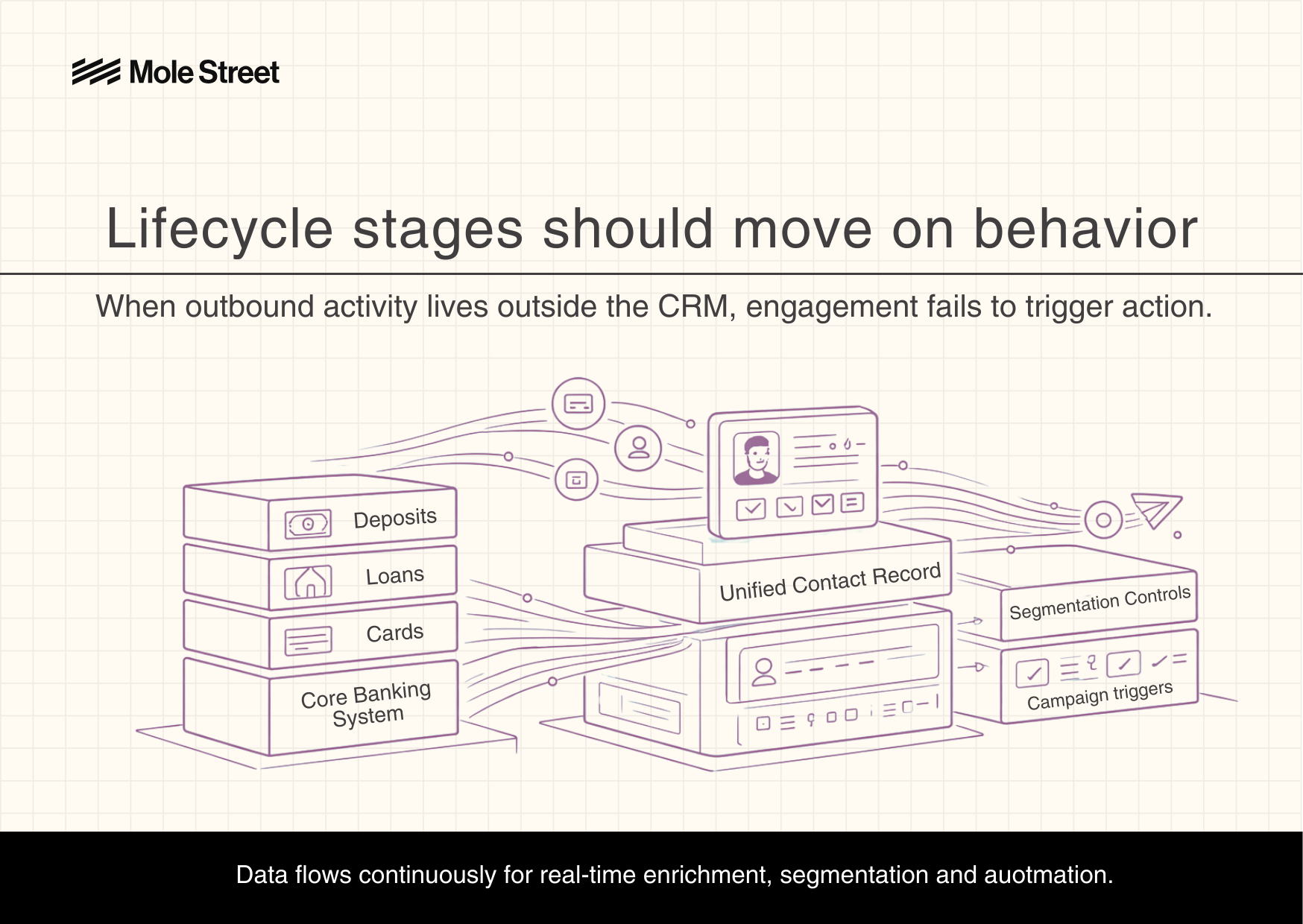
Consolidated data within a unified digital infrastructure is a high-yield asset that delivers exponential returns. This is how top credit unions frame their thinking. With such an asset, they gain real-time visibility into member behavior, accelerate campaign execution, and eliminate the friction that slows down decision-making and growth.
Marketing, sales, and service operations can access a unified source of truth that enables them to work as one cohesive unit, aligned in their march toward achieving overarching company goals.
This stands in stark contrast to the reality at many credit unions, where up to 75% still operate on legacy loan origination systems that lack true automation (Mckinsey & Company, 2025). As a result, processes remain slow and manual, and data is often outdated by the time it's put to use.
The consequences of data fragmentation is a topic that we explore in our blog “The Silent Growth Killer Inside Today’s Credit Unions.” Mole Street's client, PSECU, felt the full effect of its growth-inhibiting abilities until they unified their systems, achieving 100% team independence and significantly reducing member support calls.
Read the full case study here: How A $7B Credit Union Gained Data Control By Ripping Out Sitecore For HubSpot
2. Behavioral Data Replaces Demographics as the Marketing Standard
The sophistication of modern digital technologies has unlocked a level of analytical granularity that was previously out of reach. You can now segment members based on real-time actions like paying off a loan, abandoning an online application, or consistently maintaining high checking balances without a savings product. These behavioral cues reveal intent far more accurately than age or ZIP code.
The dichotomy between top performers and average performers underscores the strategic advantage of data-driven personalization and the commitment to meeting member expectations with precision. Above all, it’s a financially lucrative move.
According to Gartner, customers are 1.8 times more likely to pay a premium and 3.7 times more likely to purchase more than intended when they feel their experience is personalized (Gartner, 2025).
3. Top Credit Unions Prioritize Lifetime Value Over One-Off Campaign Metrics
Long-term thinking is valued for its ability to embrace short-term tradeoffs in pursuit of lasting gains. It’s a skill we all know yields a high ROI, yet many credit unions fail to adopt this way of strategic thinking. Those that do avoid being pulled into the vortex of isolated campaigns and frivolous vanity metrics, and instead channel their focus toward building deeper, more valuable member relationships over time.
The Top Performer Approach
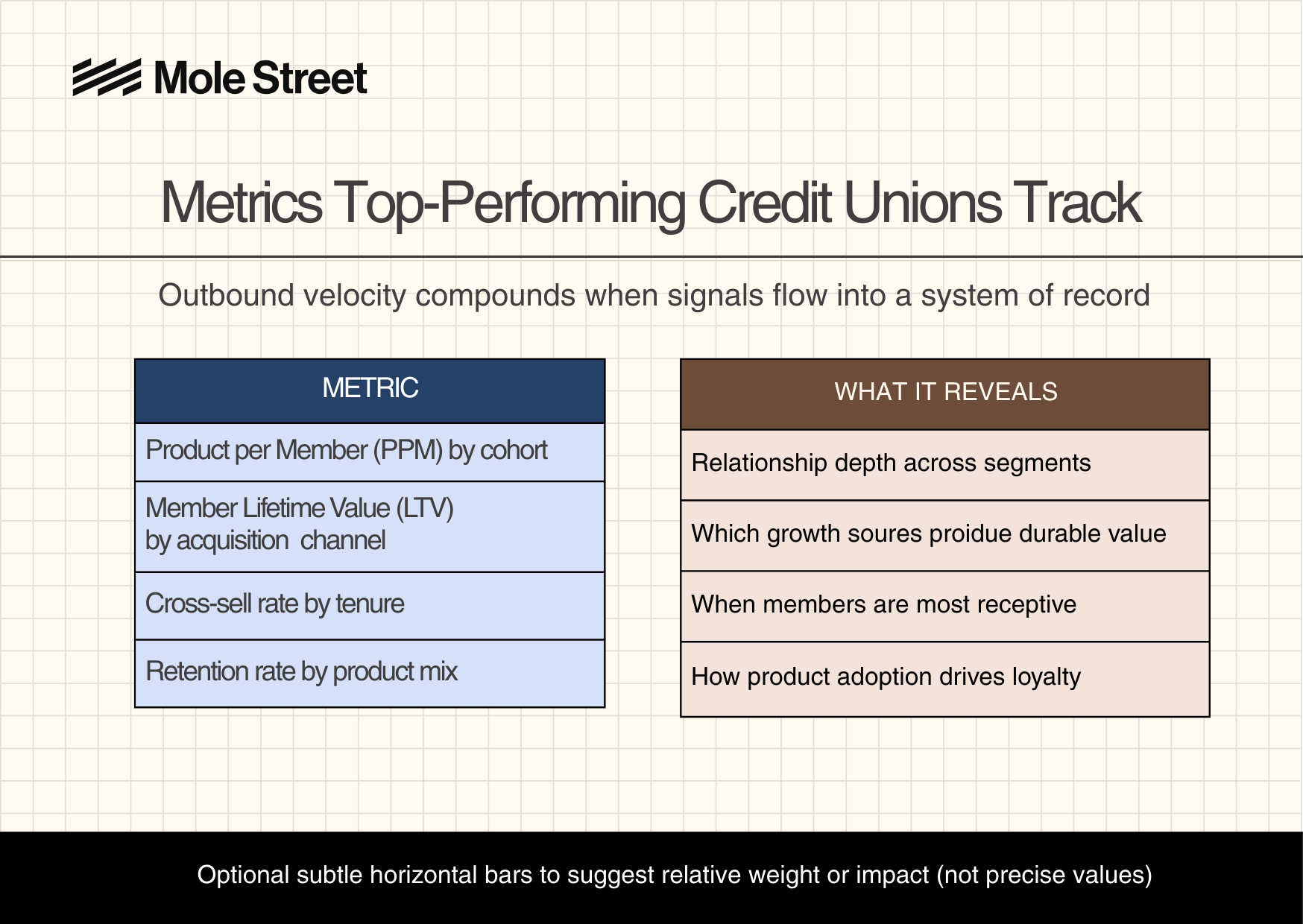
Leading credit unions quantify the value of deeper member relationships, such as comparing the lifetime value of a member with both a checking account and a mortgage to one with only checking.
They use these insights to design campaigns that move members up the value ladder. This loyalty-focused mindset matters, as companies with a strong loyalty effect grow at more than twice the industry average.