The 2026 Bank CRM Rollout Playbook: How to Drive Adoption Across Marketing and Sales
In an era where banks are drowning in data and saturated with SaaS tools, an effective CRM has never been so crucial to providing a service that satisfies the modern-day customer.
This is especially true for banks, where a personalized service isn’t expected; it’s demanded. Data is at the core of personalization, requiring sales and marketing teams to work in sync from the same accurate, accessible data, not their own separate versions of the customer.
A powerful CRM will help you achieve this. Obtaining one is the first step. Having your teams adopt it is the second. Unfortunately, CRM adoption is where many banks struggle, often because it is hard to use and no real change management process was put in place.
If you lead marketing or revenue operations at a bank, this rollout is yours to get right. The pipeline, the reporting, and the marketing-to-sales handoff all run through the CRM, so when adoption stalls, your targets stall with it.
In this blog, you will discover:
-
CRM implementation challenges in financial institutions: why they come down to fragmented data and human behavior, not the feature list you compared during the demo
-
The marketing and sales divide: why the two teams stall on separate definitions of the same customer, and what it costs you
-
A 6-step change management playbook: the exact sequence for a mid-sized bank CRM rollout, from executive sponsorship to measured adoption
What Is a Bank CRM Rollout, and Why Is It Different From a Software Install?
A bank CRM rollout is the process of deploying a customer relationship management system across a financial institution and moving its marketing, sales, and service teams onto one shared view of every customer.
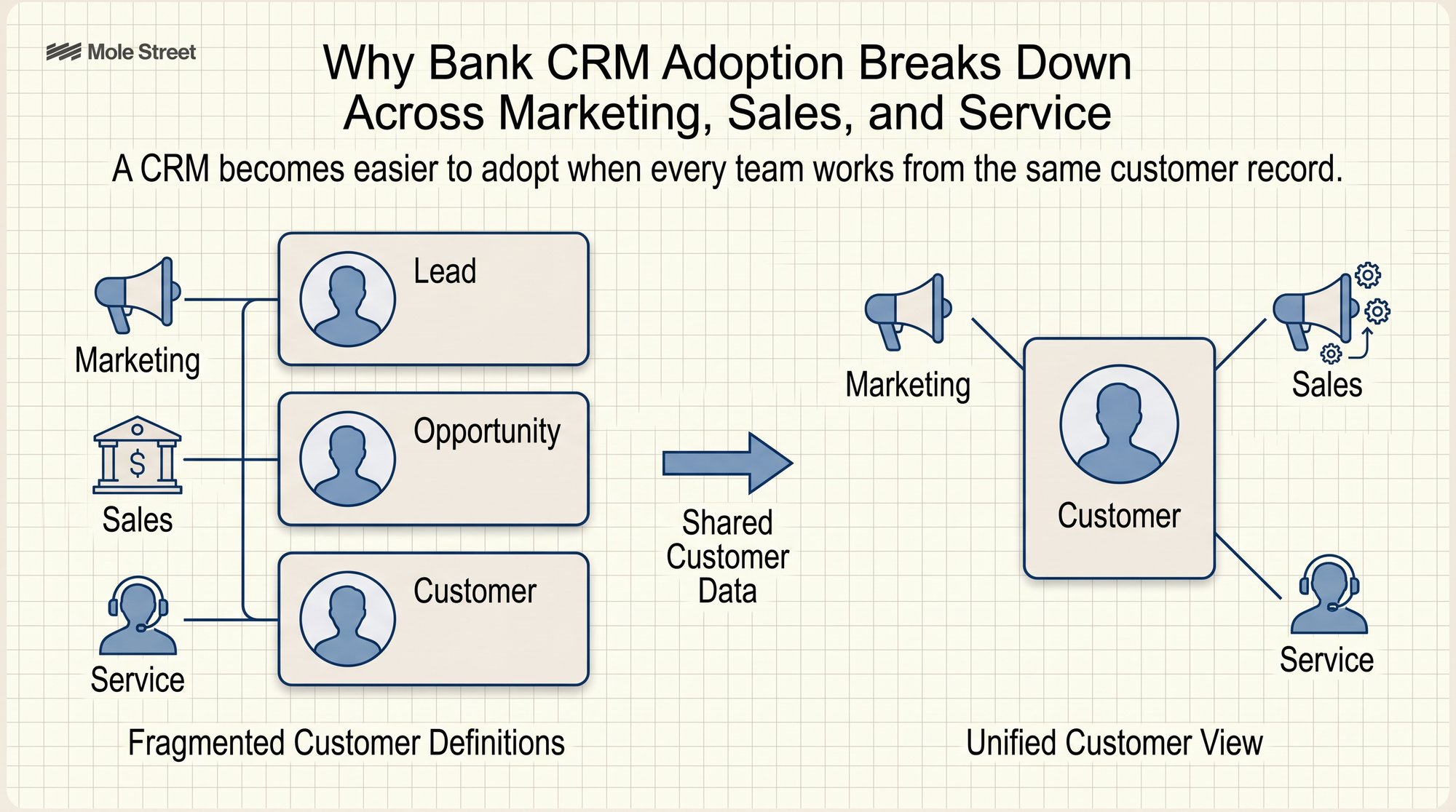
Imagine every siloed system in your tech stack reconciled into a single customer record. Now imagine marketing, sales, and service all working from that same record at the same moment, collaborating as one unit instead of trading spreadsheets to learn what the others already know.
Consolidating that data is the foundation of every effective bank CRM, and it is what Mole Street builds for financial institutions.
This is also why a bank CRM rollout is not a simple software install. Three things set it apart:
- The customer is scattered: one person exists as a checking account in one system, a mortgage in another, a service ticket in a third, and a marketing record in a fourth, and the rollout has to reconcile them into a single record before the CRM means anything.
- The bank is regulated: every field, message, and data flow has to satisfy audit, privacy, and governance requirements, so that work belongs in the plan from day one.
- The people have habits: relationship managers who hit their numbers on spreadsheets and instinct will not switch for nicer screens, they move when the change is led.
What Are the Key Features and Benefits of a Banking CRM?
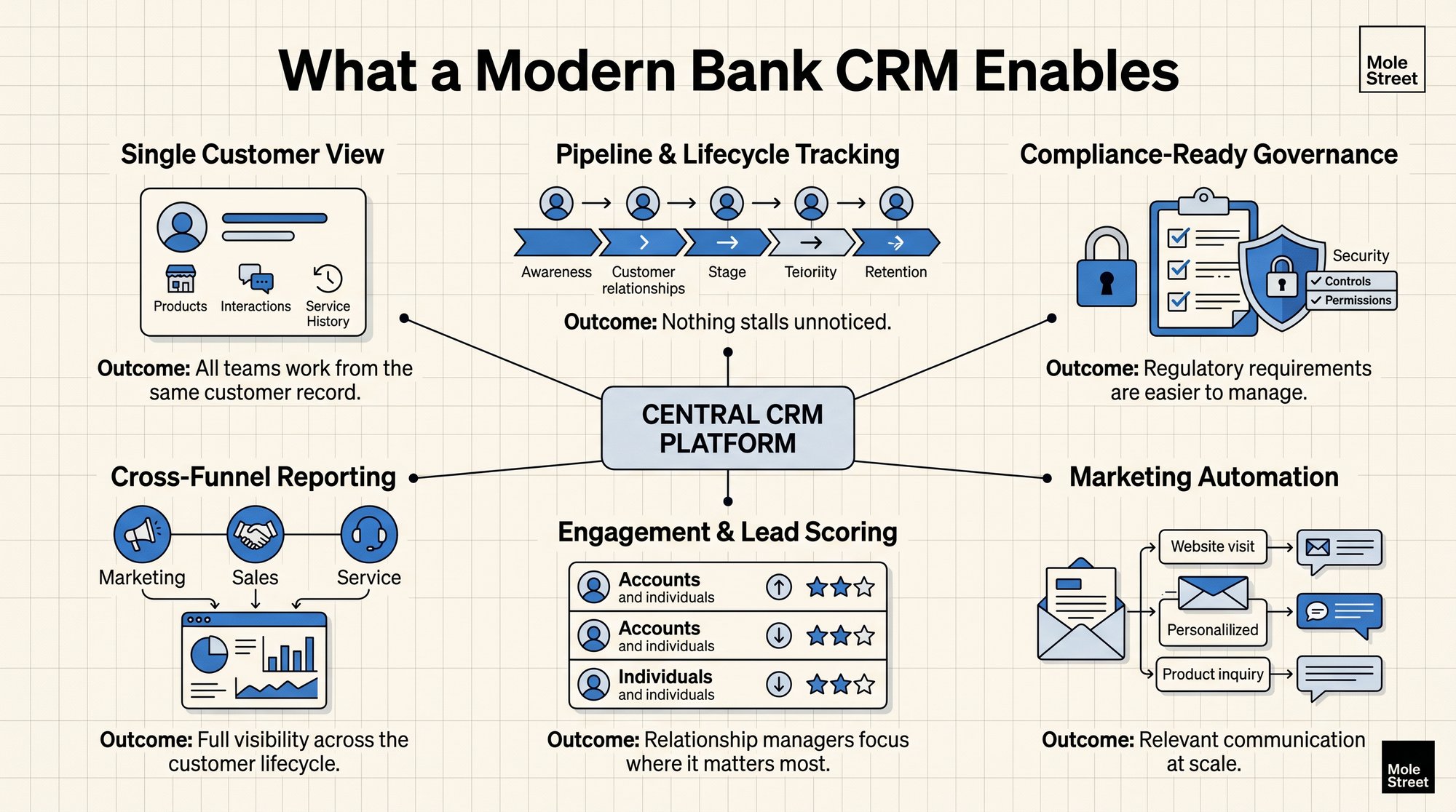
A banking CRM is a system that unifies customer data across products, channels, and teams into one record that marketing, sales, and service can all act on. At Mole Street, clients often have a big sigh of relief after their CRM implementation.
Nobody wants to waste time tediously chasing hidden insights and manually piece together a customer's full story from half a dozen disconnected systems every time they need an answer. They want the complete picture already in front of them, ready to act on.
| Feature | How it Improves Performance |
| Single customer view | Every product, interaction, and service event on one record, so no team works from a partial picture |
| Pipeline and lifecycle tracking | Deals and relationships tracked through defined stages, so nothing stalls unnoticed |
| Compliance-ready governance | Field-level permissions and audit trails that satisfy regulators without a fire drill |
| Marketing automation | Triggered, segmented outreach tied to real customer behavior |
| Engagement and lead scoring | Accounts ranked by genuine intent, so relationship managers focus where it counts |
| Cross-funnel reporting | Marketing contribution and sales activity side by side, so cross-sell becomes visible |
What Makes CRM Implementation Hard for Mid-Sized Financial Institutions?
CRM implementation is hard for mid-sized financial institutions because their customer data is fragmented, their core systems are dated, compliance slows the build, and their employees resist the change.
There’s a lot there to unpack. But one could argue that data fragmentation is the biggest challenge that banks struggle to overcome. Financial services institutions run an average of 1,026 applications, and 81% of IT leaders say data silos hinder digital transformation (MuleSoft Connectivity Benchmark Report, 2024).
Banks feel this acutely: more than three-quarters plan to increase their data-management investment, yet only a quarter say their data platforms are ready for the AI tools they are buying (Deloitte, 2025).
A bank is the extreme case, where the same customer exists as a checking account in one system, a mortgage in another, a service ticket in a third, and an email record in a fourth.
This is why fragmentation sits beneath the other three challenges. Compliance, integration, and adoption all get harder when there is no single reconciled record to work from.
Why Do Banks Struggle With CRM Implementation Across Marketing and Sales?
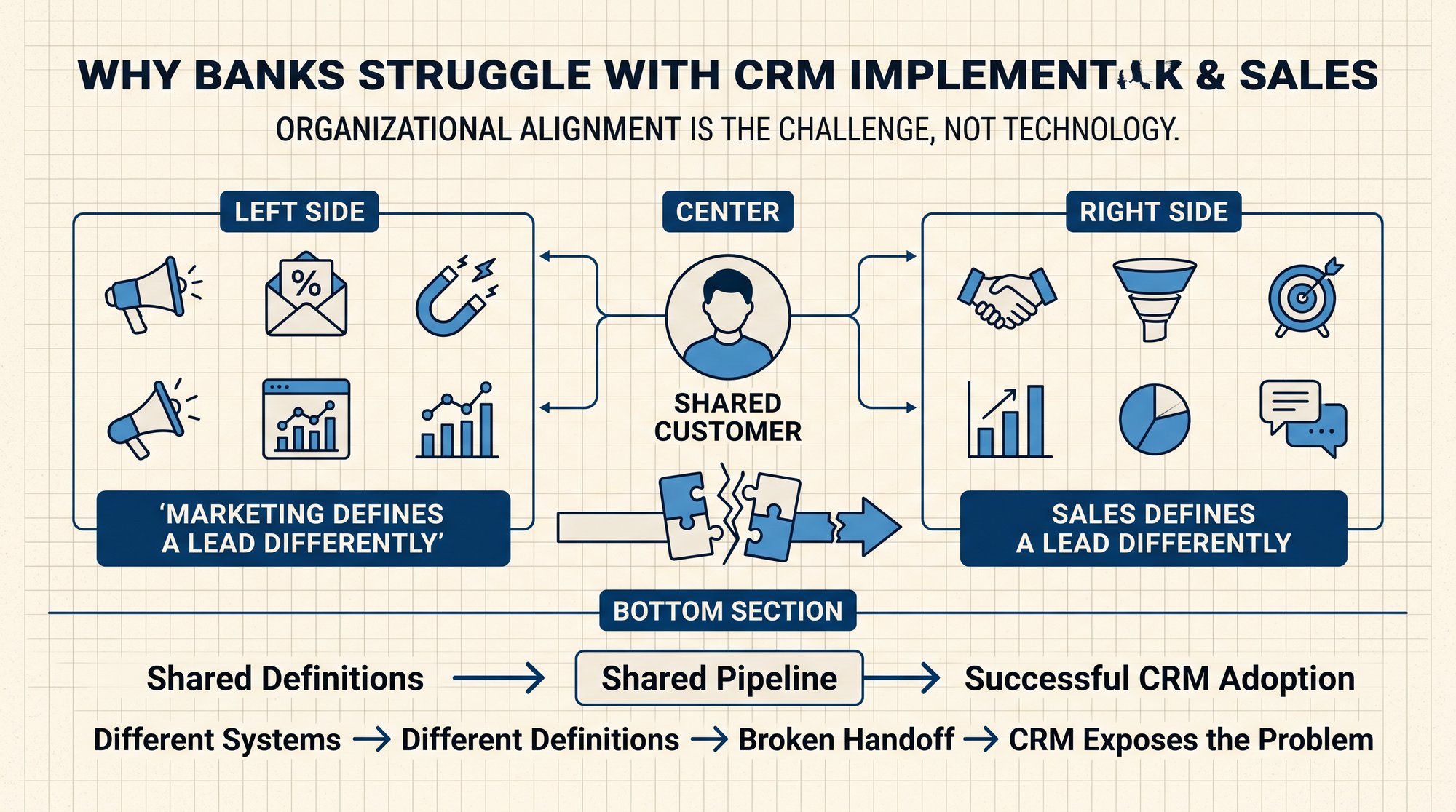
Banks struggle with CRM across marketing and sales because marketing and sales each run on their own systems, their own definitions, and their own incentives. A single CRM forces them onto shared ground for the first time, a reconciliation most banks have avoided for years.
So what exactly is the problem here?
The two teams do not define the customer the same way. Marketing counts a lead as someone who downloaded a mortgage guide. Sales counts a lead as someone ready for a rate conversation. When those definitions never meet, the handoff breaks, and good prospects sit untouched while each team assumes the other has them.
A CRM does not fix that disagreement. It just puts it on a bigger screen. Marketing logs its leads, sales works a different set, and the report at the end of the quarter shows two versions of the truth.
The cost of running two teams on two screens is measurable. Forrester found in 2024 that customer-obsessed companies, the ones that coordinate around the customer instead of around the org chart, grow revenue 28% faster, with 33% higher profitability growth and 43% better customer retention than their peers (Forrester, 2024).
This is why a bank CRM rollout cannot be owned by IT alone. It is a revenue operations decision about how marketing and sales will share a pipeline, a vocabulary, and a definition of success. Settle that agreement first. The configuration is downstream of it.
How Do You Lead Change Management for a Bank CRM Rollout?
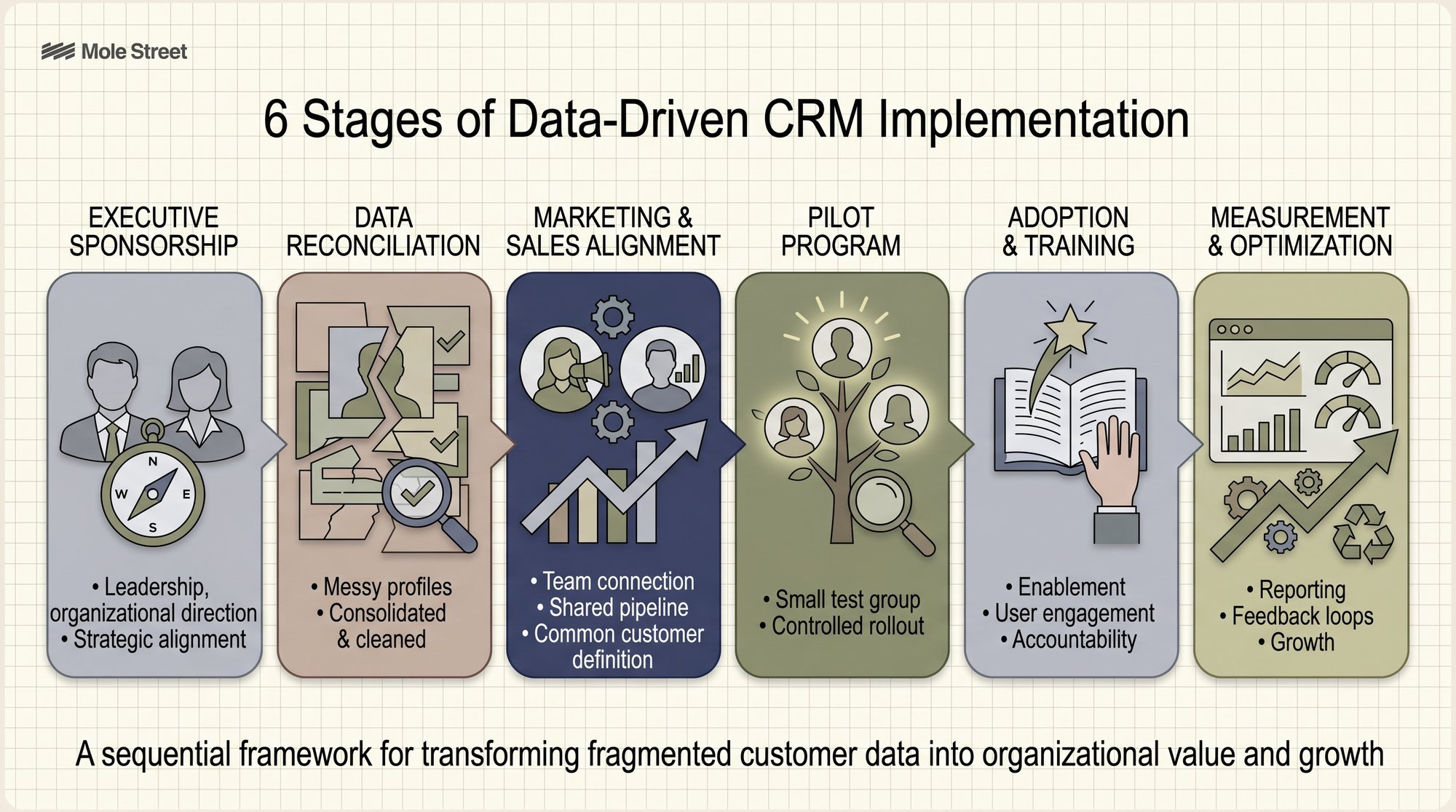
You lead a bank CRM rollout by sequencing it as six stages: secure sponsorship, reconcile the data, align marketing and sales, pilot before scaling, drive adoption, then measure and iterate. Skip a stage and the rollout regresses to the one you skipped.
Step 1: Secure Executive Sponsorship and Write the Change Narrative
Name an executive owner before you name a platform. A CRM rollout with no visible sponsor reads as an IT initiative, and IT initiatives are easy to ignore. Write one paragraph that answers the question every relationship manager is asking: what does this change for me on Monday? If you cannot answer it, the rollout is not ready to start.
Step 2: Reconcile the Data Before You Migrate It
Do not migrate the mess. Audit every source system, define the golden record for each customer, and resolve duplicates and conflicts before a single field moves. This is the step teams compress to save time, and it is the step that decides whether anyone trusts the CRM in month three. A relationship manager who finds one wrong phone number stops trusting every record on the screen.
Step 3: Align Marketing and Sales on One Pipeline and One Definition
Get marketing and sales in a room before configuration to agree on the lifecycle stages, the definition of a qualified lead, and the exact moment a lead becomes the sales team's responsibility. Document it. This agreement is the spine of the whole system, and it is a human negotiation, not a settings menu.
Step 4: Pilot With One Team Before You Scale to the Bank
Run the CRM with a single branch or product line first. A pilot surfaces the integration gaps and adoption friction at a survivable scale. Fix them with ten users, not five hundred, then expand with evidence and early advocates instead of a mandate.
Step 5: Drive Adoption Through Training, Incentives, and Accountability
Adoption is engineered, not hoped for. Tie CRM usage to the metrics each team already cares about, train people on their actual daily workflow rather than the full feature catalog, and make the data visible in the meetings where decisions get made. When the CRM is where the pipeline review happens, logging activity stops being optional.
Step 6: Measure Adoption and Iterate in Public
Track usage, data completeness, and pipeline velocity from day one, and report the numbers openly. A rollout that goes dark after launch tells everyone the change was a project, not a new way of working. Keep it visible. Keep refining it.
Which CRM Is Best for a Mid-Sized Bank?
The best CRM for a mid-sized bank is the one that unifies marketing, sales, and service on a single data model with the least adoption friction, which for most mid-sized institutions points to HubSpot. The comparison below frames the trade-offs.
| Factor | HubSpot |
|
|
||
| Data model |
Single unified model across marketing, sales, service |
Powerful, but often assembled from multiple clouds |
Flexible, deeply tied to the Microsoft stack |
||
| Adoption |
Fast, intuitive interface, lower training burden |
Steeper learning curve, heavier admin |
Moderate, familiar to Microsoft-native teams |
||
| Integration | Native marketing-to-sales integration out of the box |
Strong, frequently needs configuration or partners |
Strong within the Microsoft ecosystem |
||
| Best-fit size |
Mid-sized institutions wanting speed to value |
Large, complex institutions with dedicated admins |
Banks already standardized on Microsoft |
Unfortunately, the honest answer starts where every consultant's answer starts: it depends on your circumstances. No single CRM is best for every institution. Your bank has its own needs, and the right CRM is the one built to meet them.
In our work with banks, HubSpot has let us put marketing, sales, and service onto a single customer record, without the year of configuration that heavier platforms demand.
How Does HubSpot Support a Bank CRM Rollout?
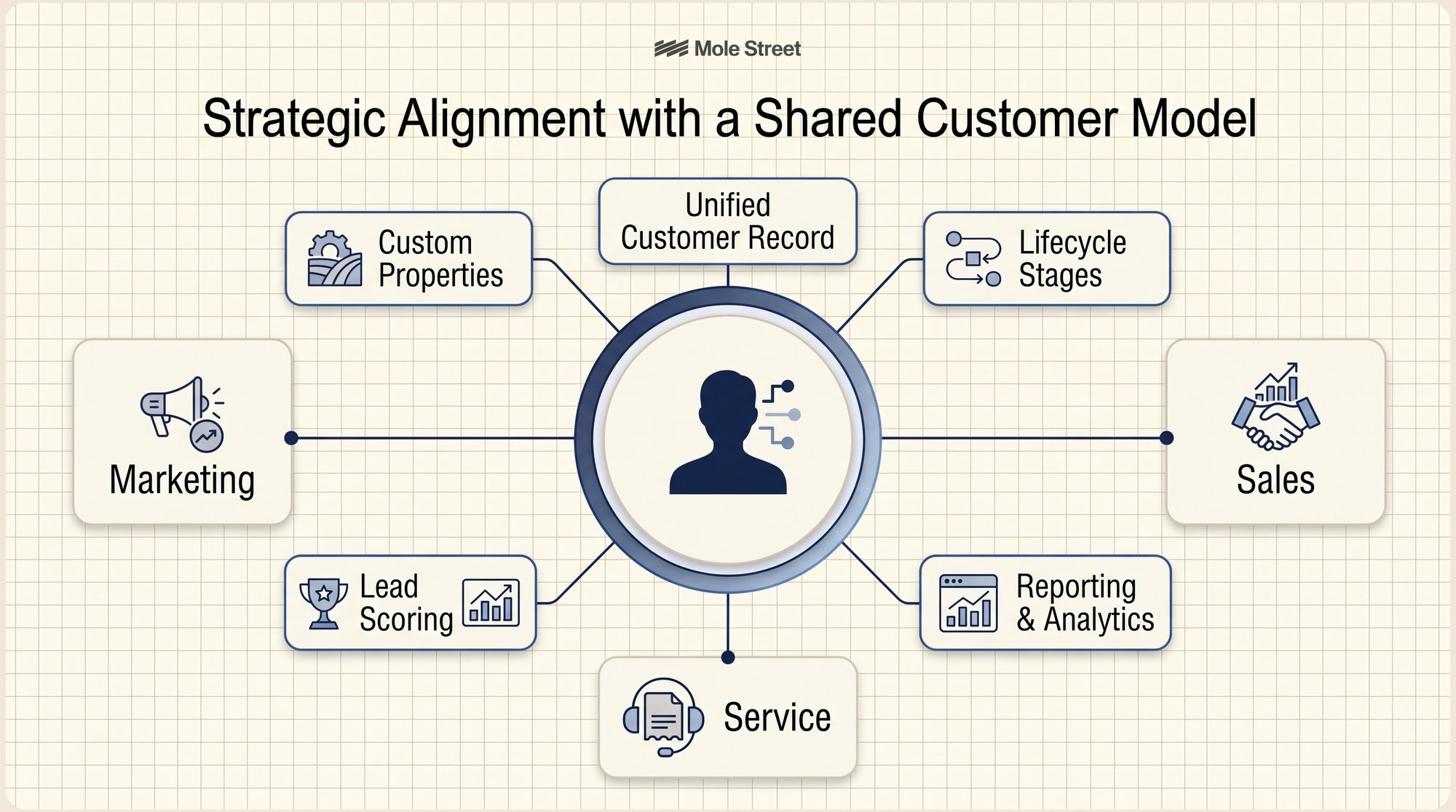
HubSpot supports a bank CRM rollout by giving marketing, sales, and service one shared data model, so the integration and alignment problems that sink most projects are designed out rather than patched over. The platform is built around the exact reconciliation a bank is trying to force.
In practice, that means:
- A unified customer record: marketing engagement, sales activity, and service history attach to one contact, so the single customer view lives in the data model instead of in a report someone rebuilds every quarter
- Custom contact and deal properties: tag every customer with products held, originating branch, relationship manager, and lifecycle stage, so marketing and sales finally read from the same definitions
- Lifecycle stages and shared pipelines: encode the Step 3 agreement directly into the system, so the handoff from marketing-qualified to sales-ready becomes a tracked event, not a forwarded email
- Engagement and lead scoring: score customers on real interaction signals so relationship managers spend their hours on the accounts most likely to convert
- Native cross-funnel reporting: dashboards that show marketing's pipeline contribution and sales follow-up rates side by side
Ultimately, HubSpot’s user-friendly interface and intuitive design naturally makes it a lot easier for users to adopt. Notwithstanding that, this does not devalue the significance of following an effective change management process.
As an Elite HubSpot Solutions Partner, Mole Street architects the platform and leads the rollout so both work together. Click here to find out more about Mole Street’s HubSpot implementation services.
How Can a HubSpot Partner Help With a Bank CRM Implementation?
A HubSpot partner helps a bank CRM implementation by handling the work most banks have never done before: aligning the teams, cleaning the data, and onboarding people so the system is trusted from day one.
As an Elite HubSpot Solutions Partner, Mole Street leads each stage of the rollout:
- Discovery and planning: we align stakeholders across marketing, sales, and service before any build, so the CRM is shaped around how your bank actually operates
- Data migration: we cleanse, map, and migrate records to remove duplicates and errors, so teams trust the data on day one
- Configuration and compliance: we build pipelines, workflows, and reporting with the permissions and audit controls a regulated bank requires
- HubSpot Integration: we connect HubSpot to your core systems and existing tools, so the single customer record actually holds
- Training and onboarding: we run hands-on onboarding tailored to each team's daily workflow, which is what turns a launch into real adoption
How Is AI Changing CRMs in Banking in 2026?
AI is changing CRMs in banking from a system of record to a system that proactively predicts customer needs.
But how so exactly?
For example, HubSpot can help gather, consolidate, and analyze your data to predict which customers are ready for a loan, which are about to leave, and which to call first.
As a whole, we can say with confidence that there are three shifts reshaping the banking CRM in 2026:
- Generative and agentic AI: drafting customer outreach, summarizing a full relationship history in seconds, and surfacing the next best action for a relationship manager
- Predictive lead and churn scoring: flagging cross-sell moments and at-risk accounts before a human would notice them
- Open banking data: feeding richer, fuller customer profiles into the CRM as data-sharing rules mature
Every one of these depends on the same thing: clean, connected customer data. That is exactly what the playbook's data-reconciliation step builds. AI is not a shortcut around the change work, it is the reward for doing it.
How Can a HubSpot Partner Help With a Bank CRM Implementation?
A HubSpot partner helps a bank CRM implementation by handling the work most banks have never done before: aligning the teams, cleaning the data, and onboarding people so the system is trusted from day one.
As an Elite HubSpot Solutions Partner, Mole Street leads each stage of the rollout:
- Discovery and planning: we align stakeholders across marketing, sales, and service before any build, so the CRM is shaped around how your bank actually operates
- Data migration: we cleanse, map, and migrate records to remove duplicates and errors, so teams trust the data on day one
- Configuration and compliance: we build pipelines, workflows, and reporting with the permissions and audit controls a regulated bank requires
- HubSpot Integration: we connect HubSpot to your core systems and existing tools, so the single customer record actually holds
Training and onboarding: we run hands-on onboarding tailored to each team's daily workflow, which is what turns a launch into real adoption
How Is AI Changing CRMs in Banking in 2026?
AI is changing CRMs in banking from a system of record to a system that proactively predicts customer needs.
But how so exactly?
For example, HubSpot can help gather, consolidate, and analyze your data to predict which customers are ready for a loan, which are about to leave, and which to call first.
As a whole, we can say with confidence that there are three shifts reshaping the banking CRM in 2026:
- Generative and agentic AI: drafting customer outreach, summarizing a full relationship history in seconds, and surfacing the next best action for a relationship manager
- Predictive lead and churn scoring: flagging cross-sell moments and at-risk accounts before a human would notice them
- Open banking data: feeding richer, fuller customer profiles into the CRM as data-sharing rules mature
Every one of these depends on the same thing: clean, connected customer data. That is exactly what the playbook's data-reconciliation step builds. AI is not a shortcut around the change work, it is the reward for doing it.
The Right CRM and the Right Partner Make Adoption Easier
The success of a bank CRM rollout hinges on two elements: the right CRM and well-led change. The CRM market has exploded in recent years and is currently worth US$109.07bn (Statista, 2026). Its increase in demand has inevitably led to many CRMs being deployed onto the market, making it challenging to cherry-pick the best one for your business.
The Right CRM and the Right Partner Make Adoption Easier
The success of a bank CRM rollout hinges on two elements: the right CRM and well-led change. The CRM market has exploded in recent years and is currently worth US$109.07bn (Statista, 2026). Its increase in demand has inevitably led to many CRMs being deployed onto the market, making it challenging to cherry-pick the best one for your business.
Mole Street has worked with many clients in the banking and financial space, and HubSpot has been transformative for their business:
-
Unified data: fragmented records pulled into a single customer view
-
Connected teams: marketing, sales, and service working from one record
-
Real adoption: the day-to-day usage that turns the platform into results
But the right platform is only one of the two elements. The second is a well-led change, and that is where a partner who has done this before earns its place. We clean the data, align marketing and sales, and onboard teams so the system is trusted from day one rather than worked around.
Get this right and you deliver the personalized service modern customers demand, because every team finally works from one accurate view of the customer.
And what does this lead to?
Cleaner data. Tighter alignment between marketing and sales. And a bank that finally sees its customer as one relationship, ready for the AI-driven decisions ahead.
Want to find out more about our HubSpot services for banks? Book your consultation now
Frequently Asked Questions
How long does a CRM implementation take at a mid-sized bank?
A focused rollout typically runs three to six months for core configuration and data migration, with adoption maturing over the following six to twelve months. The platform setup is fast. The behavior change is the long pole.
Who should own a bank CRM rollout, IT or RevOps?
Revenue operations should own the outcome, with IT owning the integration and security work. CRM is a decision about how marketing and sales operate, so the owner has to be accountable for revenue, not just uptime.
What is the most common reason bank CRM rollouts fail?
Poor user adoption, driven by skipped change management. The system works as built, but the people it was built for were never given a reason or a workflow to use it.
How do you measure CRM adoption in a financial institution?
Track active daily users, data completeness on key records, logged activities per relationship manager, and pipeline velocity. Adoption is a behavior, so measure the behavior, not the login count.
Can a mid-sized bank integrate a CRM with a legacy core banking system?
Yes, through middleware or API connectors, but the integration depends on the age and openness of the core. Audit the core's data access early, because it sets the ceiling for what the CRM can show.
Does HubSpot work for regulated financial institutions?
Yes. HubSpot supports the permissions, audit trails, and data governance controls that regulated environments require, which is why the compliance review belongs in the rollout plan from the start.
By: Harry Maule