How Core Banking Data Silos Are Costing Credit Unions Millions
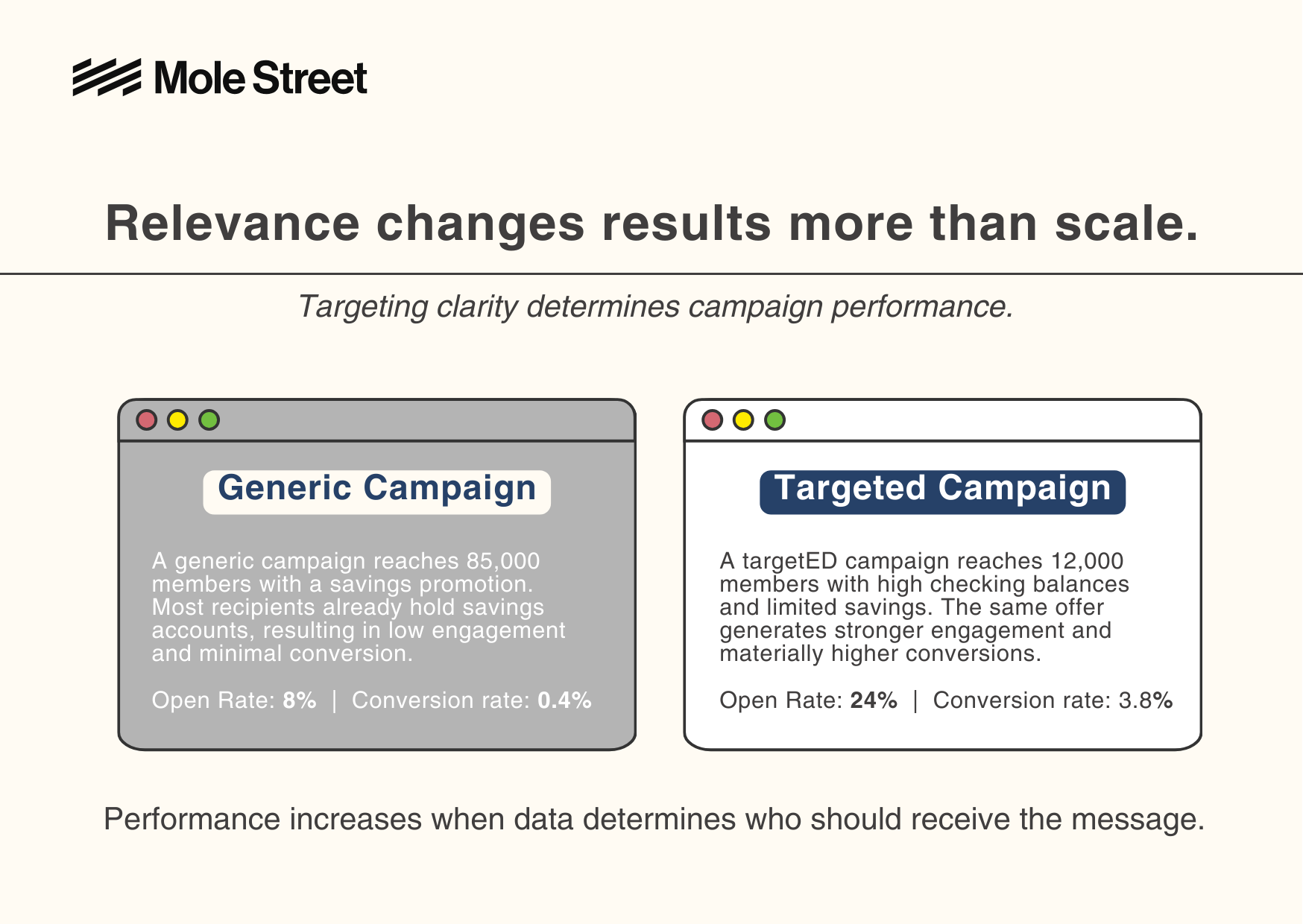
Imagine running a credit union with 85,000 members, but your marketing team can’t tell you which members have auto loans. They can’t segment by account balances, product holdings, or tenure. Every email campaign you send is a generic blast to the entire membership base.
Most credit unions are sitting on a goldmine of member insights, but data silos and fragmented systems keep that value locked away. Teams know the data exists and how powerful it could be, yet they can’t access it to drive meaningful, data-driven marketing.
The cost of inaction is significant. While your core banking system holds complete, accurate information about every member’s financial life, your marketing platform sees only email addresses and basic demographics.
That disconnect creates a ripple effect of consequences: missed cross-sell revenue, wasted marketing spend, delayed campaigns, and a growing competitive disadvantage as banks and fintechs race ahead with integrated systems.
What Your Core Banking System Already Knows About Members
Your core banking platform contains the most complete and accurate picture of your members’ financial lives. Systems like Symitar, DNA, and Corelation are designed to be systems of record, capturing product holdings, balances, and lifecycle signals across every interaction.
While this data exists inside the core, marketing platforms can’t fully see or activate it, limiting your ability to deliver timely, relevant member experiences.
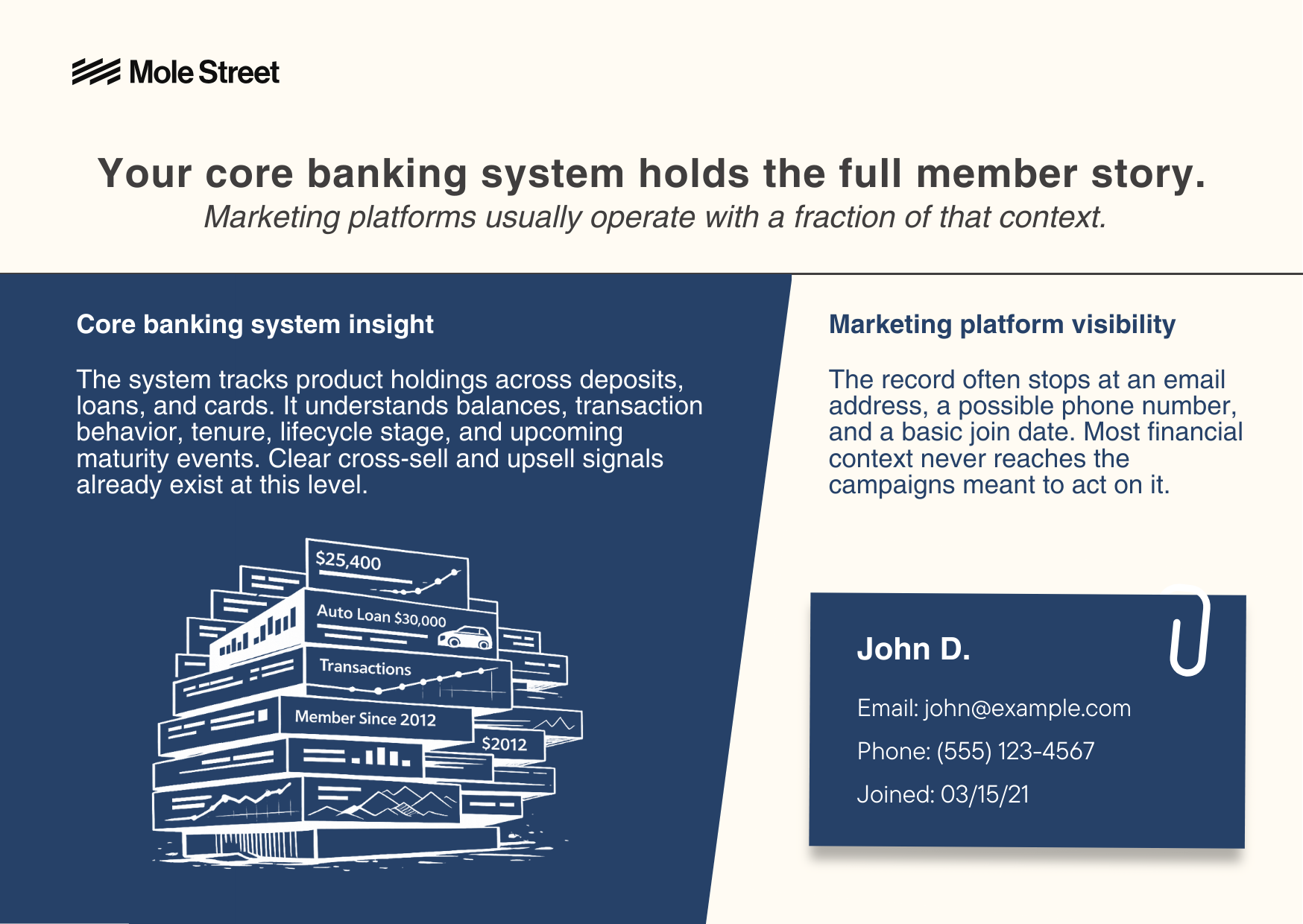
To put it simply, your core banking system knows who your members actually are. Your marketing platform often only knows how to contact them. That gap is where millions in unrealized revenue quietly disappear every year.
The Four Hidden Costs of Core Banking Data Silos
1. Missed Cross-Sell Revenue
Cross-selling is one of the most effective levers for driving revenue growth and increasing share of wallet, but it depends on a deep understanding of the customer. According to McKinsey (2025), leading organizations rely on end-to-end visibility into customer behavior, transactions, and lifecycle stages to identify and act on cross-sell opportunities.
This visibility matters. McKinsey & Company (2023) found that data-driven organizations that personalize engagement generate up to 40% more revenue, reinforcing the link between lifecycle insight and growth.
For many credit unions, however, this level of execution remains out of reach. The data needed to understand member goals, behaviors, and lifecycle stages is locked inside siloed core banking systems, disconnected from marketing and sales tools.
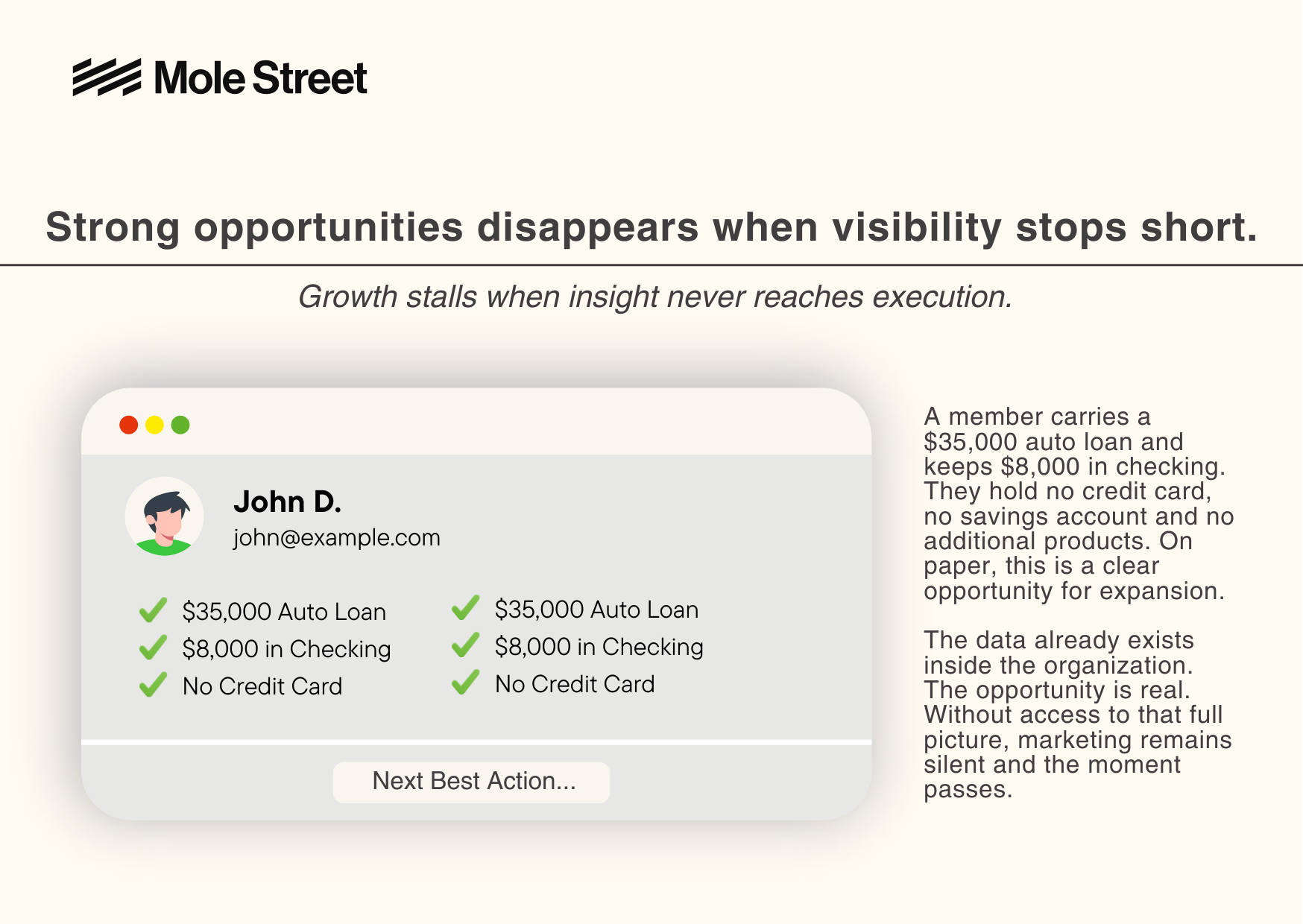
The key to capturing these opportunities is building trust through targeted, relevant communications. That trust is earned when messaging reflects what you actually know about each member’s financial situation, not generic assumptions.
We’ve explored how this same trust-first approach drives results in advisor-led growth as well, including in our article on lead generation for financial advisors using HubSpot.
2. Generic Campaigns That Waste Marketing Spend
Every action, strategy, or decision made in marketing is based on data. Build your marketing campaigns off bad data and your attempt to hit the bullseye will drastically miss the mark. You want maximum accuracy with minimum effort. That’s the aim of the game.
More than a quarter of data teams report losing over $5 million each year due to poor data quality, with some estimating losses of $25 million or more from wasted spend, failed campaigns, and unreliable analytics (Forrester, 2024).
Credit unions are no exception and are, in fact, under more pressure to deliver results with limited budgets. When your marketing platform can't see member product holdings, you're forced to send one-size-fits-all campaigns to your entire membership base.
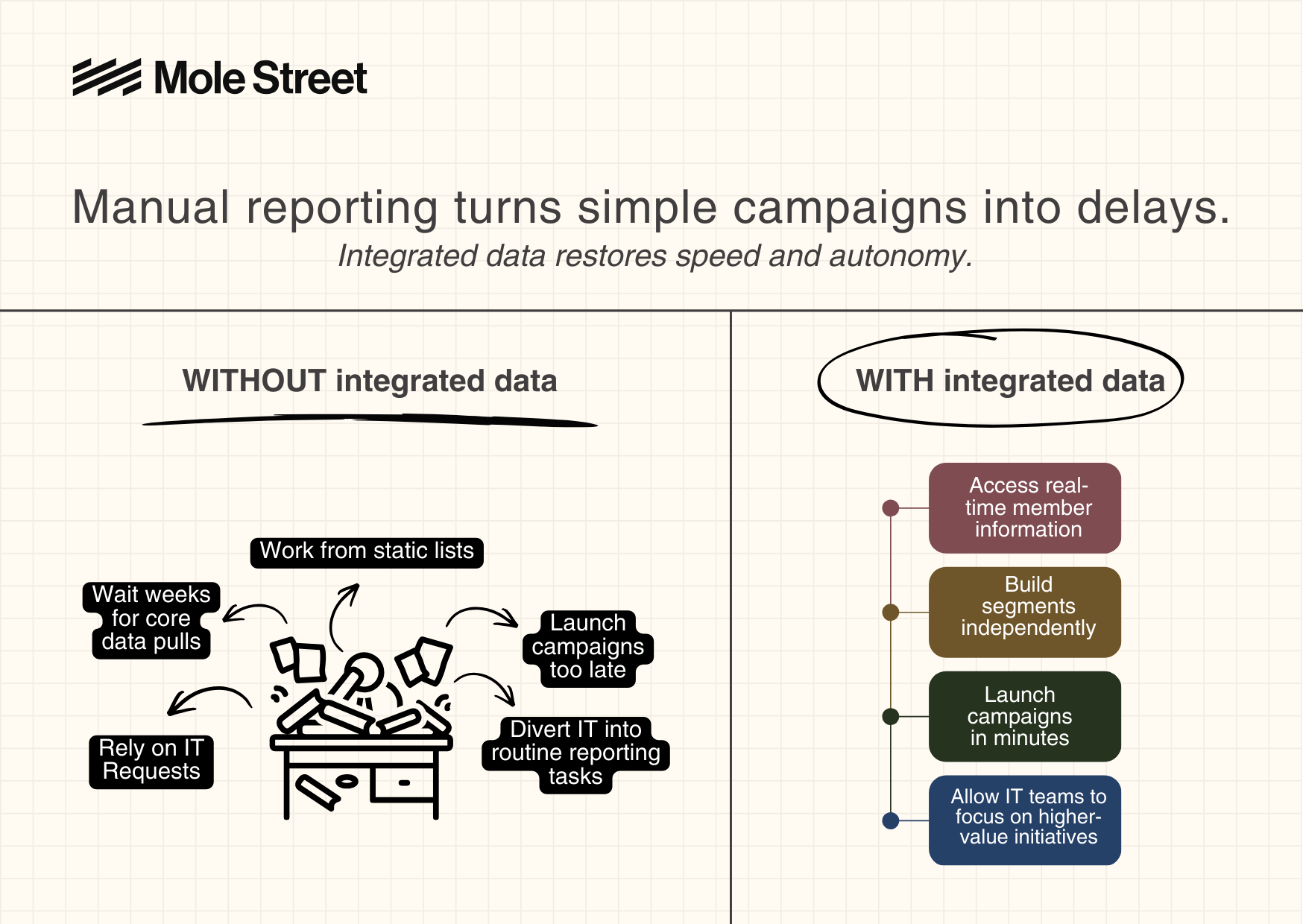
3. Manual Reporting That Slows Everything Down
We’re in the midst of the AI era, where every business owner recognizes efficiency as a prerequisite to success. Despite this, many credit unions still rely on manual and outdated processes to get their operational wheels turning.
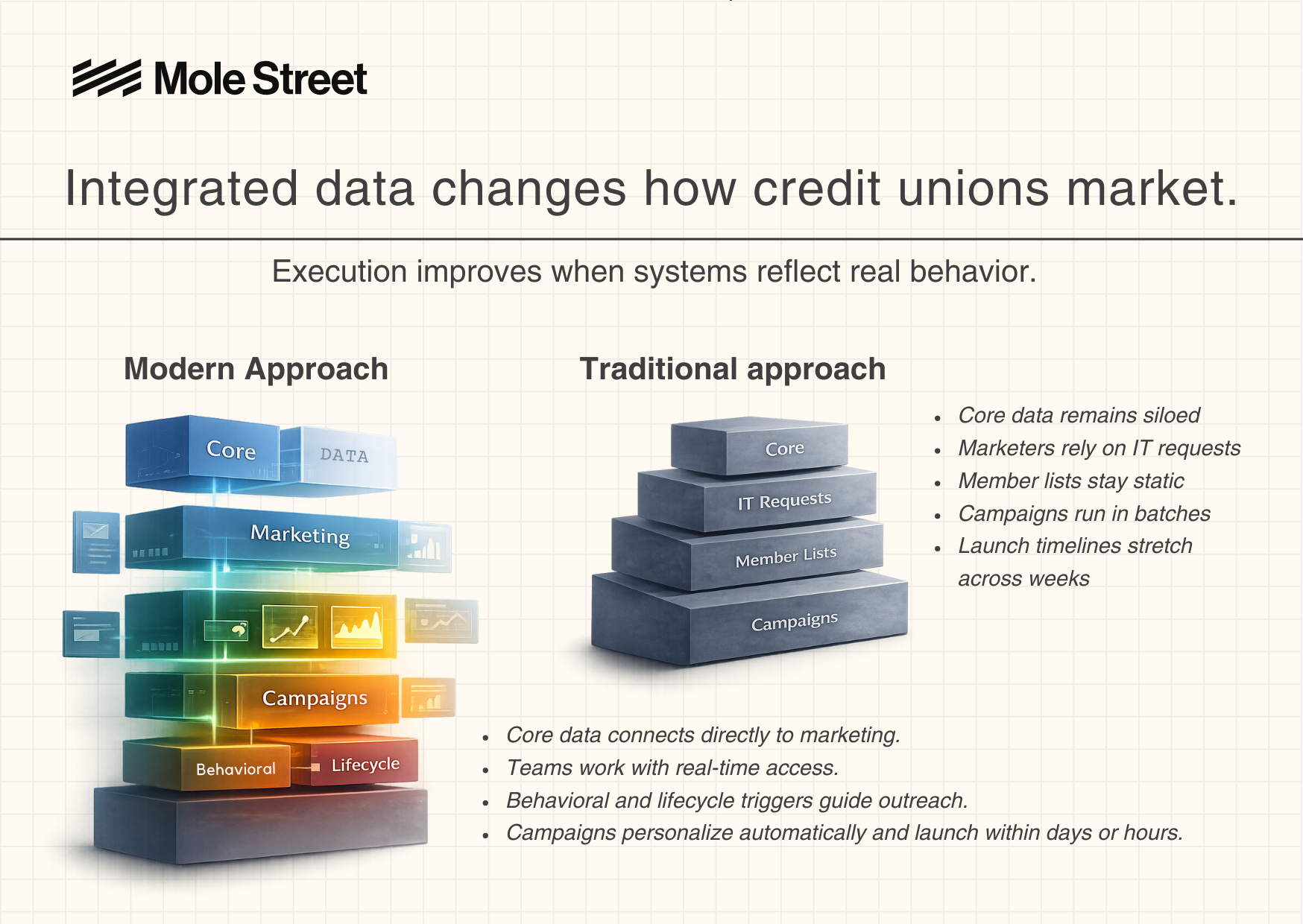
Without integration, marketing teams must rely on IT or operations to pull lists from the core. What should take minutes takes weeks. Opportunities expire, campaigns lose relevance, and momentum stalls. Meanwhile, IT teams are pulled into manual reporting instead of higher-value work.
4. A Growing Competitive Disadvantage
Member expectations have changed. Personalization is demanded, not expected, increasing the squeeze on businesses across all industries to tailor their services. Studies illustrate this shift in expectation, whereby 71% of consumers expect companies to deliver personalized interactions, and 76 % get frustrated when personalization doesn’t happen (McKinsey & Company, 2023).
Banks and fintechs have responded by investing in integrated data systems. They know which customers are ready to refinance, which are building savings, and which are opening new accounts. They act on this insight in real time, delivering timely, relevant communications that reflect each customer’s financial reality.
Most credit unions cannot; not because they lack member data, but because that data is trapped inside core banking systems. Marketing teams can’t see product holdings, segment by life events, or trigger communications based on real member behavior. As a result, campaigns default to generic, one-size-fits-all messaging.
The consequences are measurable. Customers dissatisfied with their financial institution’s digital experience are twice as likely to switch to a competitor (McKinsey & Company, 2025). Credit union websites see 41% bounce rates, more than double those of regional banks, and Gen Z members prefer digital banking channels at banks by more than 20 percentage points for the same products.
Baby boomers still drive more than 50% of credit union revenue today, but their share of the market is shrinking. Credit unions aren’t just losing younger members. They’re losing them because siloed core data makes it impossible to deliver relevant, timely experiences at scale.
Why This Problem Exists (And Why It’s Getting Worse)
This is a problem that involves no finger-pointing. You are not to blame for this quantum shift as the credit union industry was not designed for modern marketing and personalization.
Core banking systems were built decades ago to do one thing exceptionally well: process transactions securely and meet strict regulatory requirements. Their data models prioritize accuracy, stability, and compliance, not real-time access, segmentation, or campaign execution.
Meanwhile, in a parallel universe, marketing technology has evolved exponentially to the point where it’s almost impossible to keep up. The pace of change is relentless. Who could have predicted 40 years ago that CRMs, SaaS platforms, and marketing automation would become the staple diet of modern business?
There was no crystal ball to foresee this.
But you are living in the present, and you are cognizant of the changing landscape. You can still act now. Member expectations continue to rise, regulatory pressure is increasing, and the cost of inaction compounds over time. While this problem wasn’t created overnight, it no longer has to be permanent. Credit unions that act now can close the gap. Those who don’t will feel it widen with every passing year.
What Modern Credit Unions Are Doing Differently
The tide has changed, and many credit unions are now swimming with the current rather than fighting against it. Siloed data is now recognized as a growth inhibitor that must be avoided at all costs.
PSECU, Pennsylvania’s largest credit union ($7B in assets), unified fragmented data and removed developer dependency, enabling marketing to move faster with less IT support. Manual reports, IT tickets, and weeks-long campaign delays are now a thing of the past.
This is the new standard. Credit unions that follow this path gain speed, relevance, and control. Those that don’t will struggle to keep pace with faster-moving competitors.
If you want to explore how member data can be turned into predictable revenue, we recently published an article that outlines a clear path forward: How to Turn Your GTM Outbound Into Predictable Revenue With HubSpot.
The Gap Is Widening and Data Silos Are the Reason
The digital evolution has shaken the credit union industry to its core. Data silos are like cancer, attacking the metabolic health of an organization, spreading quietly, limiting growth, and weakening performance across every area.
No business in any sector can avoid meeting the demands of the modern consumer, which entails delivering personalized, timely, and relevant experiences powered by accessible, accurate data.
Banks have already adapted. Fintechs were already born in this era. Now it’s time for credit unions to break free from data silos and compete on relevance, speed, and member experience.
Many credit unions are already leading the charge. Keesler Federal Credit Union achieved full marketing autonomy in just 90 days by integrating their Jack Henry Symitar core with HubSpot, synchronizing 97 data fields and enabling independent campaign execution.
How quickly could you achieve your growth goals with unified data?
Want to Speak to a Specialist? Book a Strategy Call Now.
By: Harry Maule