AEM vs. Sitecore vs. HubSpot: The 2026 CMS Comparison
Adobe Experience Manager (AEM). Sitecore. Or HubSpot. Which CMS will you build your entire digital infrastructure on? It’s a dilemma that many business leaders question, ponder, and wonder which will best serve their goals in 2026 and for years to come.
And rightly so. Your CMS will shape your growth trajectory for years to come. After all, the platform influences how quickly campaigns launch, how seamlessly teams collaborate, how effectively data flows across systems, and how confidently leadership makes decisions.
Its success depends not only on the platform itself, but on the expertise and resources you have at your disposal. With so many factors to consider, it’s easy to get lost in feature lists, pricing tiers, and vendor promises. That is where a structured comparison becomes essential.
In this blog, we will break down AEM, Sitecore, and HubSpot across cost, implementation, scalability, and real-world use cases. You’ll fully grasp the true cost of enterprise CMS’ (like AEM and Sitecore), their capabilities, and how they compare with HubSpot, so you can evaluate which platform aligns with your organization’s growth strategy.
The Framework: How We Are Comparing These Platforms
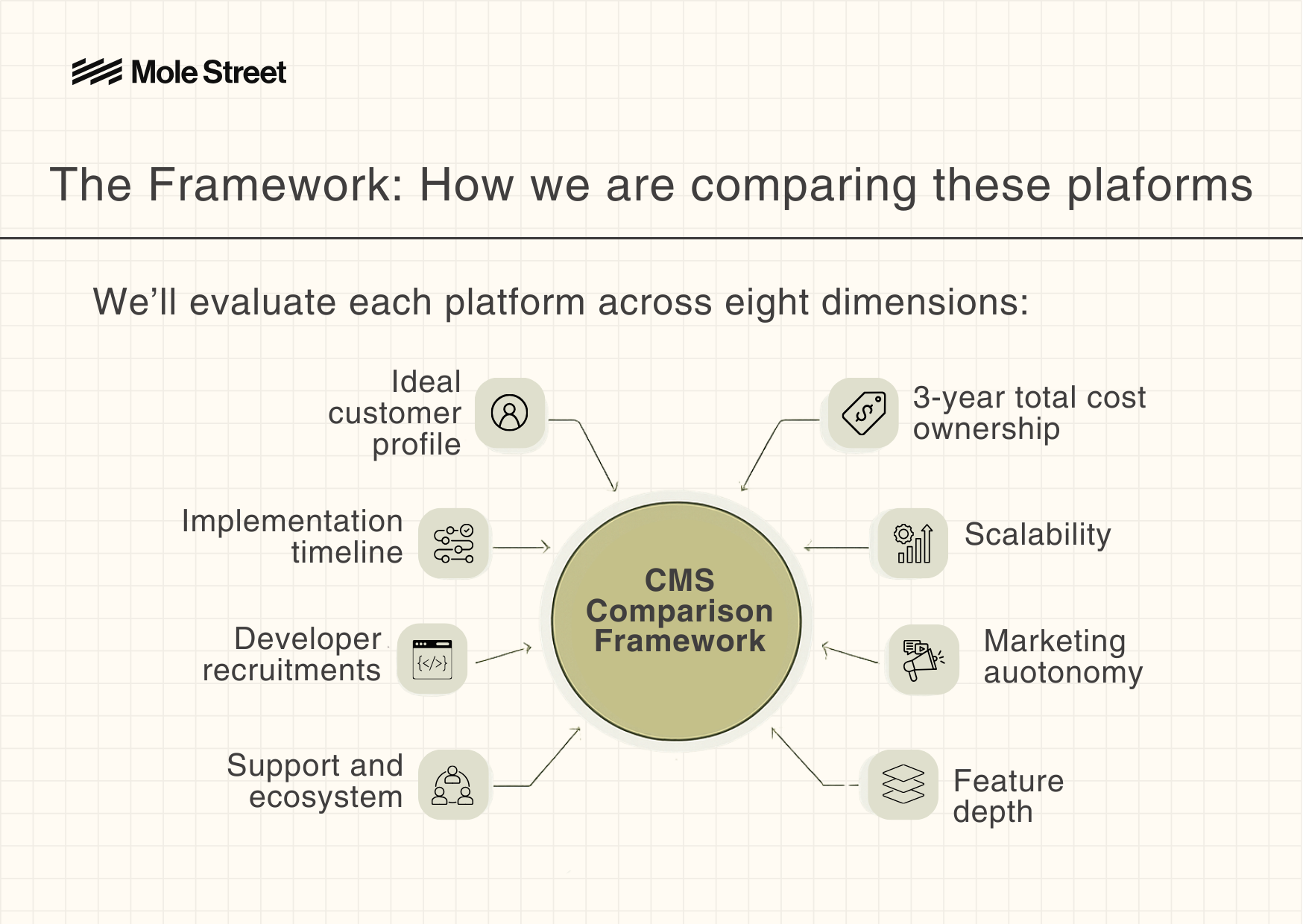
Every CMS looks strong in a demo environment. What matters in the real world are operational realities. Therefore, we’ll evaluate each platform across eight dimensions:
With this framework, you can evaluate each platform based on how it will actually function inside your organization, not just how it performs in a demo.
Adobe Experience Manager
AEM is a behemoth of a platform. The CMS is built on a Java based, component driven architecture where developers define reusable templates, content models, and structured components that control how pages are created and managed.
To translate this into simple terms, its wide range of capabilities and customizable features are geared towards people with profound technical expertise (developers), making it harder for marketing teams to utilize. Although powerful and highly flexible, it often requires ongoing developer involvement to adapt, test, and evolve digital experiences.
Note: We actually wrote a comprehensive article explaining the downfall of AEM and Sitecore in today’s digital environment. Make sure to give it a read for more context and insight into their capabilities.
Ideal Customer Profile
AEM is built for large enterprises with complex digital ecosystems.
It fits organizations with:
- $1B+ in annual revenue
- 20 or more websites across brands or regions
- Heavy commerce integration with systems like SAP or Oracle
- Strict compliance requirements in industries such as financial services or healthcare
- Large internal IT teams with deep Java expertise
It is rarely the right solution for mid market organizations running a single primary website with a lean marketing team.
3 Year Total Cost of Ownership
Real-world implementations show a substantial investment profile.
The total three-year investment typically lands between $2.1M and $4M, with $3M as a realistic midpoint. However, the license fee is only one part of the equation. Dedicated developers, infrastructure, and upgrade cycles drive the long-term cost.
Implementation Timeline
The scale and complexity of AEM make a quick launch unlikely. Here’s an overview of what to expect.
- Discovery and planning: 2 to 3 months
- Development: 6 to 9 months
- Content migration: 2 to 3 months
- Testing and launch: 1 to 2 months
In short, you can expect around 12-18 months to successfully implement AEM. For global organizations aligning multiple stakeholders, that timeline can extend further.
Marketing Autonomy
This is the key factor for many businesses. How quickly can my marketing team move with AEM? Not very is the answer. Marketing teams will likely have to use developers as a crutch, requiring technical expertise to even tinker, toggle, and adjust marketing campaigns.
When marketing velocity is a competitive advantage, that dependency can slow progress and limit experimentation.
Developer Requirements
AEM is a developer heavy platform. Therefore, Java expertise is essential. Custom components are standard. Ongoing development is not optional.
Most enterprise deployments maintain two to four dedicated developers to keep the system evolving and secure.
Feature Depth and Scalability
With all its complexity, AEM offers one of the deepest feature sets in the CMS market. Advanced personalization, headless architecture, enterprise workflow management, and digital asset management at scale are all native strengths.
It handles millions of page views per day and supports complex global architectures, making it an ideal platform for large enterprises.
Businesses operating at such a level will find those capabilities valuable, though not every company requires that degree of complexity. For smaller enterprises, speed and autonomy often take priority, making that level of control an unnecessary expense.
Support and Ecosystem
AEM benefits from Adobe’s extensive enterprise ecosystem. Large global agencies, certified partners, and system integrators support implementations across industries. However, that depth often comes with higher consulting fees and longer onboarding cycles. Organizations typically rely on certified developers or external partners to maintain and evolve the platform, reinforcing its enterprise-grade positioning.
Sitecore
Ideal Customer Profile
Sitecore occupies the space between mid market and enterprise.
It works well for organizations with:
- $200M to $2B in revenue
- Five to fifteen websites
- Strong interest in personalization
- Internal or agency based .NET development teams
- B2B buyer journeys with multiple stages and stakeholders
Smaller companies without dedicated IT resources often find it challenging to maintain.
Three Year Total Cost of Ownership
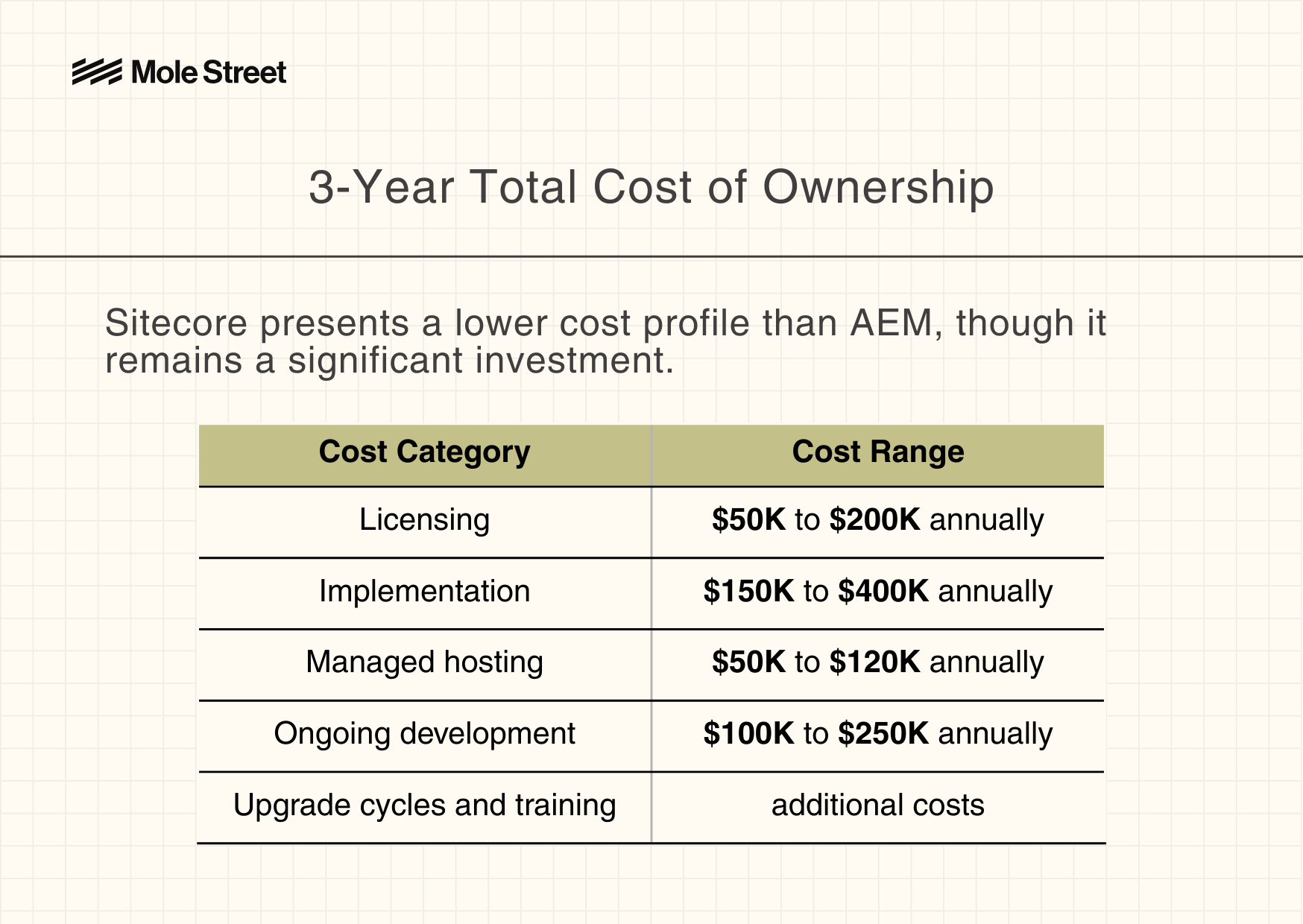
Sitecore presents a lower cost profile than AEM, though it remains a significant investment.
Total three year investment typically ranges from $930K to $2.6M, with $1.5M as a common midpoint. Compared to AEM, it is more accessible. Compared to modern SaaS platforms, it is still capital intensive.
Implementation Timeline
- Discovery and planning: 1 to 2 months
- Development: 4 to 6 months
- Content migration: 1 to 2 months
- Testing and launch: around 1 month
As a rough estimation, you can expect the implementation to be completed between eight to twelve months.
Marketing Autonomy
Sitecore offers an Experience Editor that enables visual editing. Marketing teams can create pages within existing templates. Basic A/B testing is possible.
Complex changes, structural updates, and deeper personalization initiatives generally require developer involvement. In fact, a Forrester study of Sitecore Experience Platform (XP) found that some organizations allocated two to three full-time engineers solely to manage infrastructure, upgrades, and ongoing support (Forrester, 2025).
The collaboration model between marketing and IT needs to be strong for Sitecore to perform well.
Developer Requirements
Sitecore requires .NET expertise. One to two dedicated developers are common in ongoing operations. Major version upgrades can be complex and disruptive.
Feature Depth and Scalability
Sitecore delivers robust personalization, multi site management, and solid analytics. It scales effectively for mid market to enterprise environments, handling tens of millions of page views per month when architected properly.
For organizations that need more flexibility than SaaS platforms provide, without moving into AEM’s cost tier, Sitecore can represent a balanced option.
Support and Ecosystem
Sitecore maintains a strong partner ecosystem, particularly among .NET-focused development agencies. The platform is well supported by implementation partners and integration specialists, though the talent pool is narrower than broader open-source systems. As with most enterprise CMS platforms, ongoing support often requires dedicated technical resources or an external partner relationship.
HubSpot
HubSpot CMS Hub is a cloud-based CMS that was initially built for marketers. This means every aspect of the platform is designed for ease of use, allowing teams to build pages, run tests, and launch campaigns without heavy developer involvement. It is particularly well-suited for mid-market, growth-focused organizations that prioritize speed, integration, and cost efficiency over deep architectural customization.
Ideal Customer Profile
HubSpot CMS Hub aligns closely with mid-market, marketing-led organizations.It fits companies with:
- $50M to $500M in revenue
- B2B growth strategies
- Limited internal IT resources
- A need for faster time to market
- Existing investment in HubSpot CRM or Marketing Hub
It is less suited for massive global deployments with dozens of localized sites and deeply customized headless architectures.
3 Year Total Cost of Ownership
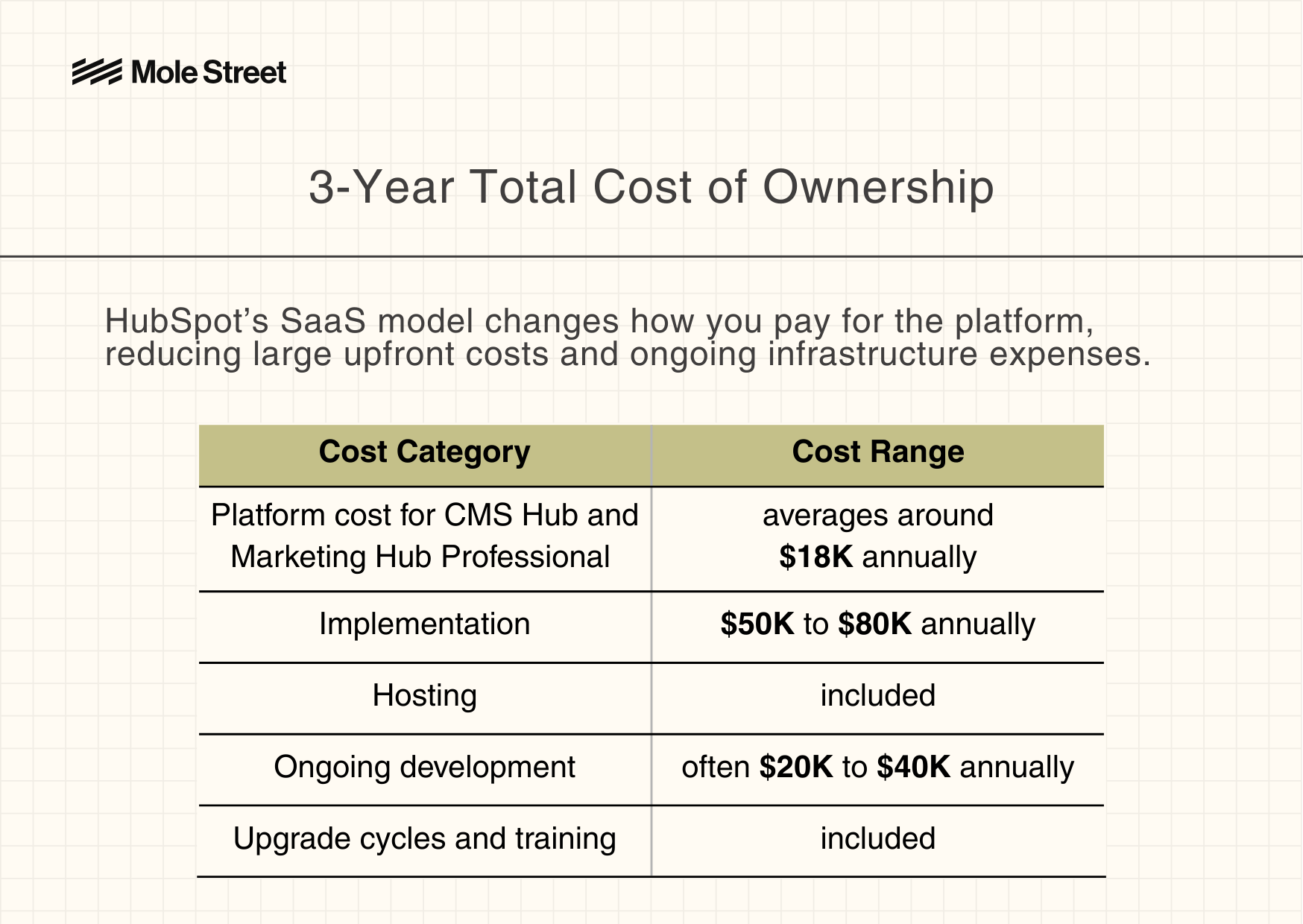
HubSpot’s SaaS model changes how you pay for the platform, reducing large upfront costs and ongoing infrastructure expenses.
Three year investment commonly falls between $164K and $254K, with $200K as a practical midpoint. The absence of hosting fees, major upgrade projects, and large developer teams reshapes the economics.
Implementation Timeline
- Discovery and planning: 2 to 4 weeks
- Development: 6 to 10 weeks
- Content migration: 2 to 4 weeks
- Testing and launch: 1 to 2 weeks
Most organizations can expect a total implementation timeline of approximately three to four months from initial discovery through launch. That shorter timeline can materially change how the investment is evaluated.
Marketing Autonomy
Now this is an area where HubSpot truly differentiates itself. If your business wants speed and full marketing autonomy, HubSpot will give your team the tools to build, test, and launch campaigns without relying heavily on developers.
Campaigns can go from concept to launch in a single day, allowing you to quickly capitalize on opportunities as they arise. In fact, HubSpot’s marketing capabilities are broadly recognized in the market, earning the company a position as a Leader in the Gartner® Magic Quadrant™ for B2B Marketing Automation Platforms (Gartner, 2024)
Developer Requirements
Basic HTML and CSS knowledge is helpful but not required for daily operations. Developers are needed for complex integrations or custom modules. Routine marketing execution does not depend on IT.
Feature Depth and Scalability
HubSpot offers strong core CMS functionality integrated directly with CRM and marketing automation. Personalization, analytics, email marketing, and landing pages are native.
Since it prioritizes ease of use, HubSpot does not aim to replicate the extreme customization depth of enterprise platforms. It scales comfortably into the mid-market and supports millions of monthly page views through its cloud infrastructure.
Support and Ecosystem
HubSpot offers a broad and accessible partner network, along with extensive documentation, onboarding resources, and in-platform support. Because the platform is designed for marketing teams, many organizations can operate it without heavy reliance on external developers. This lowers the barrier to adoption and reduces dependency on specialized technical talent, particularly for mid-market firms.
The Right CMS Depends on Your Internal Capabilities and Growth Goals
Your business is unique. Your goals, resources, and internal expertise are specific to your organization. With that level of variation, adopting a one-size-fits-all approach would be short-sighted. No single CMS fits every organization.
AEM delivers deep customization, but it requires a dedicated development team to fully realize its value. Sitecore offers a balanced option with strong personalization, though it still depends on ongoing technical support. HubSpot, by contrast, prioritizes ease of use, allowing marketing teams to launch campaigns, test ideas, and iterate quickly without heavy developer involvement.
Ultimately, the best CMS is the one that matches your company’s size, resources, technical capacity, and growth strategy. Consider the complexity of your digital ecosystem, the size and skill set of your internal team, your budget over a three year horizon, and how quickly you need to move. Then run the numbers.
If you want to see how these platforms compare using your own numbers, use our CMS ROI calculator to model three year costs based on your team size, campaign volume, and infrastructure requirements. The math often tells a clearer story than any demo ever will.
Want to Speak to a Solutions Architect? Schedule a Consultation Now.
By: Harry Maule