Best CRM Implementation Services for Complex Sales Pipelines in 2026
Sales pipelines have reached an all-time high in complexity. The SaaS explosion over the last decade and the rising reliance on software to execute daily tasks are the main causes.
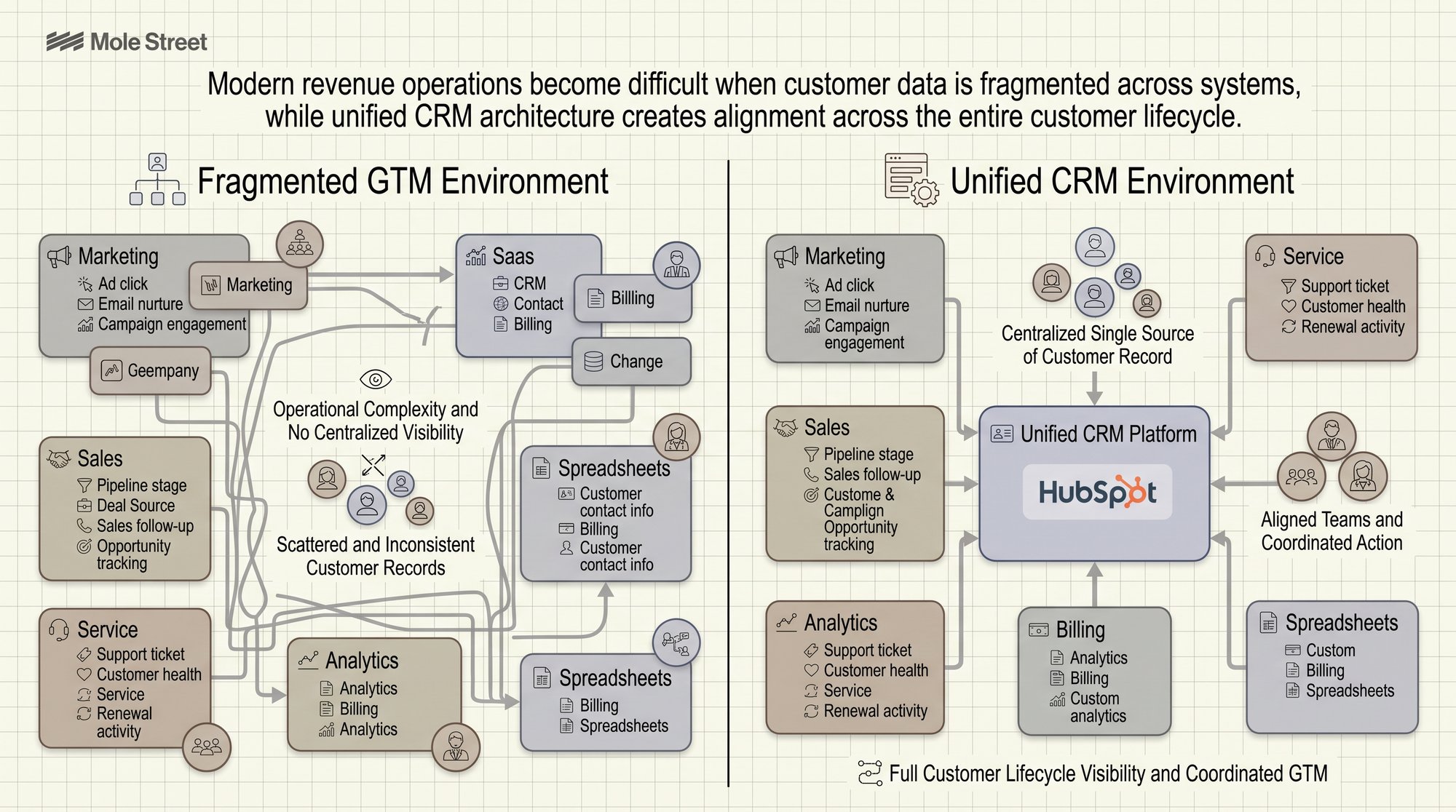
According to Statista, the average business now runs on 130 SaaS applications. That is over 100 places where customer data sits, duplicates, and contradicts itself.
The result is a sales pipeline that no longer flows in a straight line. Deals now cross dozens of systems, multiple teams, and a year's worth of touchpoints before close. No CRM rollout configured for a simple lead-to-deal flow can hold that.
CRM implementation agencies are now in high demand as businesses prioritize unified tech stacks to consolidate data across their sales, marketing, and service teams.
But pinpointing the right agency is challenging. You need one that can safely unify your data across marketing, sales, and service, then configure HubSpot against a single customer record. Most cannot.
In this blog, you will discover:
-
The 5 CRM implementation agencies that unify data before configuring the platform in 2026
-
A 5-point checklist to vet any HubSpot Solutions Partner
-
What real alignment looks like at the contact, workflow, and reporting level
What is the best CRM implementation service for complex sales pipelines in 2026?
The best CRM implementation services for complex sales pipelines in 2026 are agencies that unify your data across marketing, sales, and service before configuring the platform.
The top five for HubSpot rollouts are Mole Street, Aptitude 8, New Breed, SmartBug Media, and RevPartners. Each handles a different dimension of pipeline complexity. The right pick depends on which dimension matters most to your sales motion.
What makes a sales pipeline "complex"?
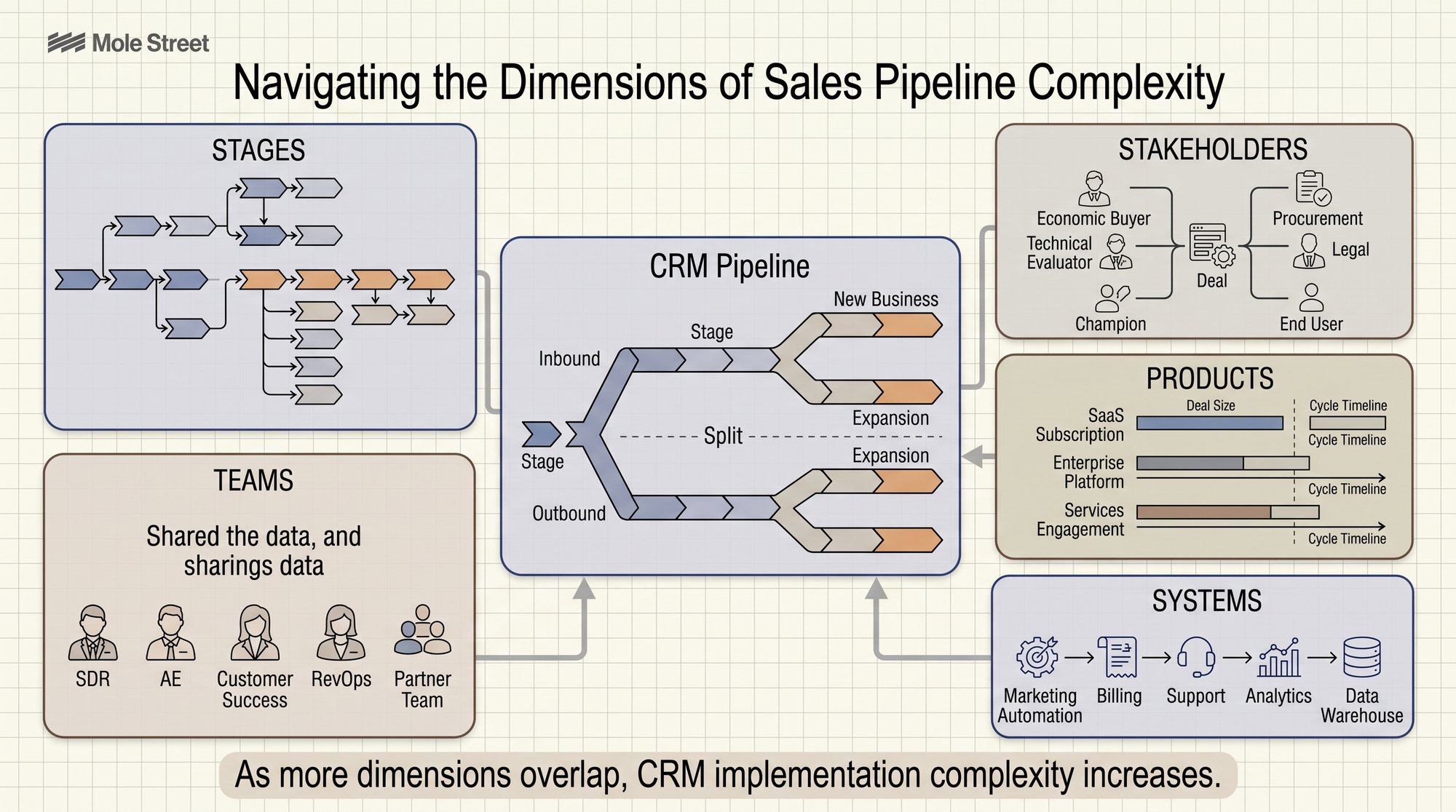
A sales pipeline is complex when it scores high on three or more of five dimensions: stages, stakeholders, products, systems, and teams. Most pipelines that fail in CRM rollout score high on four or five. If yours scores high on three or more, you need a specialist implementation partner.
Signs Your Sales Pipeline Is Operationally Complex
- 7+ deal stages or branching pipeline paths
Pipelines with separate motions for inbound vs outbound, expansion vs net-new, or multi-region sales quickly outgrow standard CRM configurations. - Buying groups with 5+ stakeholders
Economic buyers, champions, technical evaluators, procurement, legal, and end users all require distinct properties, workflows, and engagement paths inside the CRM. - Multiple product lines with different sales cycles
Managing both low-ACV SaaS deals and high-value services engagements inside one funnel creates reporting, forecasting, and ownership problems. - 4+ integrations connected to the CRM
Marketing automation, billing, support, analytics, and warehouse integrations introduce synchronization and governance challenges during implementation. - 3+ revenue teams operating in the same system
SDRs, AEs, Customer Success, partners, and RevOps teams require different permissions, workflows, lifecycle stages, and reporting structures.
What criteria should you use to evaluate a CRM implementation partner for complex pipelines?
Eight criteria separate partners who can ship complex pipelines from those who cannot. Score every partner against all eight before signing.
- Three references with pipelines as complex as yours Ask for three references with comparable stage counts, stakeholder counts, and integration depth. Not three references in your industry. Three references with pipelines as complex as yours.
- Elite, Diamond, Crest, or Summit partner certification For HubSpot, that means Elite Solutions Partner status (the top tier, fewer than 60 firms globally). For Salesforce, Crest or Summit. For Microsoft Dynamics, Solutions Partner with verified Customer Experience.
- A dedicated RevOps practice, not a marketing agency with a CRM team A team that operates revenue systems is a different discipline from a marketing agency that took on CRM as a service line. Ask to see a current RevOps services page and the team behind it.
- A data model built before the platform is configured Confirm the partner builds the schema (objects, properties, associations) before touching the platform UI. Configuration without a data model is the single most common reason rollouts fail.
- Custom code when standard connectors fall short Standard connectors cover roughly 70% of integration needs. The other 30% requires custom code. Ask to see a recent custom build (Operations Hub, MuleSoft, Workato, custom middleware).
- Documented compliance experience in your regulated industry If you are in financial services, healthcare, or government, the partner needs documented compliance experience (GLBA, HIPAA, SOC 2). General CRM experience does not transfer cleanly into a regulated environment.
- 90-day adoption and training included in the implementation fee The partner trains your team, builds the runbook, and runs the 90-day adoption audit. If adoption is sold as a separate engagement, the partner does not own the outcome.
- Fixed-fee pricing with defined change-order rates Hourly-only billing on a complex pipeline rollout will exceed budget by 40% or more. Fixed-fee implementations with clearly defined change-order pricing keep both sides honest.
What are the 7 best CRM implementation services for complex sales pipelines?
The seven CRM implementation services best equipped to handle complex sales pipelines in 2026 are Mole Street, Aptitude 8, SmartBug Media, New Breed, RevPartners, Lynton, and Bayard Bradford. Each has different strengths. Match the partner to your specific complexity profile.
1. Mole Street
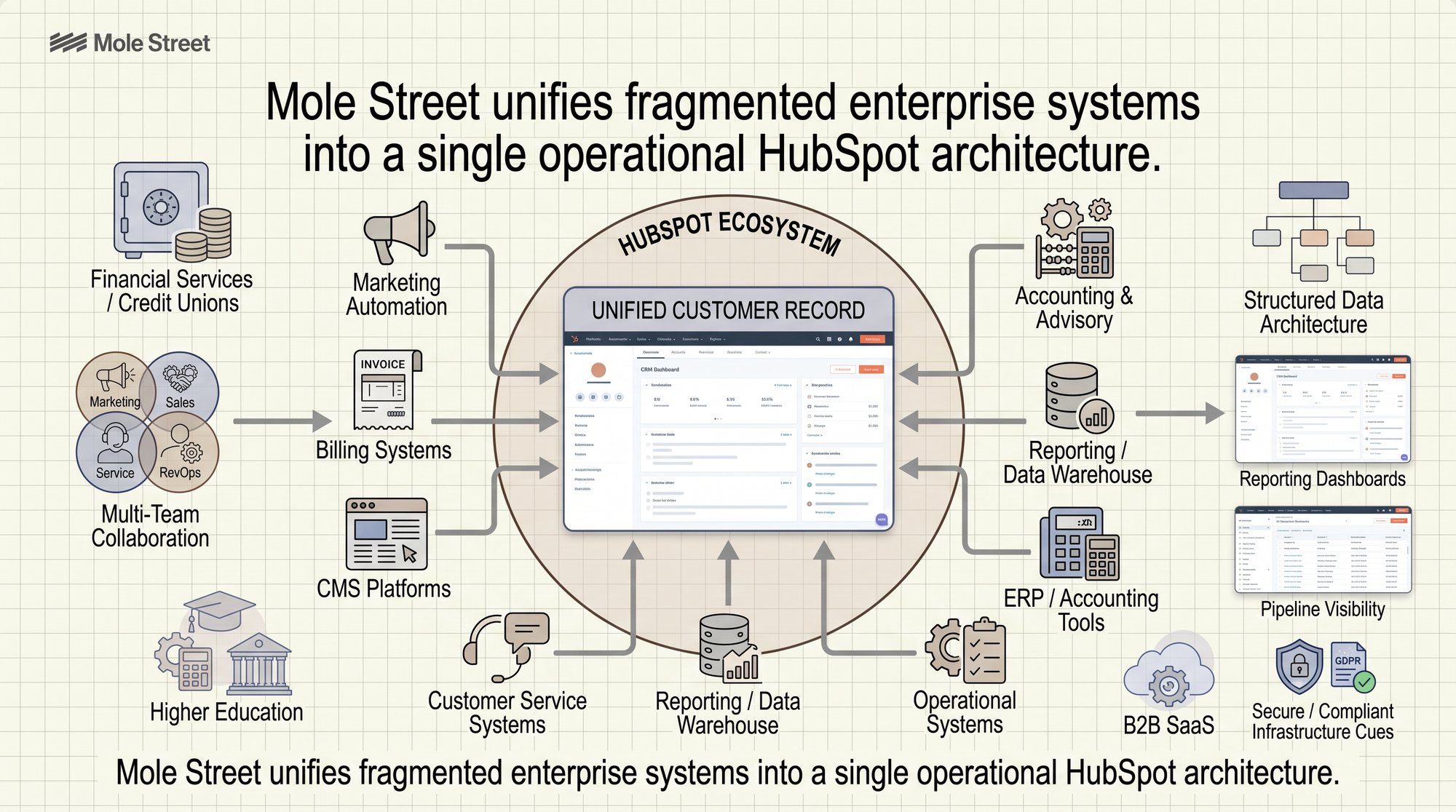
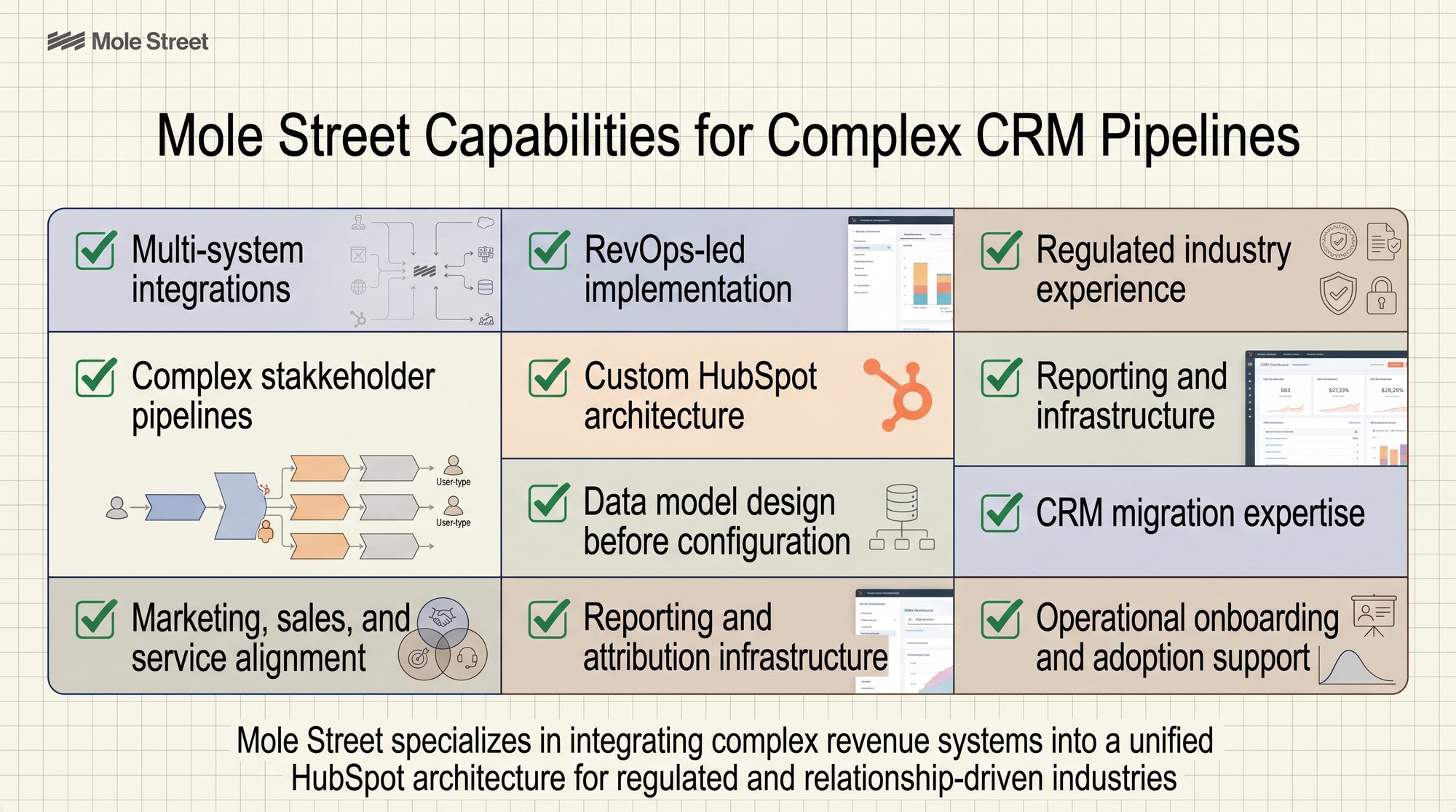
Mole Street is a HubSpot Elite Solutions Partner with a dedicated RevOps practice and a track record in complex multi-system integrations across financial services, higher education, accounting and advisory, and B2B SaaS.
The firm specializes in pipelines that score high on the multi-system and multi-stakeholder dimensions. Their team architects the data model before touching the platform, then ships the integrations and reporting layer that lets revenue leaders run forecasts, partner attribution, and pipeline health out of a single HubSpot instance.
Notable client work includes:
- Full Sitecore-to-HubSpot replatform for a regulated credit union: Pennsylvania State Employees Credit Union (PSECU) deployment across HubSpot CMS Hub Enterprise, Marketing Hub, and CRM. Passed all post-launch security compliance audits and eliminated developer dependency for content updates.
- 3-hub HubSpot rollout integrated with Wolters Kluwer for a Top 100 accounting firm: Sax LLP implementation of Marketing Hub Enterprise, Sales Hub Enterprise, and Operations Hub Professional. Migrated and cleaned 25,000+ contacts and 1,100+ deals, with 145+ team members onboarded to their first CRM.
- Jack Henry Symitar integration for Mississippi's largest credit union: Keesler Federal Credit Union ($5B in assets) HubSpot Marketing Hub Enterprise deployment integrated with Symitar core banking via Kinective. 85% faster campaign launches and full marketing autonomy in 90 days.
Where Mole Street fits best
B2B firms in regulated or relationship-driven industries running multi-system stacks that need to integrate billing, marketing automation, and operational data into HubSpot.
2. Aptitude 8
Aptitude 8 is a HubSpot Elite Solutions Partner with a deep enterprise specialty. They focus on the largest, most technically demanding HubSpot rollouts, often replacing Salesforce or Microsoft Dynamics in companies with 500+ employees.
Their strength is custom development inside the HubSpot ecosystem. They build serverless functions, custom-coded actions, and bidirectional integrations that extend HubSpot beyond its native capability. They are often the best fit for organizations requiring non-standard architectures and highly customized data models.
Where Aptitude 8 fits best
Mid-market and enterprise B2B SaaS companies with 200+ users, custom data requirements, and engineering teams that can participate in the build.
3. SmartBug Media
SmartBug Media is a HubSpot Elite Solutions Partner and one of the largest HubSpot agencies by headcount. They cover the full HubSpot ecosystem, from Marketing Hub through Service Hub, and run a sizable implementation practice alongside their inbound marketing services.
Their advantage lies in operational breadth. SmartBug can deploy cross-functional teams spanning CRM, marketing automation, RevOps, content, and campaign operations within a single engagement. That becomes especially valuable when implementation depends on coordinated changes across attribution, lead scoring, and lifecycle management.
Where SmartBug Media fits best
Mid-market B2B companies wanting a single-vendor solution covering CRM implementation and ongoing marketing services.
4. New Breed
New Breed is a HubSpot Elite Solutions Partner with a strong RevOps and demand generation practice. They serve mid-market and lower enterprise B2B SaaS organizations, with particular depth in revenue lifecycle design and attribution modeling.
The firm excels in multi-stage, multi-stakeholder sales environments. Their team has implemented pipelines with 10+ stages, branching inbound and outbound motions, and sophisticated lifecycle automation across both marketing and sales.
Where New Breed fits best
B2B SaaS companies running ABM or demand generation motions with detailed funnel attribution requirements.
5. RevPartners
RevPartners is a HubSpot Elite Solutions Partner and a dedicated RevOps-as-a-service firm. Their model combines implementation and ongoing RevOps support under a single subscription engagement.
What differentiates RevPartners is operational continuity after go-live. The same team that architects the system continues managing it during the first 6 to 12 months, helping close the adoption gap that often undermines CRM rollouts.
Where RevPartners fits best
B2B SaaS companies that want to build RevOps capability internally while relying on an external partner during the transition.
6. Lynton
Lynton is a HubSpot Elite Solutions Partner specializing in mid-market and enterprise CRM implementations. They bring particular depth in integrations involving industry-specific systems across healthcare, education, and association management.
Their strongest differentiator is integration expertise. Lynton maintains a large library of custom integrations and routinely develops new connectors for organizations operating outside standard SaaS environments.
Where Lynton fits best
Mid-market firms in healthcare, education, or association management with systems like EHRs, SIS platforms, or AMS platforms that need to integrate with HubSpot.
7. Bayard Bradford
Bayard Bradford is a HubSpot Diamond Solutions Partner and RevOps consultancy focused on industrial, manufacturing, and distribution organizations with channel-driven revenue models.
The firm stands out in partner-channel and distributor-network configuration. Their team has implemented multi-tier partner pipelines with deal registration, partner portals, and distributor reporting built directly into HubSpot.
Where Bayard Bradford fits best
Industrial, manufacturing, or distribution companies with partner-led sales motions and dealer or distributor networks operating inside HubSpot.
What are the most common CRM implementation mistakes that derail complex pipelines?
Five mistakes account for the majority of complex CRM rollouts that miss their go-live date or fail adoption inside the first six months.
1. Selecting the partner before defining the data model
Most procurement teams shortlist partners based on platform certification and case studies, then sign before the data model is scoped. The result is a partner contracted to build a pipeline they have not yet seen. Define the data model first, share it with shortlisted partners, then evaluate based on their response.
2. Treating marketing automation as a separate workstream
A complex pipeline depends on the marketing automation platform and the CRM operating as a single data model. If marketing automation is configured in parallel by a different team, the two systems will not align on contact lifecycle, lead scoring, or attribution. Build them together.
3. Skipping the pipeline complexity audit
Most implementations begin with a discovery phase that documents the current sales process. That is not the same as a complexity audit. The audit measures stages, stakeholders, products, systems, and teams against the framework above, and produces a complexity score that drives scope.
4. Over-customizing in phase one
Complex pipelines tempt partners to build every requested feature in the first release. The result is a rollout that takes 8 months instead of 4, and a system the internal team cannot maintain. Ship the core pipeline first. Layer customization in phase two after adoption is confirmed.
5. No adoption plan past go-live
A complex pipeline requires training across sales, marketing, customer success, and RevOps. If adoption is treated as an end-of-project deliverable rather than a 90-day program, usage will drop below 60% inside three months. Build the adoption program into the implementation contract.
The agency you choose will shape your growth trajectory
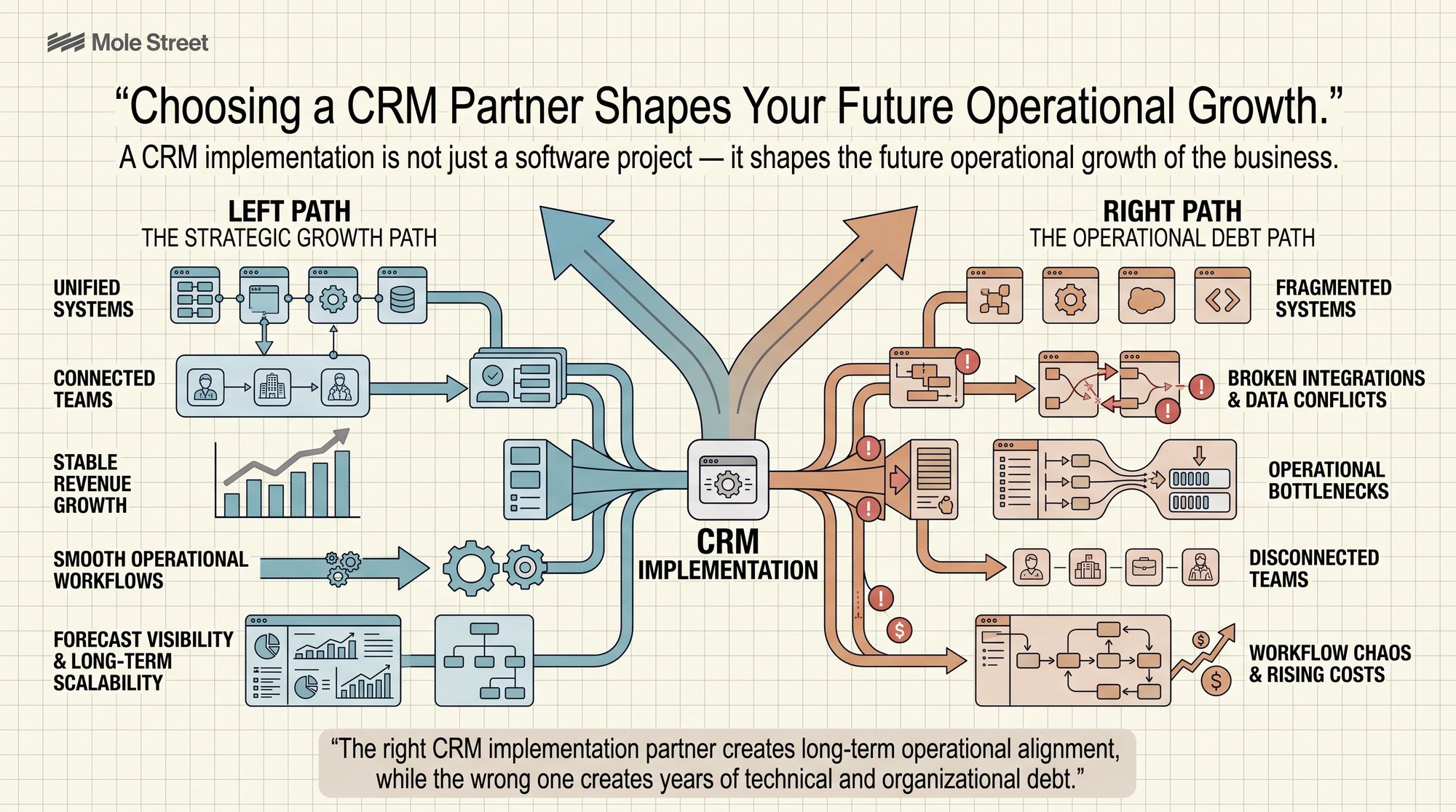
A complex pipeline rollout is one of the biggest operational decisions a revenue leader makes. Get it right and your CRM becomes the system your team forecasts, sells, and reports from for the next five years. Get it wrong and you rebuild it in 18 months at double the cost.
The five agencies in this list (Mole Street, Aptitude 8, New Breed, SmartBug Media, and RevPartners) have all shipped complex pipelines at the Elite tier. The right pick depends on which dimension of your complexity matters most and which agency has the closest match to your situation.
While each agency offers unique advantages, Mole Street has the deepest track record in regulated, multi-system, and relationship-driven industries.
Clients consistently value Mole Street’s partnership-driven approach, where their business needs remain the top priority. Above all else, clients consistently achieve measurable results that help accelerate and sustain their growth goals.
For more information on what results they’ve delivered for clients, you can view the entire case study page here.
Frequently asked questions
What is the average cost of a HubSpot implementation for a complex sales pipeline?
A HubSpot implementation for a complex sales pipeline typically costs between $80,000 and $300,000 for an Elite Solutions Partner engagement. The range depends on integration depth, data migration scope, and customization. A standard 5-integration rollout sits in the $100K to $180K range. Custom development pushes the cost higher.
How long does a complex HubSpot implementation take?
A complex HubSpot implementation takes 12 to 28 weeks from kickoff to go-live. Standard rollouts with up to 5 integrations run 12 to 16 weeks. Rollouts with custom development run 16 to 24 weeks. Enterprise implementations with multiple data sources and a custom data model run 24+ weeks.
Do you need an Elite HubSpot Solutions Partner for a complex pipeline?
Yes. Elite Solutions Partners (fewer than 60 firms globally) hold the project volume, certifications, and customer satisfaction scores HubSpot requires for the top tier. Diamond partners are the next tier and can also handle complex work, but verify case studies that match your pipeline complexity before signing.
What is RevOps and why does it matter for CRM implementation?
Revenue operations (RevOps) is the discipline of aligning sales, marketing, and customer success around shared data, processes, and reporting. A complex CRM implementation is a RevOps project. If the implementation agency does not run a RevOps practice, the build will function as a sales tool but not as a revenue system.
Should you choose HubSpot or Salesforce for a complex pipeline?
Choose HubSpot for pipelines under 500 users where speed of implementation, marketing and sales integration, and total cost of ownership are priorities. Choose Salesforce for pipelines over 500 users, deeply customized data models, or industries where Salesforce has a verticalized cloud (Financial Services Cloud, Health Cloud, Manufacturing Cloud).
Can you implement HubSpot yourself for a complex pipeline?
You can self-implement HubSpot for a simple linear pipeline. A complex pipeline rollout consistently fails when handled in-house without an experienced lead. The cost of partner-led implementation is recovered within 12 months through adoption and reduced rework. Self-implementation on a complex pipeline typically results in a partial rebuild within 18 months.
How do you measure the ROI of a CRM implementation?
ROI is measured through forecast accuracy improvement, sales cycle reduction, marketing-influenced pipeline coverage, and customer retention. Quantify the baseline before kickoff. Most complex rollouts can demonstrate measurable improvement in forecast accuracy and sales cycle length within 12 months of go-live.
What is the difference between a CRM implementation agency and a CRM consultant?
A CRM implementation agency is contracted to deliver a working system, including configuration, integration, data migration, and training. A CRM consultant advises on strategy, process, or architecture without owning the body of work. Most complex pipelines need both functions, often supplied by the same agency under a single engagement.
By: Harry Maule