Credit Union

Why Credit Unions Marketing Automation Fails (and How To Fix It)

13 min read
Why Credit Unions Marketing Automation Fails (and How To Fix It)

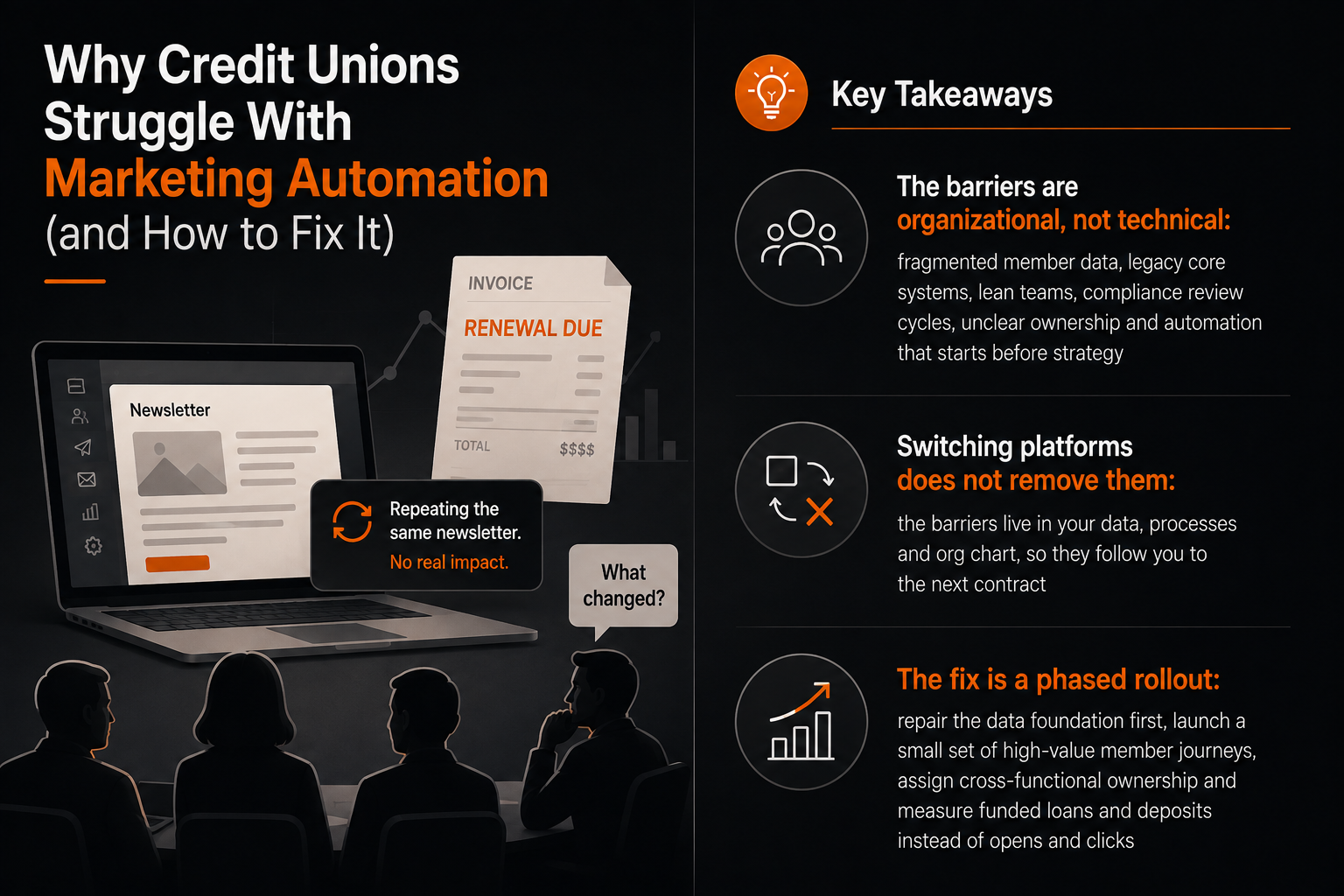
A credit union signs with a capable marketing automation platform. Twelve months later, that platform is doing exactly one thing: sending the same monthly newsletter to every member, the same way the old email tool did. The renewal invoice arrives, and someone in the boardroom asks what changed.

This pattern repeats across the industry, and the diagnosis is almost always wrong. The platform exposes gaps in member data, ownership and strategy that existed long before the contract was signed.

Rather than switching platforms, fixing those gaps is what causes automation to produce funded loans, deposits and new memberships. In this guide, we break down the six barriers that stall implementation and the rollout approach that credit unions who succeed, including those we work with at Mole Street, use to get past them.

Key Takeaways:

  • The barriers are organizational, not technical: fragmented member data, legacy core systems, lean teams, compliance review cycles, unclear ownership and automation that starts before strategy
  • Switching platforms does not remove them: the barriers live in your data, processes and org chart, so they follow you to the next contract
  • The fix is a phased rollout: repair the data foundation first, launch a small set of high-value member journeys, assign cross-functional ownership and measure funded loans and deposits instead of opens and clicks
ChatGPT Image Aug 27, 2026, 11_41_12 AM

Why Do Credit Unions Struggle With Marketing Automation Platform Implementation?

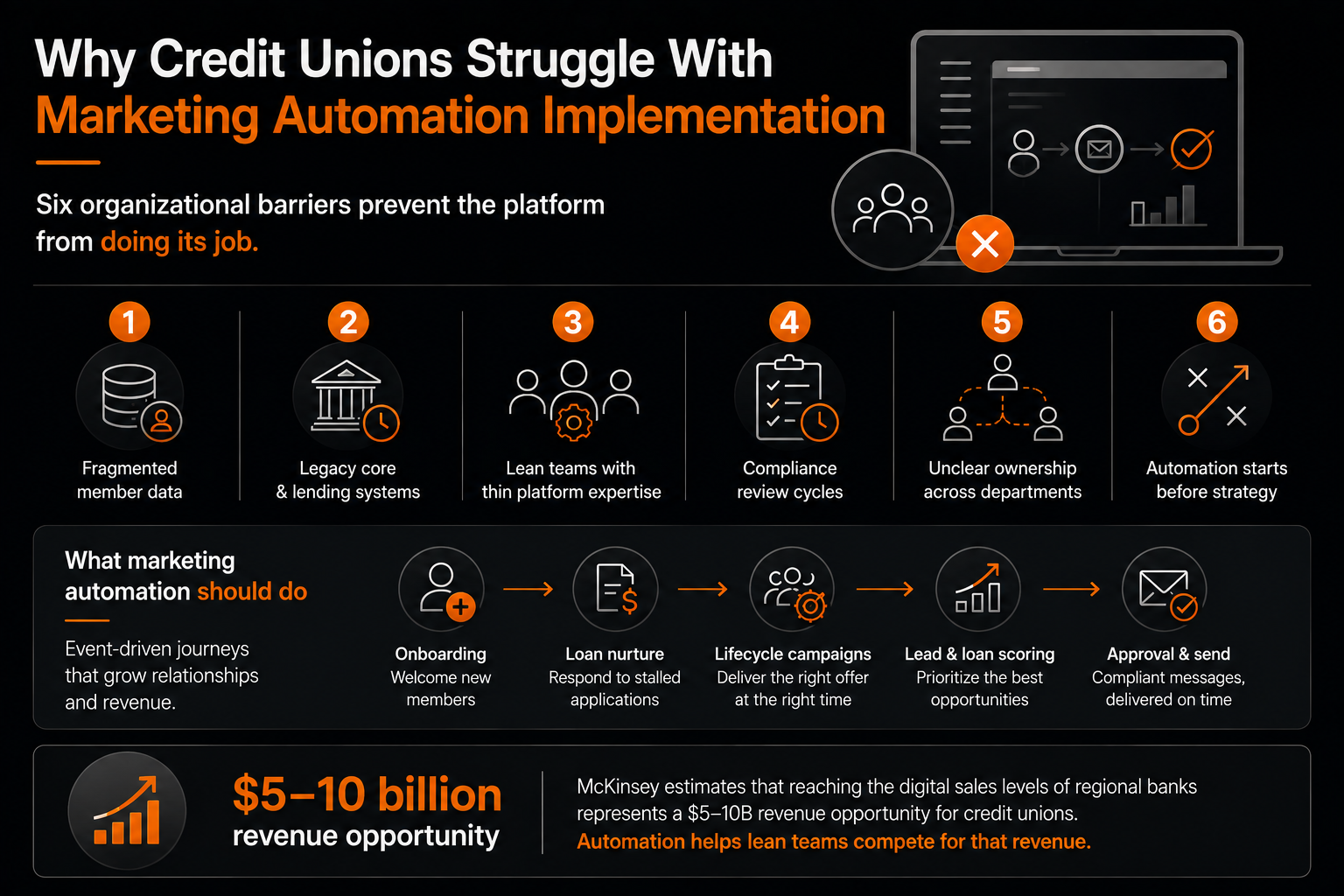
Credit unions struggle with marketing automation implementation because six organizational barriers prevent the platform from doing its job. Those are fragmented member data, legacy core and lending systems, lean teams with thin platform expertise, compliance review cycles, unclear ownership across departments and automation projects that begin before the strategy is defined.

When you understand what the platform is supposed to do, the barriers make sense. Real marketing automation means event-triggered member journeys – onboarding sequences that adapt to what a new member opens, loan nurture flows that respond to an application stalling and lifecycle campaigns driven by lead and loan scoring. Every one of those depends on member data arriving in the platform quickly. Someone also has to design the journey, and compliance must approve the messages.

The stakes justify getting this right. McKinsey estimates that reaching the digital sales levels of regional banks represents a $5-10 billion revenue opportunity for credit unions. Automation allows a lean marketing team to compete for that revenue. The six barriers below stand in the way.

ChatGPT Image Aug 27, 2026, 11_45_14 AM

How Do Legacy Core Systems Block Campaign Triggers?

The automation platform is installed, but the legacy core cannot deliver data fast enough for the platform to act on it. McKinsey estimates that up to 75% of credit unions operate on legacy loan origination systems that do not offer true automation.

Older cores and lending systems typically lack modern APIs. Without them, data reaches the marketing platform through overnight batch files or manual exports. A member who funds an auto loan on Friday evening may not appear in the CRM until the following week. By then, the window for a timely welcome message or a relevant cross-sell offer has closed, and the campaign either sends late or never sends at all.

This is why platform demos disappoint in production. The demo runs on clean, connected sample data. Your instance runs on whatever your core releases, whenever it releases it. The integration layer between the core and the CRM decides what your automation can actually do, which is why we treat CRM and core system sync as the first workstream of any implementation, not the last.

Why Do Lean Marketing Teams Default to Batch Email?

Marketing automation requires four distinct skill sets (CRM strategy, data management, journey design and platform administration), and most credit union marketing teams have two or three people covering all of them alongside everything else.

Those team members are already producing the newsletter, managing the website, running community events and handling branch signage. Learning to build multi-step workflows, maintain segmentation logic and troubleshoot sync errors is a second job nobody was hired for. The team (reasonably) uses the platform for what it already knows: sending emails to a list.

The cost compounds over time. Advanced features sit unused while the subscription renews at full price. The board sees an expensive tool doing a cheap tool’s work, and confidence in marketing technology erodes with every renewal cycle. Your team is working hard on the wrong altitude of task because nobody has the capacity to design the system they should be operating.

ChatGPT Image Aug 27, 2026, 11_50_27 AM

How Does Compliance Review Slow Automation Down?

Every automated message a credit union sends can require compliance review under the Gramm-Leach-Bliley Act (GLBA) privacy rules, National Credit Union Administration (NCUA) advertising regulations and fair lending requirements, which turns a campaign build measured in days into one measured in months.


The obligations are real and specific. Promotional messages need accurate disclosures and, in most cases, the official NCUA insurance statement. Rate offers must present terms correctly. Segmentation logic itself needs a review because targeting criteria that correlates with protected classes creates fair lending exposure. Consent and opt-out preferences must be honored across every channel the platform touches.

None of this is optional. The cost comes from treating compliance as a final gate instead of a design input. When every journey goes to compliance as a finished product, every revision restarts the queue. Teams respond by launching fewer journeys and defaulting to the safest possible sends. The credit unions that move fast do the opposite: they build a pre-approved library of disclosures and templates with compliance up front, so review happens once per component instead of once per campaign.

Why Do Automation Projects Stall Without a Single Owner?

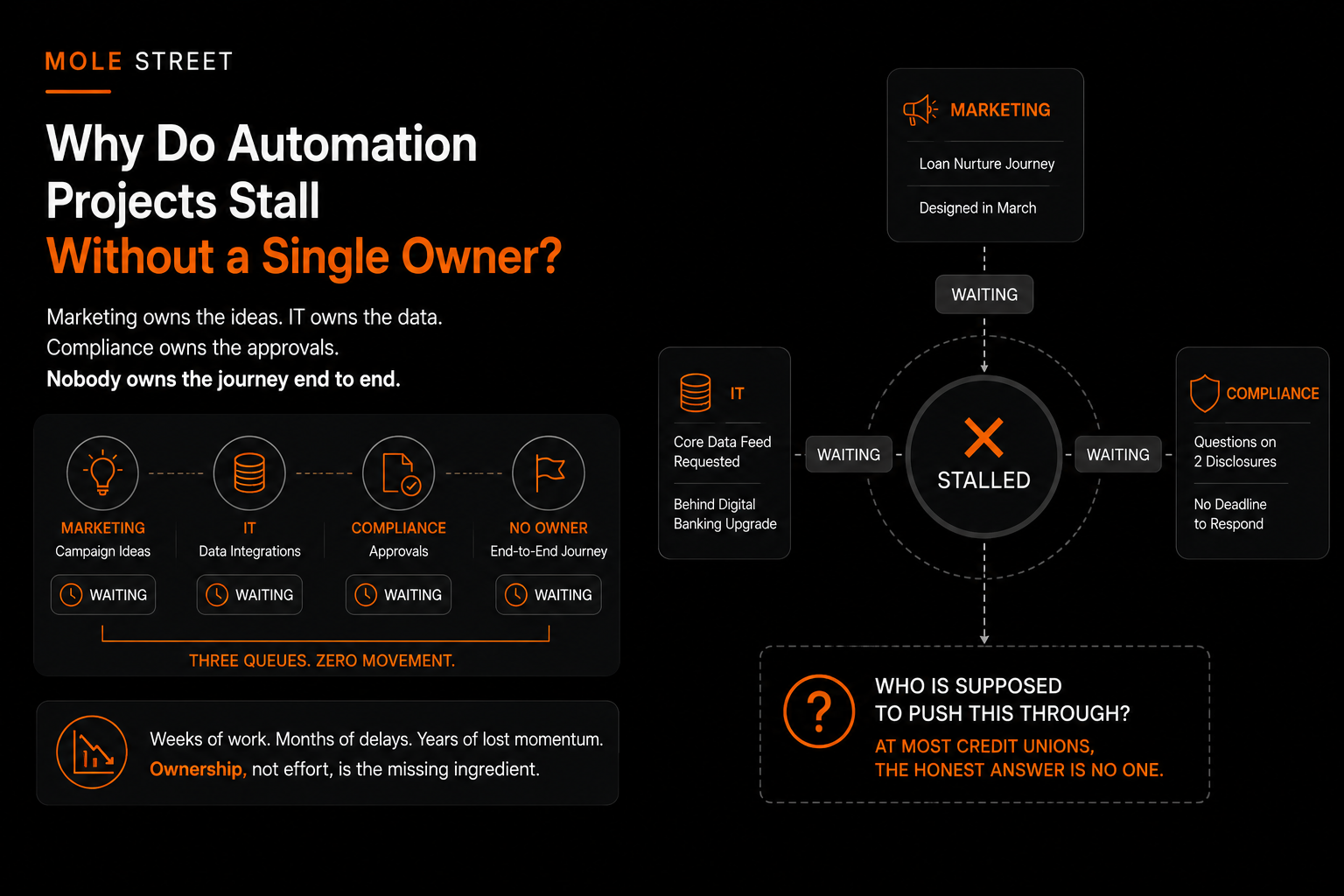
Marketing owns the campaign ideas, IT owns the data integrations, compliance owns the approvals and nobody owns the member journey from end to end, so every project waits in three queues at once.

Consider how a stalled launch looks from inside. Marketing designed a loan nurture journey in March. IT has not delivered the core data feed because the request sits behind a digital banking upgrade. Compliance has questions about two disclosures but no deadline to answer them. Nobody is at fault, but nothing ships. Who is supposed to push this through? At most credit unions, the honest answer is no one.

The cost is measured in quarters. Projects that should take weeks span fiscal years. Early momentum drains away, and the platform takes the blame for an accountability gap. Ownership, not effort, is the missing ingredient.

ChatGPT Image Aug 27, 2026, 12_03_37 PM

What Goes Wrong When You Automate Before Defining the Strategy?

Credit unions that buy the platform before deciding which member journeys matter end up automating their existing newsletter, and they cannot prove the investment worked because success was never defined in business terms.

Without a strategy, the platform gets pointed at whatever the team already does. The newsletter becomes an “automated” newsletter. The rate promotion becomes an “automated” rate promotion. Nothing about the member experience changes, so nothing about the results changes either.

Weak measurement seals the outcome. Cornerstone Advisors found in April 2026 that banks and credit unions spend an average of 0.1% of assets on marketing each year, yet nearly 6 in 10 say their core or CRM system limits their ability to measure marketing ROI. When you cannot connect a campaign to funded loans, new deposits or new memberships, you cannot demonstrate that automation produced anything. Underwhelming evidence leads to reduced investment, which leads to weaker results, and the cycle repeats until the contract lapses.

What Do Credit Unions That Succeed With Marketing Automation Do Differently?

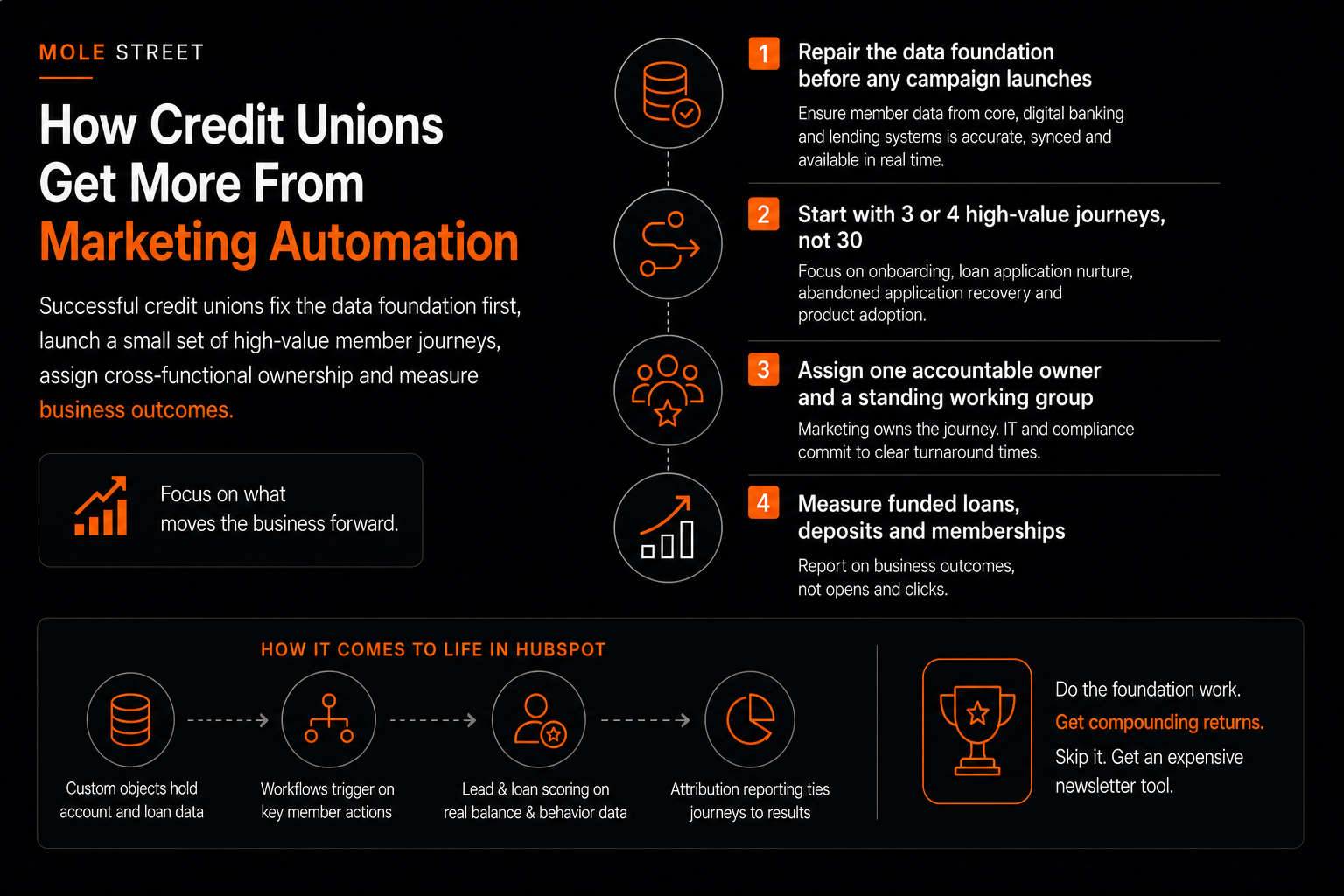
Successful credit unions fix the data foundation first, launch a small set of high-value member journeys, assign cross-functional ownership and measure business outcomes such as funded loans and deposit growth instead of opens and clicks.

The difference is sequence. The rollout that works looks like this:

1. Repair the data foundation before any campaign launches

Map how member data flows into the CRM from digital banking, the core and the loan origination system. Build the sync, validate it and confirm that the platform sees new accounts, applications and balances within hours rather than weeks. Campaigns built on a broken foundation will fail no matter how well they are written.

2. Start with 3 or 4 high-value journeys, not 30

Member onboarding, loan application nurture, abandoned application recovery and product adoption cover the moments where timing changes outcomes. Prove the model on these before expanding.

3. Assign one accountable owner and a standing working group

A single owner, usually in marketing, shepherds every journey through data, build and compliance. IT and compliance sit in a standing group with committed turnaround times, so approvals stop being an open-ended wait.

4. Measure funded loans, deposits and memberships

Opens and clicks tell you an email worked. Business outcomes tell you the program worked. Report on the second.

This is where platform choice starts to matter. In HubSpot, this rollout takes concrete shape: custom objects hold account and loan data synced from the core, workflows trigger when an application stalls or a new account opens, lead and loan scoring run on real balance and behavior data, and attribution reporting ties each journey to the loans it produced.

As an Elite HubSpot Solutions Partner, we build these implementations for credit unions, and the pattern holds every time: the credit unions that do the foundation work get compounding returns, and the ones that skip it get an expensive newsletter tool.


ChatGPT Image Aug 27, 2026, 01_01_03 PM

Create a Data Foundation and Your Platform Will Act on Member Behavior in Time

Every barrier in this guide ends the same way: the platform learns about member behavior too late to act on it. Create the data foundation with core, loan and digital banking activity synced into the CRM within hours, and the timing flips. The stalled application gets a nudge the same afternoon, the new auto loan gets a welcome message that weekend, and every campaign gets tied to the funded loans and deposits it produced.

Fixing marketing automation at a credit union boils down to that order of operations: data first, strategy second, journeys third, platform features last. Every failed implementation we have audited ran the sequence backward and hoped the foundation would sort itself out. It never does. Repair the data, pick the journeys that move loans and deposits, give one person the authority to ship, and the platform you already own will start earning its renewal.


Frequently Asked Questions

Is HubSpot a good marketing automation platform for credit unions?

Yes, particularly for lean teams. HubSpot combines CRM, marketing automation and reporting in one data model, and its open API connects to core systems through middleware, so a small team can run member journeys without depending on IT for every campaign. The platform still needs a solid data foundation underneath it to perform.

How long does marketing automation implementation take for a credit union?

Plan in months, not weeks. Discovery, data mapping and core integration come before a campaign launches, and compliance template approval runs in parallel. A phased rollout typically puts the first journeys live within the first two quarters, with expansion after that.

What data does a credit union need before automating?

A unified member record: core account data, loan and application data, digital banking activity and consent and communication preferences are all synced into the CRM on a timely schedule. If the platform cannot see a new account or a stalled application within hours, behavioral journeys cannot function.

Who should own marketing automation at a credit union?

One accountable owner, usually the marketing leader, is supported by a standing cross-functional group with IT and compliance. Split ownership across three departments with no tiebreaker is the most common reason projects stall.

Want to Take The First Step Forward to a Unified Tech Stack?