%20(25).png?width=1200&height=628&name=Copy%20of%20Copy%20of%20MS%20-%20Featured%20Image%20Template%20%20(1200%20x%20628%20px)%20(25).png)
Picture this. Your global CRM rollout is six months in, three regions are live, and you are sitting in a forecast meeting looking at $40 million in projected revenue for the quarter. The US number is in the CRM. Great.
The UK number comes out of a spreadsheet, because the team across the pond keeps their real forecast there and updates the CRM once a month. And the German number is in euros against a fiscal year that ended in March.
Situations like these are just as costly as they are frustrating. It’s 2026, and we’re in the midst of the AI era where speed is everything. You should never have to manually piece together information your CRM already holds. Yet, situations like these are all too common.
In this guide, we are going to walk you through the seven reasons enterprise CRM implementation breaks down across global sales teams, and how you can prevent each one in HubSpot.
Key Takeaways
- The real challenge is governance, not software. Deciding what must be globally consistent, what can vary by region, and who has the authority to decide is what determines whether the rollout works.
- A global CRM is a global core plus controlled local variation. Standardize account structure, core pipeline stages, KPIs, and data governance; allow currency, compensation, and local approval steps to differ.
- The sales-organization specifics are what break. Territories, quotas, compensation, currencies, and fiscal calendars rarely map across countries, and forcing them to creates reporting no one trusts.
- Adoption fails when the system ignores how regions sell. Involve regional leads early and allow controlled variation, or local teams keep their real pipeline elsewhere.

1. Sales Processes and Pipeline Stages Differ by Region
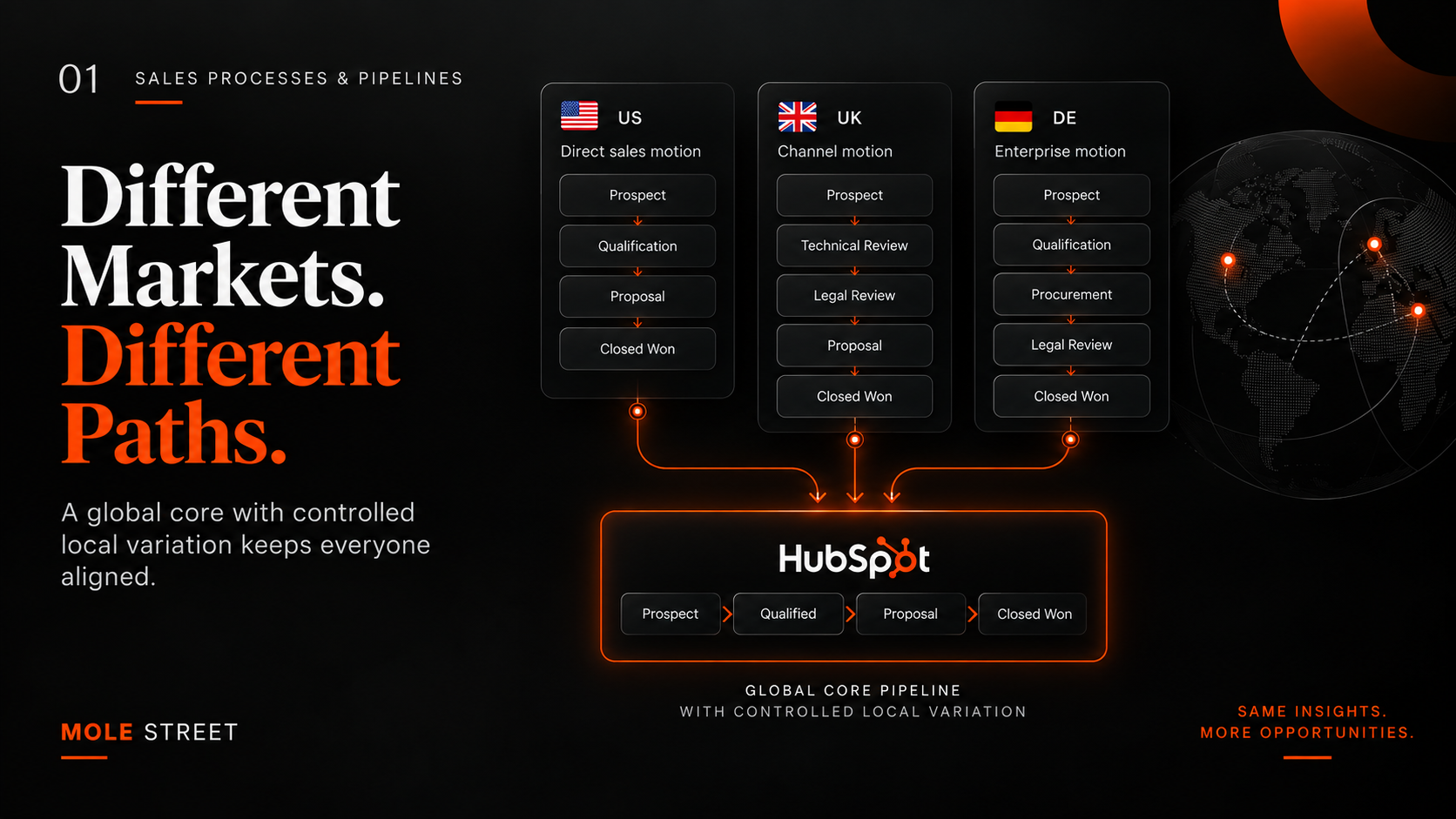
Sales teams in different countries run different motions, so a single rigid pipeline rarely fits them all. A deal in one region may pass through legal and procurement steps another region doesn’t have, and the stage names that make sense in one market confuse another. Force one pipeline on everyone, and reps stop updating it because it doesn’t match how they sell.
Define a global core set of pipeline stages that every region shares for reporting, then allow controlled variation beneath them. In HubSpot, you can run region-specific deal pipelines or use business units, while keeping a common set of core stages and definitions so leadership can still compare regions on a consistent basis.
2. Territories, Quotas and Compensation Don’t Map Across Countries
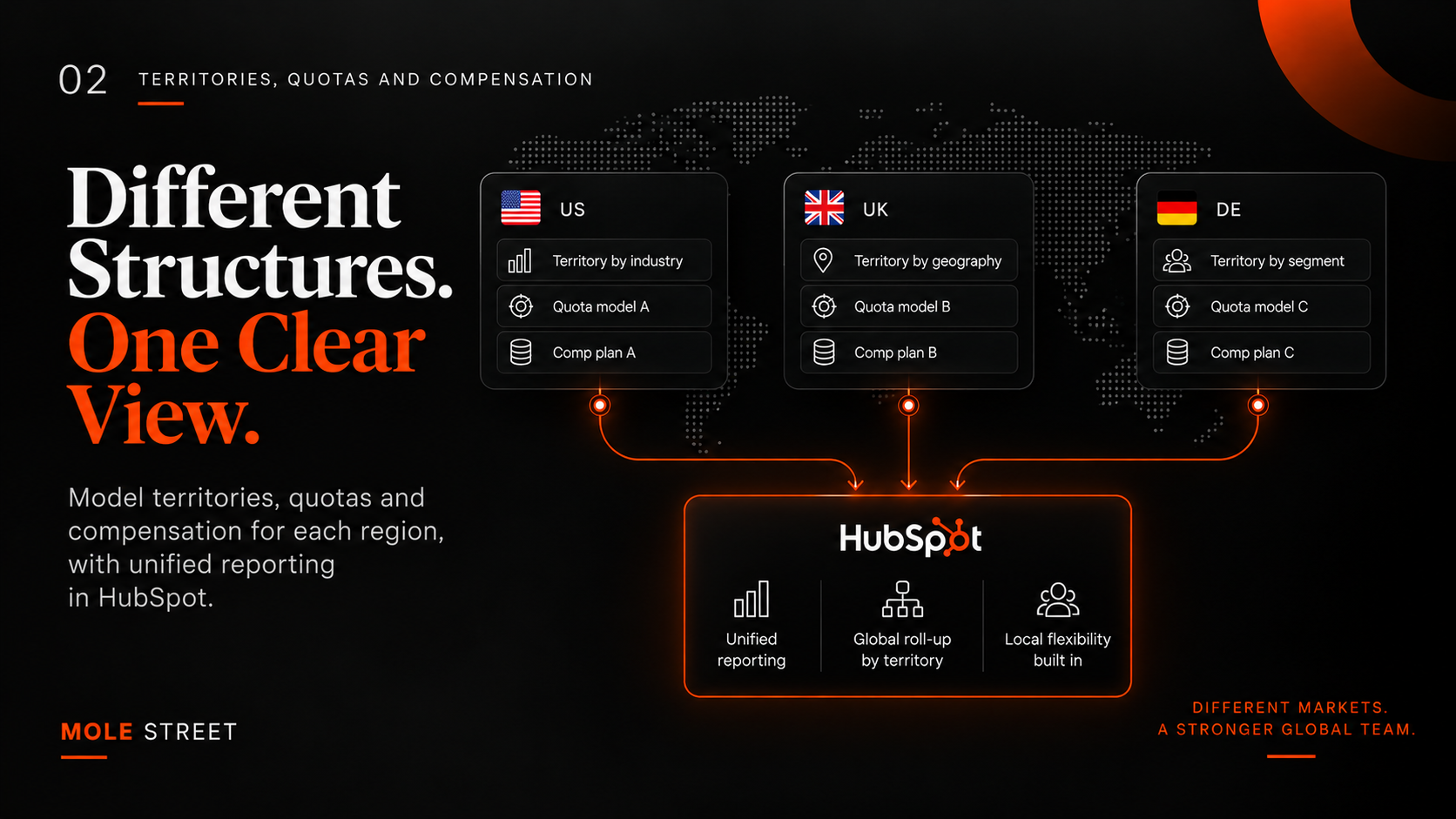
Territories, quotas and compensation are defined differently in each market, which makes a single global model hard to build and harder to report on fairly. One region assigns territory by industry, while another by geography, and comp plans vary with local norms and regulations. If the CRM forces a single structure onto all of them, the numbers stop reflecting reality.
Model territories and teams in HubSpot so ownership and reporting roll up cleanly, while keeping quota and compensation logic local. The goal is comparable reporting at the top, not identical rules underneath.
3. Currencies, Fiscal Calendars and Pricing Break Forecasting
Multiple currencies, different fiscal calendars and local pricing break global forecasting unless the CRM is set up to handle them. A pipeline reported in five currencies across three fiscal year-ends doesn’t roll into one forecast on its own, and manual conversion introduces errors every quarter.
The fix is HubSpot’s multi-currency support with a defined company currency and exchange handling, plus aligned reporting periods so regional numbers consolidate. Decide up front which currency leadership forecasts in, and set it before the first region goes live.

4. Data Governance and Privacy Rules Differ by Jurisdiction
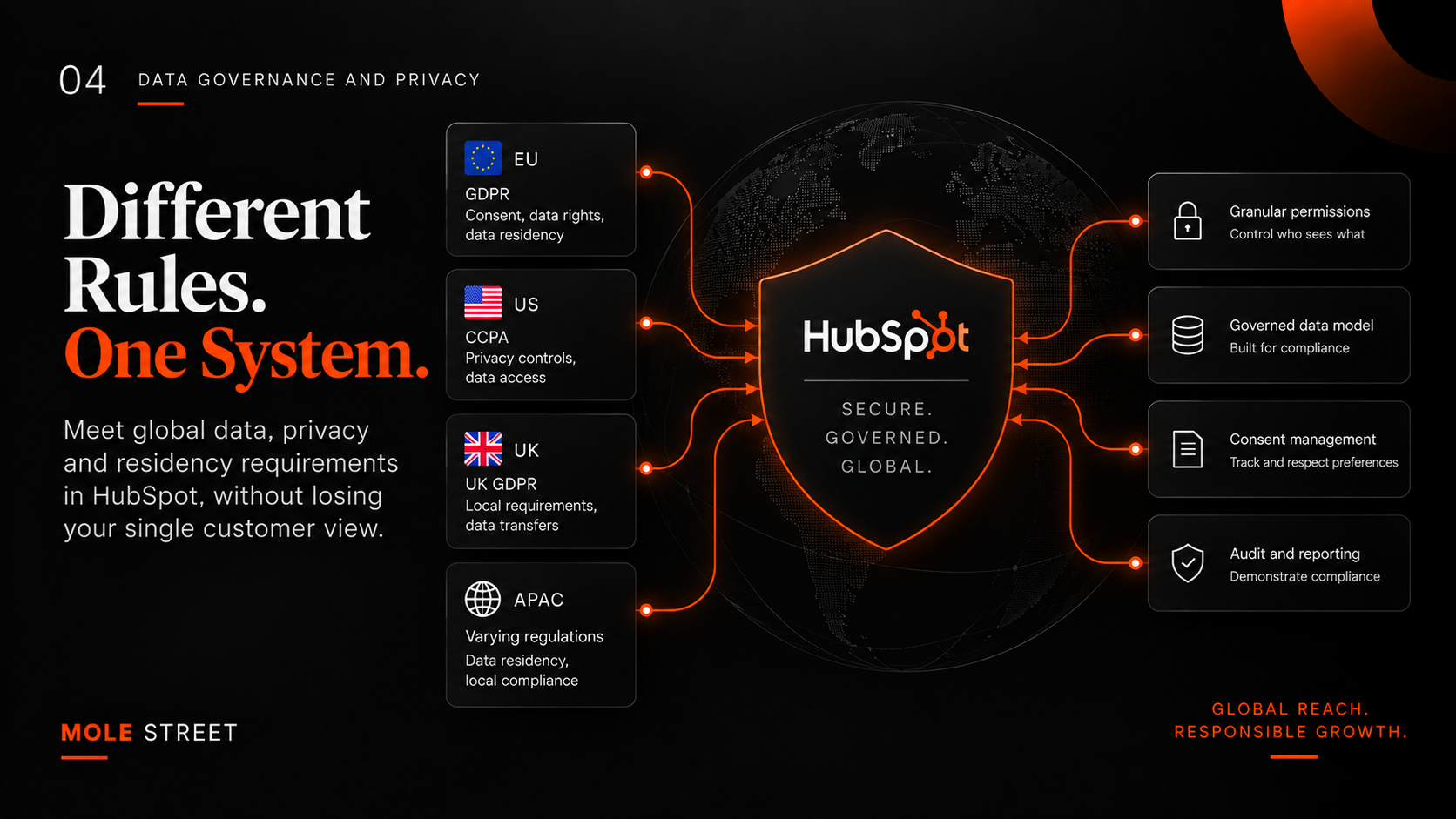
Every region has its own data protection and residency rules, so a single global data model has to satisfy several regulatory regimes at once. The General Data Protection Regulation (GDPR) in Europe and different consent and residency requirements elsewhere mean the CRM must comply with all of them without splitting your customer view into disconnected copies.
Build a governance model before you configure fields. Use HubSpot’s permissions and access controls to enforce who sees what and align your data handling with each region’s requirements. Governance is a design input here, not a cleanup task for later.
5. Local Teams Resist a Single Global Process
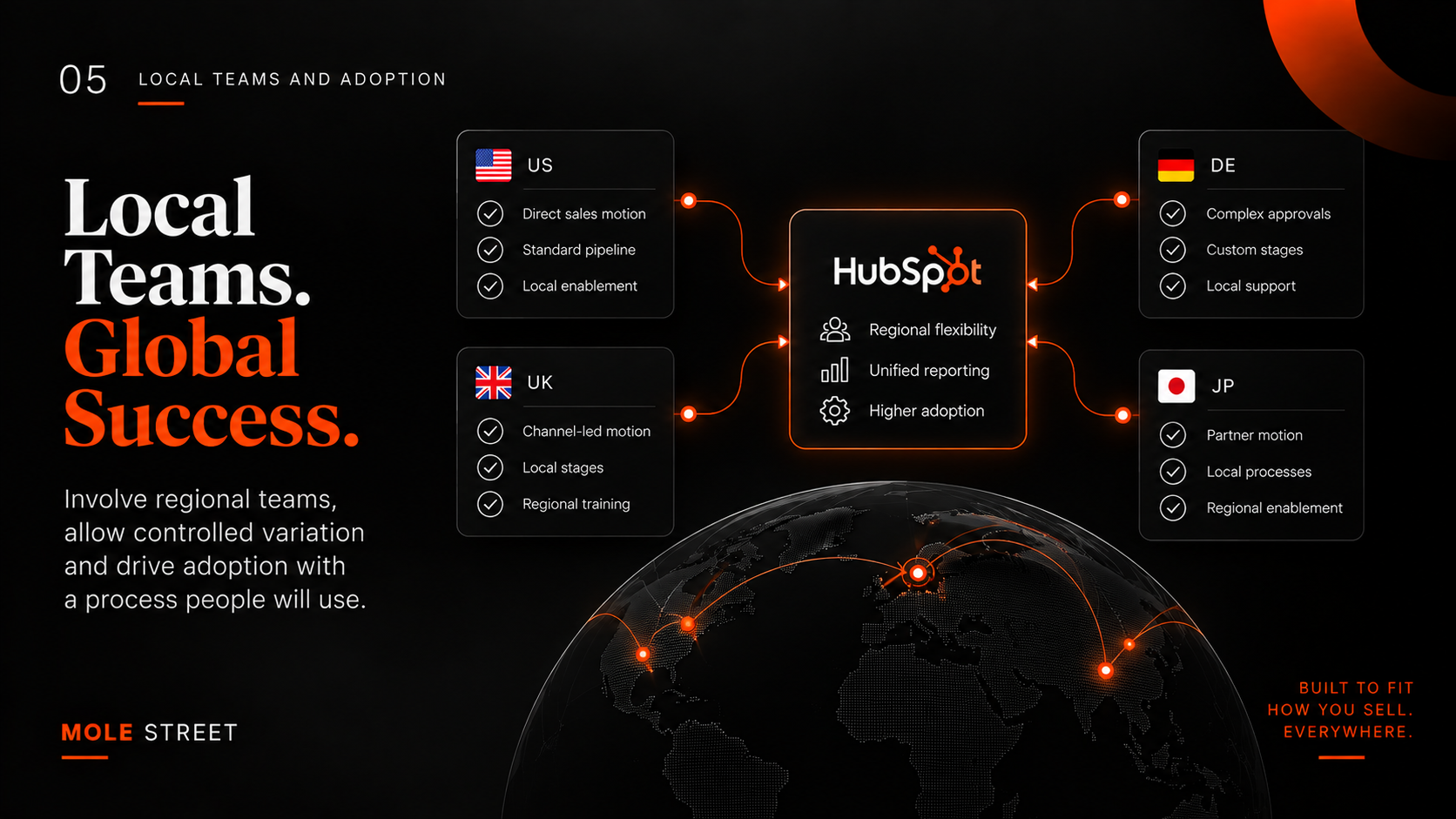
Adoption fails when the system is designed centrally and ignores how each region sells. If reps see a CRM that doesn’t fit their market, they keep their real pipeline in a spreadsheet and treat the CRM as an afterthought. Your global reporting then becomes fiction.
To avoid this, involve regional sales leads in the design, allow the controlled local variation described above and invest in enablement region by region. A process people helped shape is one they’ll use.
6. No One Has Decided What’s Global and What’s Local
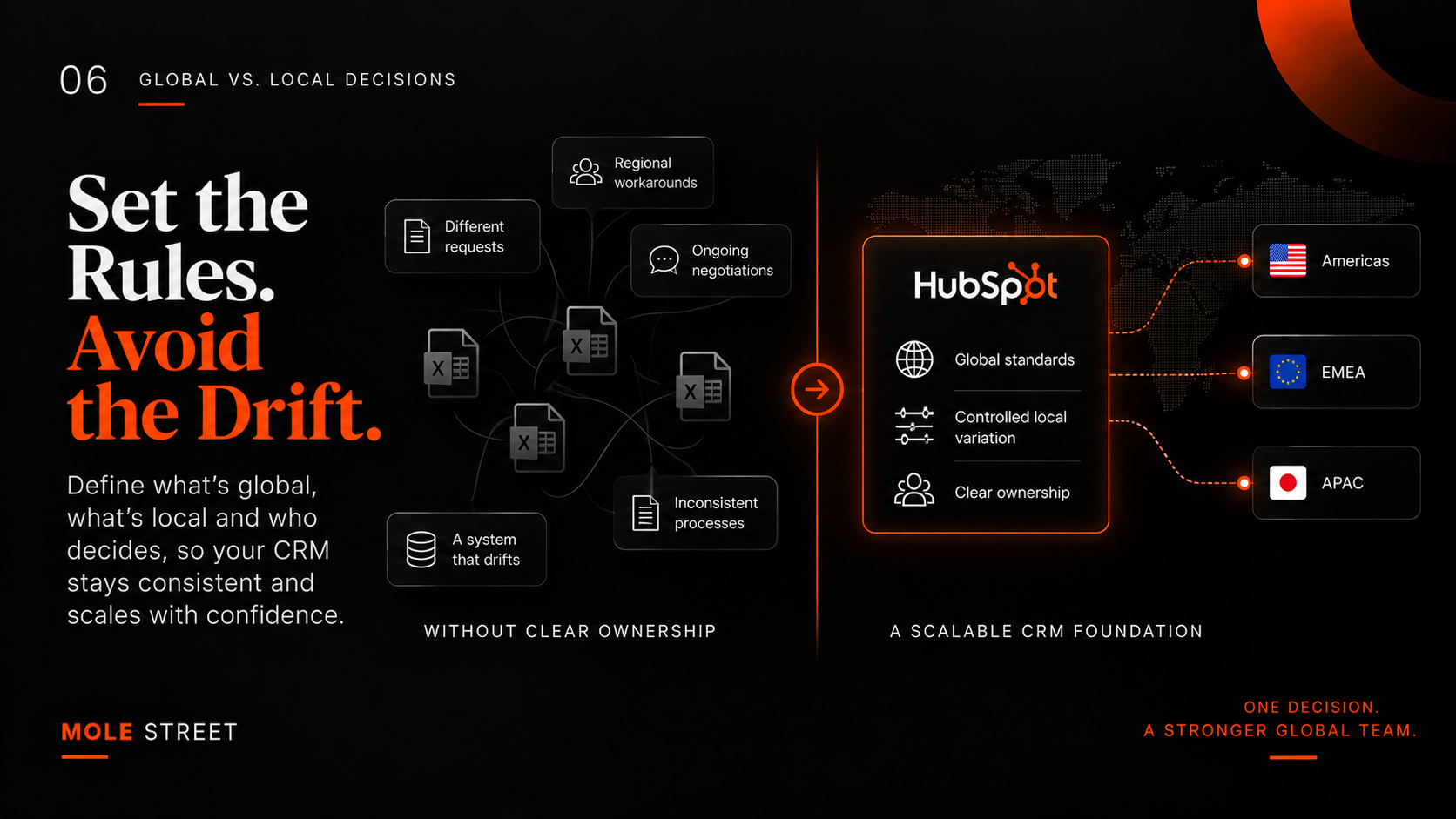
The most common root cause is that no one has decided what must be globally consistent, what can vary locally and who holds the authority to make that call. Without that decision, every regional request becomes a negotiation, and the system drifts toward one of the two failure extremes.
Establish a global template that names what’s fixed and what’s flexible, and give a single owner, usually a revenue operations function or a CRM governance council, the authority to approve local variations. This one decision prevents most of the other six problems.
7. Legacy and Regional Systems Fragment the Data
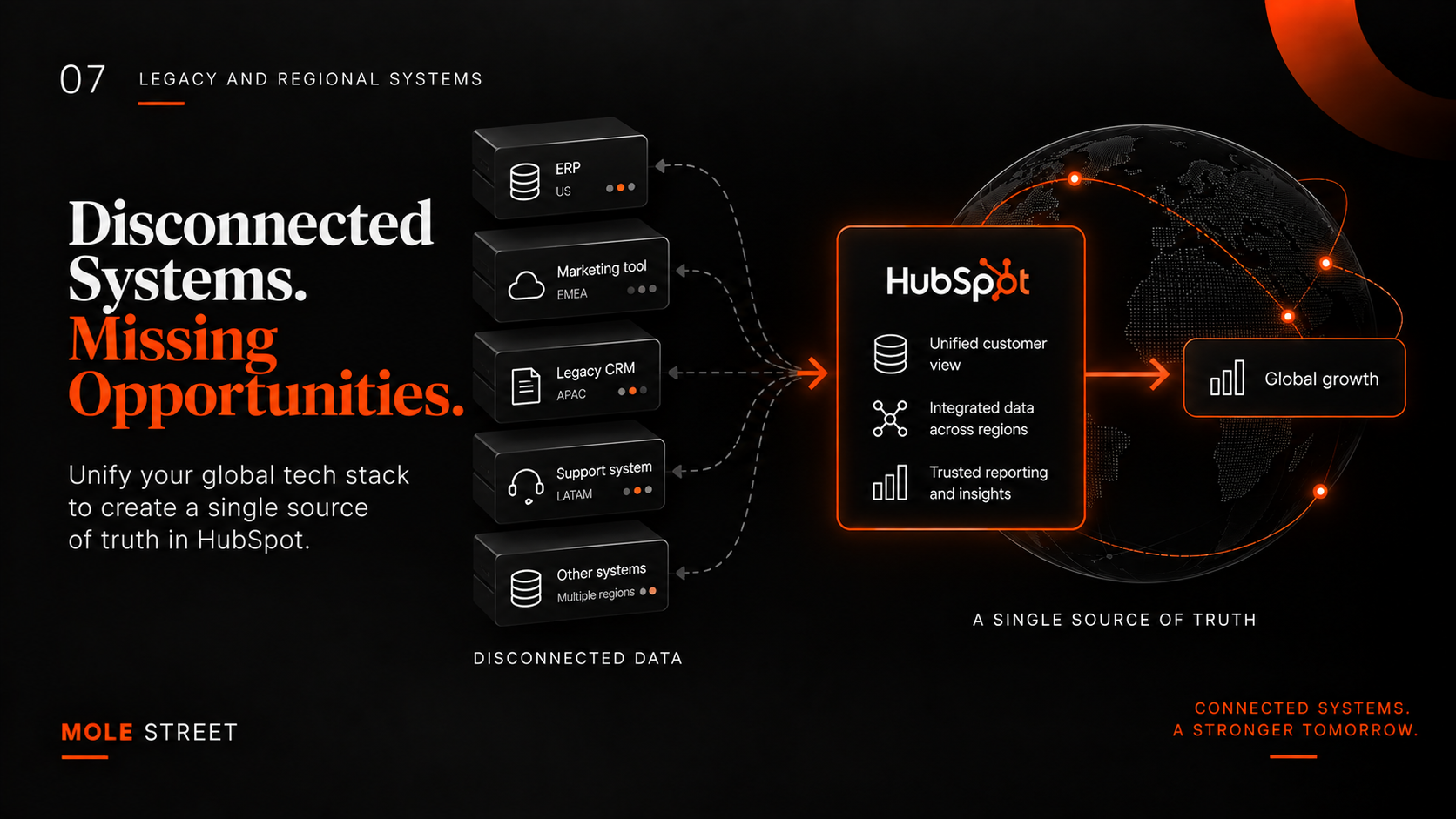
Each region often arrives with its own stack, so without a plan to unify them, the CRM inherits the fragmentation instead of fixing it. A region running its own marketing tool, enterprise resource planning (ERP) or support system leaves the customer record split across systems that don’t share data.
The fix is to consolidate those systems into a single source of truth rather than wiring each one to the next. A hub-and-spoke integration, where a central layer reconciles data from every region and feeds HubSpot, is what keeps a global customer view intact. We cover the mechanics in ourguide to synchronizing CRM data.
What Should You Standardize Globally vs. Allow Locally?
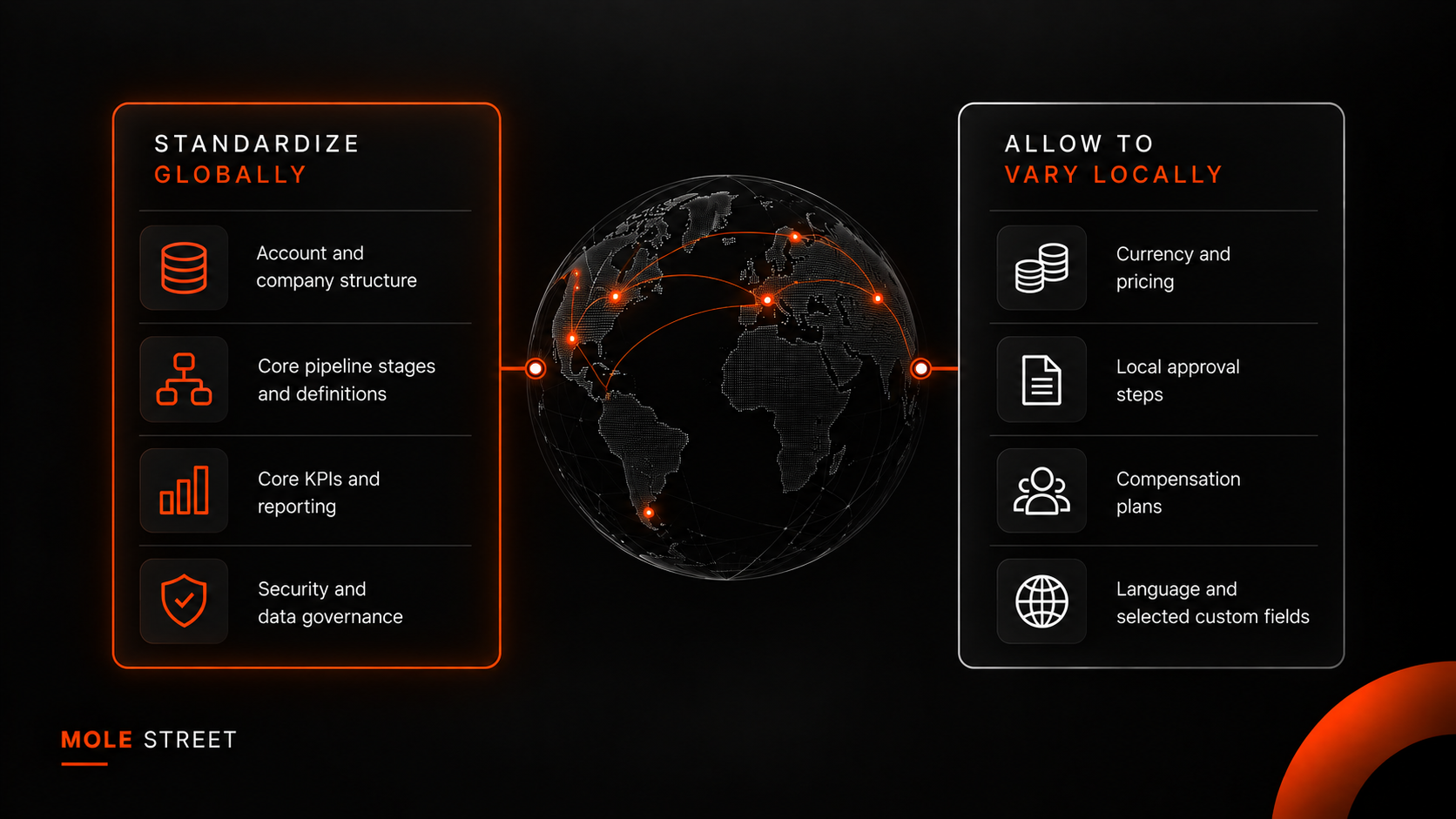
Standardize the things leadership needs to compare across regions, and allow the things that are genuinely local to vary. The split below is where most successful global rollouts land:
How Do You Prevent These Failures in a Global Rollout?
Treat the rollout as a governance program with a phased plan, not a single technical deployment. Name the owner who decides global vs. local. Agree on the global template before configuration, then roll out region by region with a parallel run so each market validates its setup before it commits. Standardize the core, allow controlled variation and keep one source of truth across every region. The mechanics of that phased approach are the same ones that decide any complex move, which we cover in ourguide to evaluating HubSpot migration services.
Get the Regions to Agree Before You Configure the CRM
Enterprises that want consistent, clean, and trustworthy data across global teams need to agree on what every region does the same way, what each one keeps control of, and who decides when they disagree. This needs to be done before building the CRM.
In most rollouts that means account structure, core pipeline stages and reporting definitions stay fixed, while currency, compensation and local approval steps are left to each market. Someone then has to own that line, usually a RevOps lead or a CRM governance council, so a regional request for an exception gets a decision rather than a debate.
Once that is agreed, HubSpot can hold a global core with controlled local variation: one pipeline structure leadership can compare, comp plans that stay local, and a single customer view across every region. The configuration work that follows is ordinary.
Frequently Asked Questions
What’s the biggest challenge in a global CRM implementation?
Deciding what must be consistent across every region and what’s allowed to vary locally, then giving someone the authority to enforce that line. Most technical problems in a global rollout trace back to that decision being skipped.
Should every region use the same CRM process?
Only for the core. Regions should share the same account structure, core pipeline stages and reporting definitions, while retaining local control over currency, compensation and local approval steps. That’s the model of a global core plus controlled local variation.
How do you handle multiple currencies and fiscal calendars in one CRM?
Use the CRM’s multi-currency support with a defined company currency and exchange handling. Align reporting periods so regional numbers consolidate. Decide which currency leadership forecasts in before the first region goes live.
Who should own a global CRM rollout?
A single owner with the authority to approve or decline local variations, usually a revenue operations function or a cross-regional CRM governance council. Without one clear owner, every regional request becomes a negotiation.
How long does an enterprise CRM implementation take across regions?
It depends on the number of regions and systems involved, but global rollouts are phased region by region and measured in months, not weeks. A parallel run per region adds time but removes the risk of a single global cutover.