Marketing Department

How to Align Banking CRM and Marketing Automation

12 min read
How to Align Banking CRM and Marketing Automation

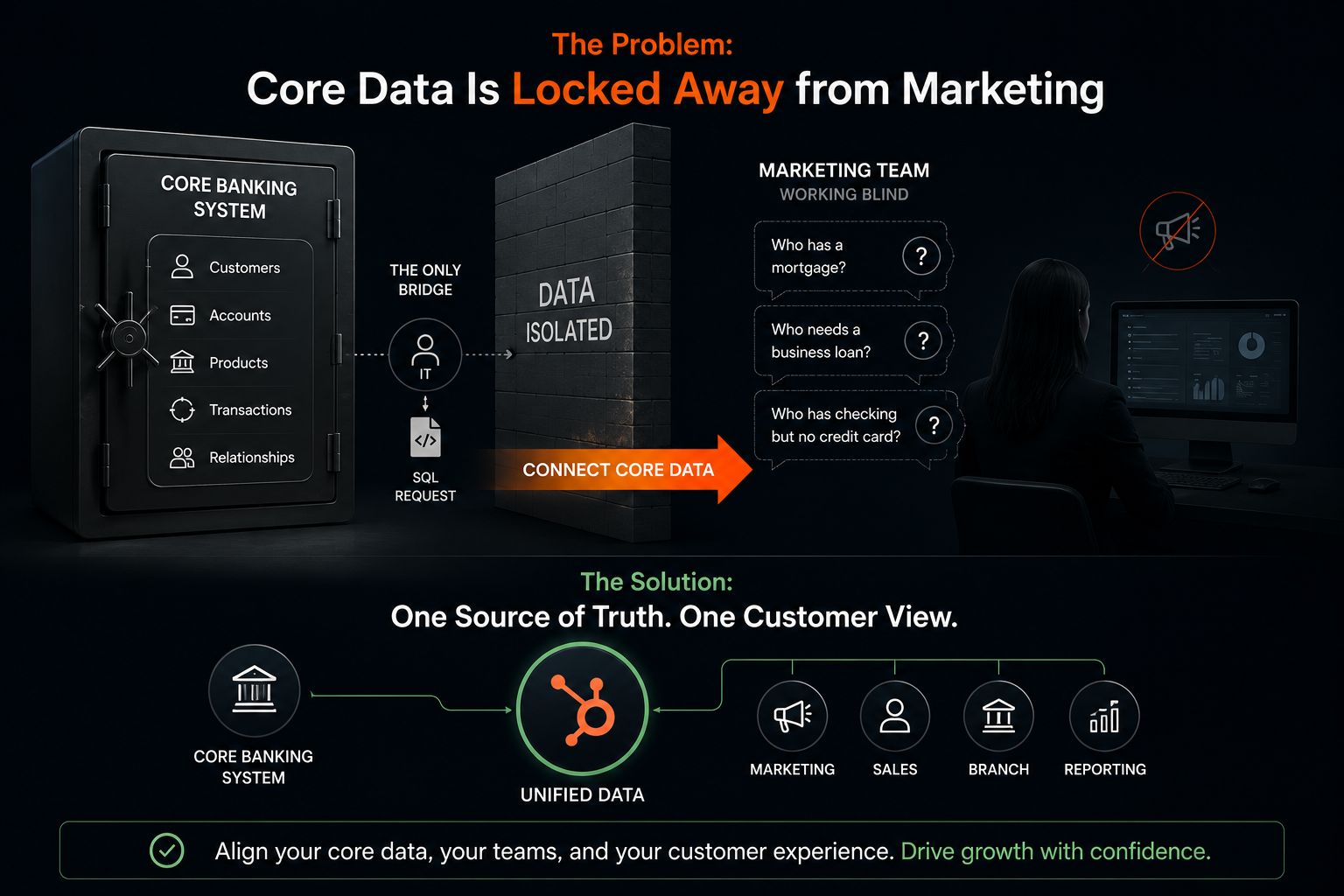
In most banks, the marketing team can’t identify which customers hold which products, and who is ready for the next one. The data exists inside the core banking system, where it’s governed by IT, but out of reach of the people running the campaigns.

This gap is the real barrier to Customer Relationship Management (CRM) implementation for banking, and it’s why marketing and sales so often work from different versions of the truth.

Aligning your financial institution CRM and your marketing automation doesn’t require purchasing new software. It’s a data and process problem that banks can solve by connecting their core data into one system, agreeing on shared definitions, and building governance in from day one.

The stakes that come with this level of change aren’t small. In the HubSpot 2026 State of Marketing Report, only 66% of Business-to-Business (B2B) marketers rate their data as high quality, which means roughly a third are working from data they don’t fully trust. For a regulated bank, acting on untrusted data is not only a wasted campaign, but it’s a compliance exposure.

In this guide, you'll learn:

  • Why banks struggle to align CRM and marketing automation
  • What makes CRM implementation uniquely hard for midsize banks
  • A six-step framework to align your CRM, marketing automation, and teams
  • What the aligned setup looks like after it’s been built in HubSpot
ChatGPT Image Jul 28, 2026, 03_41_26 PM

Why Do Banks Struggle to Align CRM and Marketing Automation?

Banks struggle to align CRM and marketing automation because their most useful customer data lives in the core banking system, not the CRM, and marketing can’t reach it without going through IT. The problem isn’t the tools, but the wall between the data and the people who need it.

That wall shows up in four predictable ways:

  • Core data is siloed. Product, transaction, and relationship data sit in a core platform such as Jack Henry Symitar or Fiserv, which are built for processing accounts, not running marketing
  • Marketing depends on IT for everything. Every campaign list means a ticket and an SQL query, so marketing moves at the speed of the IT backlog
  • There is no shared definition of a lead or a member journey. Marketing counts one thing, the branch counts another, and no one agrees on what "ready to buy" means
  • Compliance limits who can touch what. Sensitive data can’t be exported into a marketing tool without controls, so it often stays locked away entirely

The result is familiar to any bank marketer. In the same HubSpot research, 13% of teams say they still struggle to share data across their own organization, and in banking that challenge is felt every day. When Mole Street began working with Keesler Federal Credit Union, Mississippi's largest financial cooperative at $5 billion in assets, every campaign required IT approval and a manual query. The data was there, but marketing couldn’t reach it.

What Makes CRM Implementation Hard for Midsize Banks Specifically?

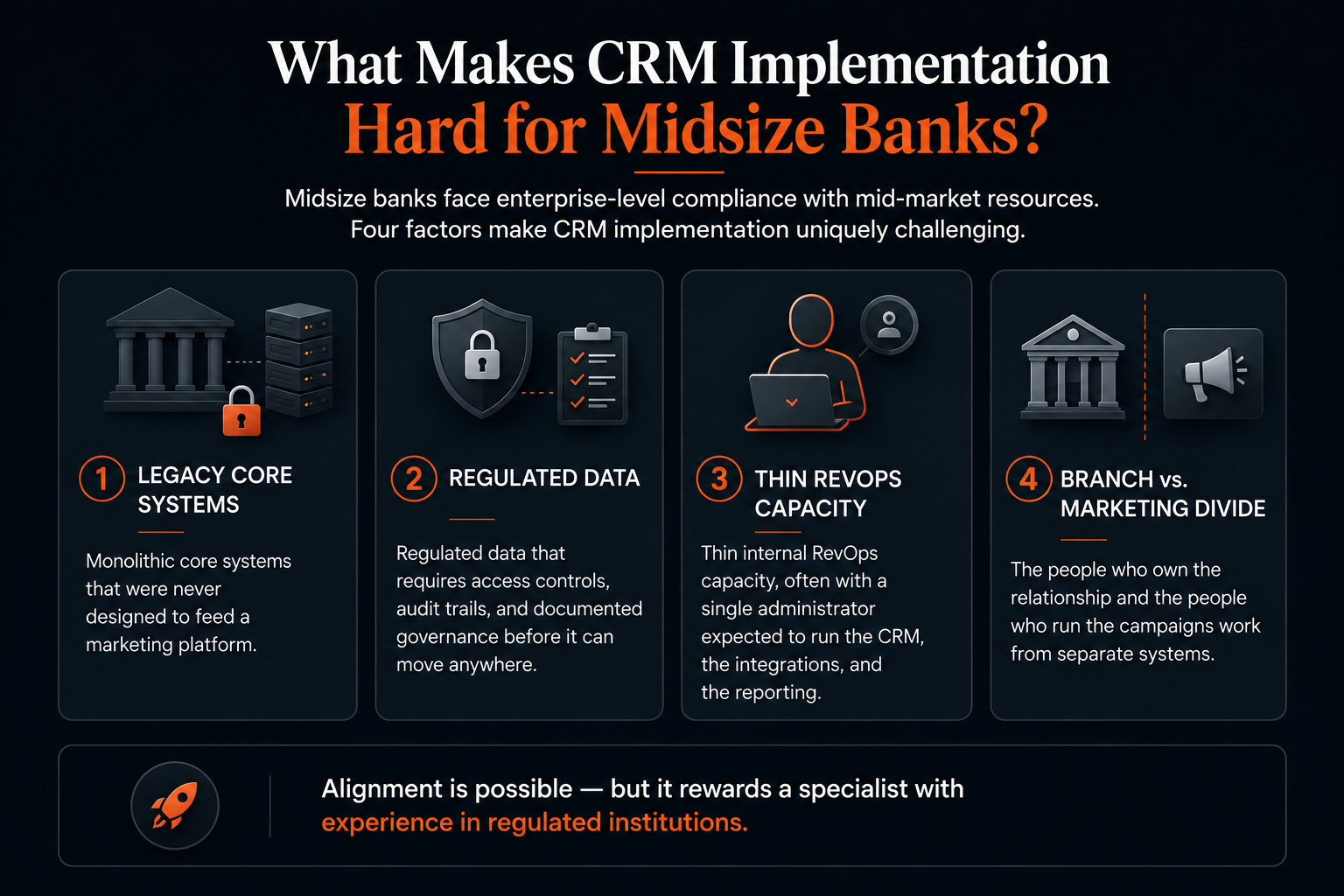
CRM implementation is hard for midsize banks, as they face the same regulated-data demands as the largest banks but with a fraction of the internal resources to meet them. They have the compliance obligations of a large enterprise and the team size of a mid-market company.

Four factors make CRM implementation harder for banks of this size:

  • Legacy, monolithic core systems that were never designed to feed a marketing platform
  • Regulated data that requires access controls, audit trails, and documented governance before it can move anywhere
  • Thin internal RevOps capacity, often with a single administrator expected to run the CRM, the integrations, and the reporting
  • Branch-versus-marketing data divides, where the people who own the relationship and the people who run the campaigns work from separate systems

None of these factors make alignment impossible. Instead, alignment becomes a project that rewards a specialist with previous experience inside a regulated institution before, rather than relying on a generalist to learn your compliance obligations on your timeline.

ChatGPT Image Jul 28, 2026, 03_44_33 PM


Want Your Bank's CRM and Marketing Automation Working as One System?

Book a call with one of Mole Street's Solutions Architects to map out what aligning your CRM and marketing automation would take at your bank. On the call, you'll see how your core banking system connects into HubSpot, learn where the compliance controls need to sit, and get a realistic timeline for giving your marketing team autonomy from IT.

Schedule Your Consultation Now

How Do Banks Align CRM and Marketing Automation?

Banks can align CRM and marketing automation in six steps, starting with one source of truth and ending with a governed, phased rollout. The sequence matters because most failed implementations skip straight to campaigns before the data underneath is trustworthy. Here are the steps to align CRM and marketing automation:

  1. Integrate the core banking system as one source of truth. Connect the core platform to the CRM so that customer and product data flows in automatically, without a manual export. This is the foundation everything else stands on.
  2. Model customers, accounts, and households as custom objects. A person, an account, and a household are different things. Model them properly so a shared family email never collapses two customers into one record.
  3. Define shared lifecycle stages across marketing, sales, and the branch. Agree on the definition of a lead, an opportunity, and a product holder, so every team reads the same journey the same way.
  4. Build governance and compliance controls into the data model. Set permissions on sensitive fields, document how data moves, and design for the audit before it arrives.
  5. Connect marketing automation to the unified data. With clean, governed data in place, segmentation and triggered journeys finally run on what customers actually hold, not on a stale list.
  6. Plan the rollout: training, adoption, and a phased go-live. Roll out in stages, train the teams who live in the system, and measure adoption, because a CRM no one uses aligns nothing.

How Has Mole Street Aligned CRM and Marketing Automation for Banks?

Two Mole Street builds show the framework in practice, one at a community bank and one at a credit union.

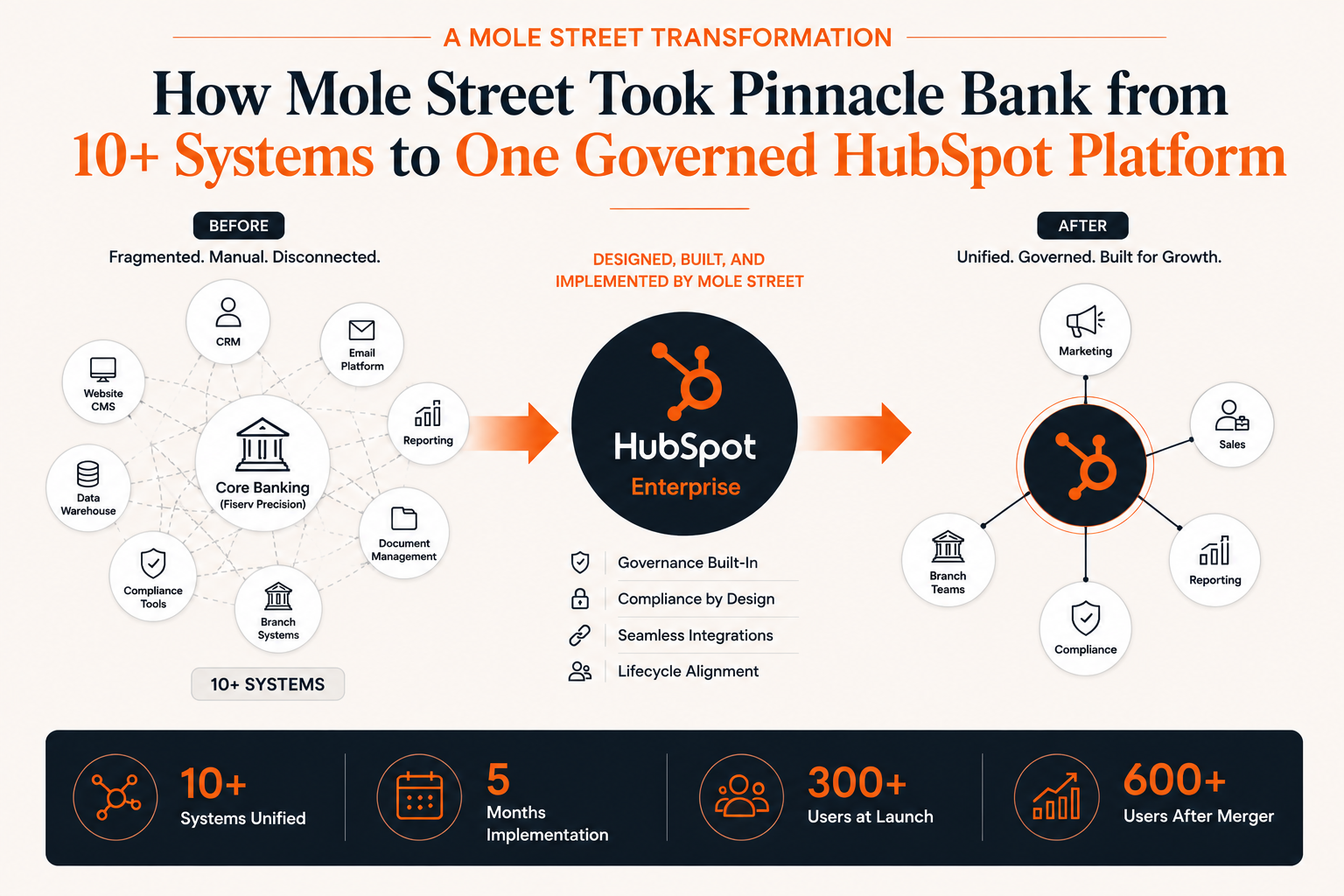
This is the exact sequence Mole Street followed at Pinnacle Bank, a $2 billion community bank serving sixteen counties in Georgia. The bank came off a legacy CRM and onto HubSpot Enterprise, with its Fiserv Precision core feeding in through a nightly integration and more than ten disconnected systems consolidated into one platform.

Governance was built in from the start, with Reg E deadlines auto-calculated inside the workflow. The rollout was phased, moving from roughly 300 users at go-live toward 600 after an incoming merger, and the full build ran in about five months.

Step five is where that groundwork pays off. At Canyon View Credit Union, Mole Street replaced Salesforce Marketing Cloud and connected the Symitar core, so segmentation and triggered journeys finally ran on what members actually held.

The result was more than 700 new members attributed to online signups, from data the marketing team could finally act on.

ChatGPT Image Jul 29, 2026, 10_03_56 AM

What Does This Look Like in HubSpot?

In HubSpot, alignment means modeling banking relationships as custom objects, piping core data in through a secure connector, and building the customer journey into lifecycle stages and automation. The platform is capable of it, but only when a specialist architects it for how a bank actually operates.

A strong build uses HubSpot's enterprise capabilities to turn locked core data into a working system:

  • Custom objects for members, accounts, and households, so the data model reflects real banking relationships instead of forcing everything into contacts and deals
  • A secure core-banking integration through a connector such as Kinective or Datava, syncing core fields into HubSpot on a governed schedule
  • Lifecycle stages and lead scoring built for the customer journey, so marketing automation is triggered by real product-holding behavior
  • Governed permissions on sensitive fields, so the data moves without breaching compliance

The proof is in the work. At Keesler Federal Credit Union, Mole Street wired 97 fields of Jack Henry Symitar data into HubSpot through a daily Kinective sync and delivered 100% marketing autonomy with 85% faster campaign launches in under 90 days.

At PSECU, a $7-billion institution, the replatforming passed every post-launch security and compliance audit. It was aligned, governed, and built to hold up under review.

Marketing, Sales, and the Branch Align When the Core Data Does

The banks that align CRM and marketing automation don’t start by buying a tool. They start by moving their core data into one governed system that marketing, sales, and the branch all trust. Everything else – the campaigns, the automation, the reporting - is built on that foundation.

For a midsize bank, that’s the difference between marketing that waits on IT and marketing that runs on its own. Instead of having a system your team works around, you now have one it works in. And rather than hoping your data is right, you now have data you can defend to an auditor.

Mole Street builds exactly that. As a HubSpot Financial Services Industry Specialist and a SOC 2-compliant partner, Mole Street has aligned CRM and marketing automation for banks and credit unions from $5-billion institutions to fast-growing regional players, connecting the core, governing the data, and giving marketing the autonomy to grow.


Get a Clear Path to Marketing Autonomy at Your Bank

Book a call with a Mole Street Solutions Architect to scope the build for you. You'll see how your core banking system connects into HubSpot, where the compliance controls need to sit, and how soon your marketing team can launch campaigns on its own.

Schedule Your Consultation Now

Frequently Asked Questions

How do banks coordinate marketing automation and CRM implementation effectively?

By treating them as one project, not two. The bank integrates its core banking data into the CRM first, agrees on shared lifecycle definitions, then connects marketing automation to that unified data so campaigns run on what customers actually hold.

Why do banks struggle with CRM implementation across marketing and sales?

Because the most valuable customer data sits in the core banking system, not the CRM, and marketing usually can’t access it without IT. Without a shared data model and shared definitions, marketing and sales work from different versions of the truth.

What makes CRM implementation hard for midsize financial institutions?

Midsize banks face enterprise-level compliance and regulated-data demands with far smaller internal teams, often a single CRM administrator, plus legacy core systems that were never built to feed a marketing platform.

How long does a banking CRM implementation take?

It varies with integration complexity and data quality, but a focused, well-scoped build can reach marketing autonomy in around 90 days. Timelines stretch when the core integration and compliance governance are treated as afterthoughts rather than the starting point.

Does marketing need IT for every campaign after a proper CRM implementation?

The goal of a proper implementation is marketing autonomy: once core data flows into the CRM on a governed schedule, marketing builds and launches campaigns without a ticket to IT for every list.

Want to Take The First Step Forward to a Unified Tech Stack?