ChatGPT for Accountants: How to Appear in AI Search Results That Drive New Business

Answer engine optimization (AEO) is now a new avenue for client acquisition. AI is now being used to research firms, validate referrals, and decide who gets the call. That's why ChatGPT for accountants is no longer just about drafting emails, but about getting named when a buyer asks AI which firm to hire.
The reality is that 73% of B2B buyers now use AI tools during the research stage, and AI-driven referral traffic in the US grew more than tenfold between July 2024 and February 2025 (Adobe, 2025).
Referrals still arrive the way they always have, but before picking up the phone, the prospect now asks ChatGPT whether your firm actually does the work. If your specialization isn't in the answer, the call rarely happens.
HubSpot's new AEO product, launched April 14, gives accounting firms the first connected way to see and influence what AI says about them.
In this blog, you will learn:
- How ChatGPT now decides whether your referrals close
- How to appear in AI search for the queries your buyers use
- Five actions to win new business through AI search this quarter
Why Is ChatGPT Now a Factor in Accounting Firm Growth?
ChatGPT holds roughly 64.5% of the AI chatbot market as of early 2026, with Gemini at 21.5% and Perplexity at 2%, according to Similarweb data. When a CFO opens an AI tool to vet a referral, they are most often opening ChatGPT. The same dynamic applies across Gemini, Perplexity, and Google's AI Overviews, but ChatGPT tends to be the default option for most people and businesses.
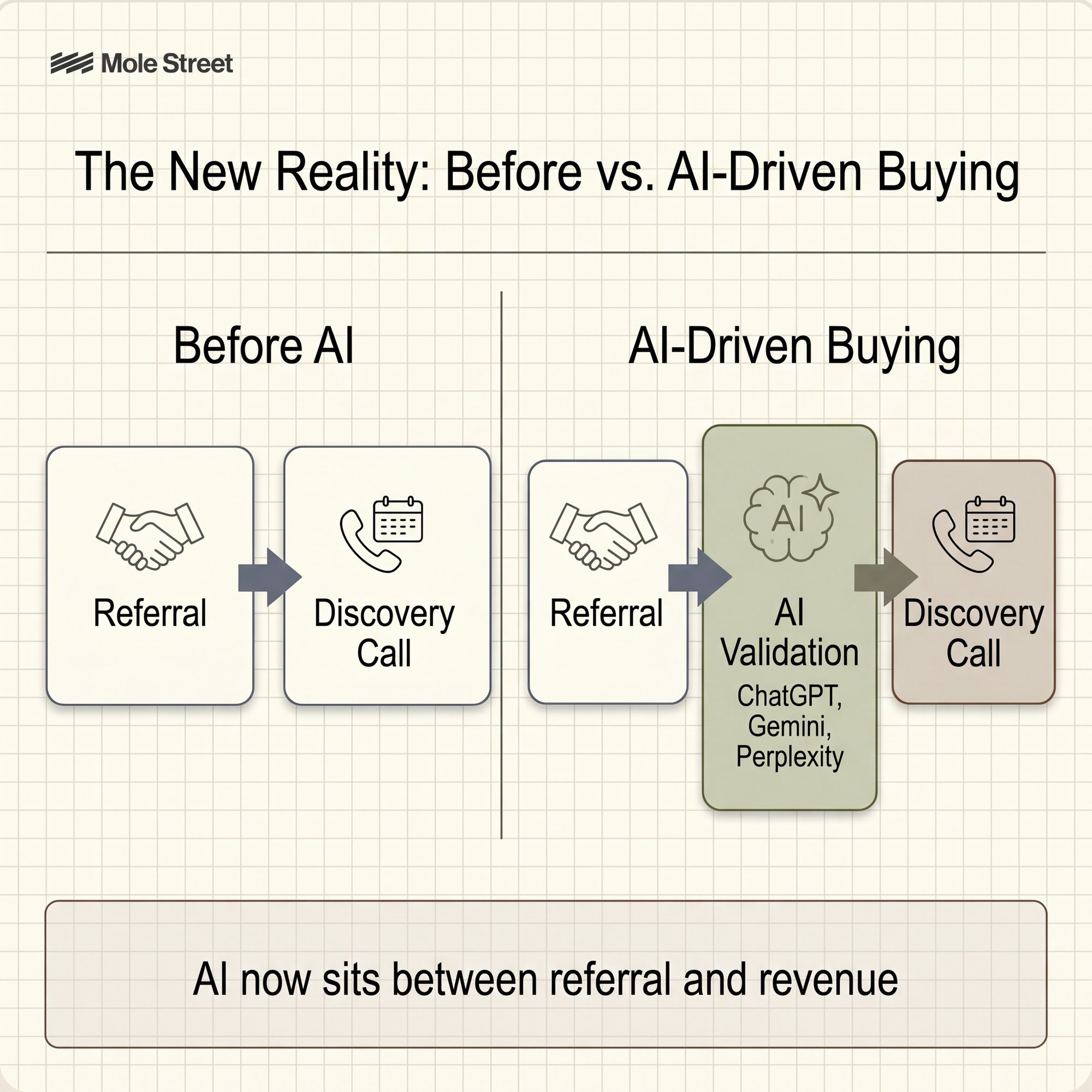
Moreover, ChatGPT has essentially inserted itself into the validation step between a referral and a booked discovery call. Buyers use it to confirm whether the firm they were recommended actually has the expertise the referral implied.
Here's how that plays out in practice…
A board member recommends your firm for an R&D tax credit study. The CFO writes the name down. Then, before reaching out, the CFO opens ChatGPT and asks, "What's the best mid-market accounting firm for R&D tax credits in the Midwest?" Your firm has done this work for fifteen years. Your name does not appear in the answer. The CFO books the call with the firm ChatGPT named instead.
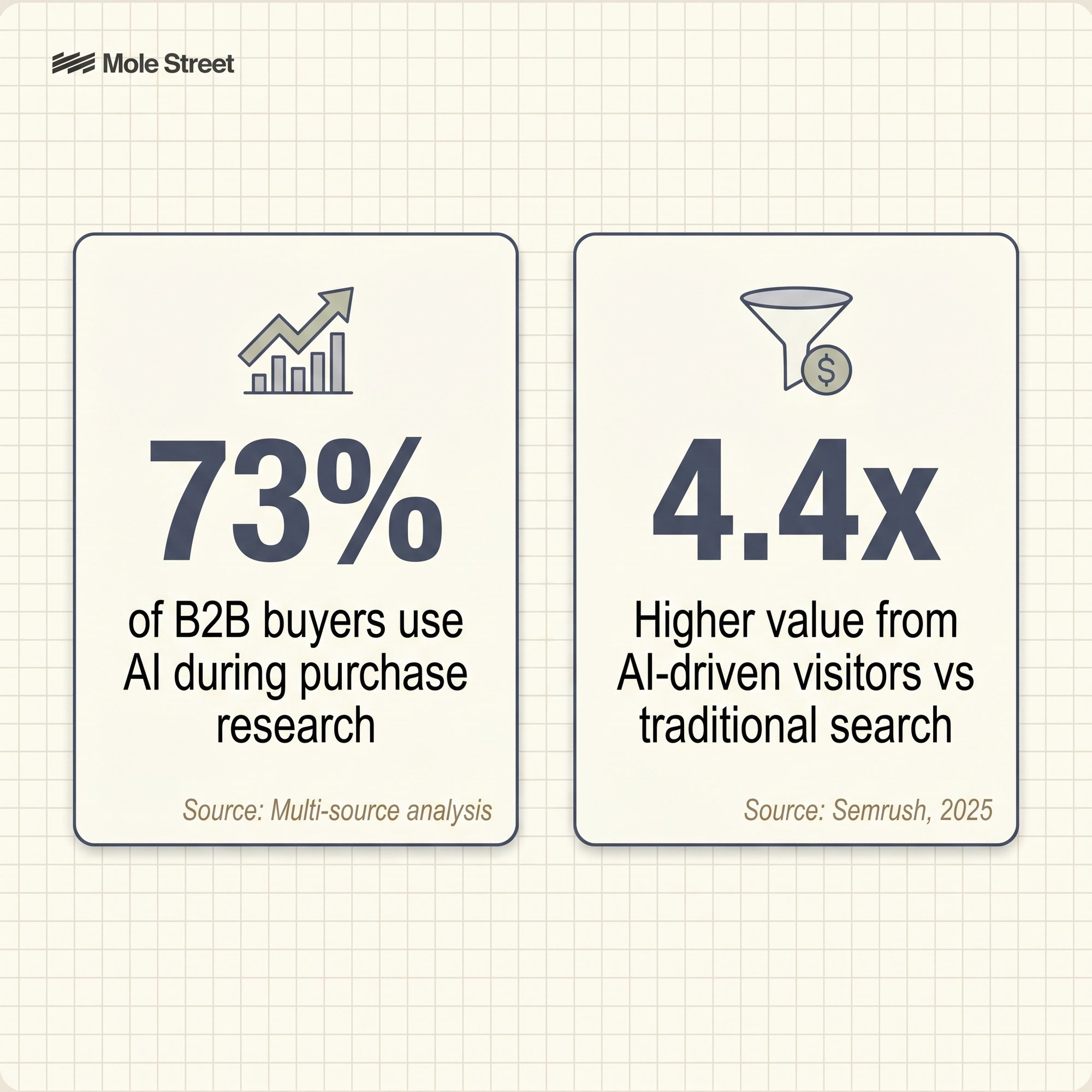
That sequence is no longer rare. A recent multi-source analysis found that 73% of B2B buyers now use AI tools during purchase research. Accounting firm AI adoption itself jumped from 9% to 41% in a single year in markets like Virginia, according to reporting from Virginia Business. The buyers are using AI. So are the firms they evaluate.
For Mole Street's accounting firm clients, this is the most consequential shift in lead flow since the move to inbound. Referrals still drive the pipeline. AI now decides whether the referral closes.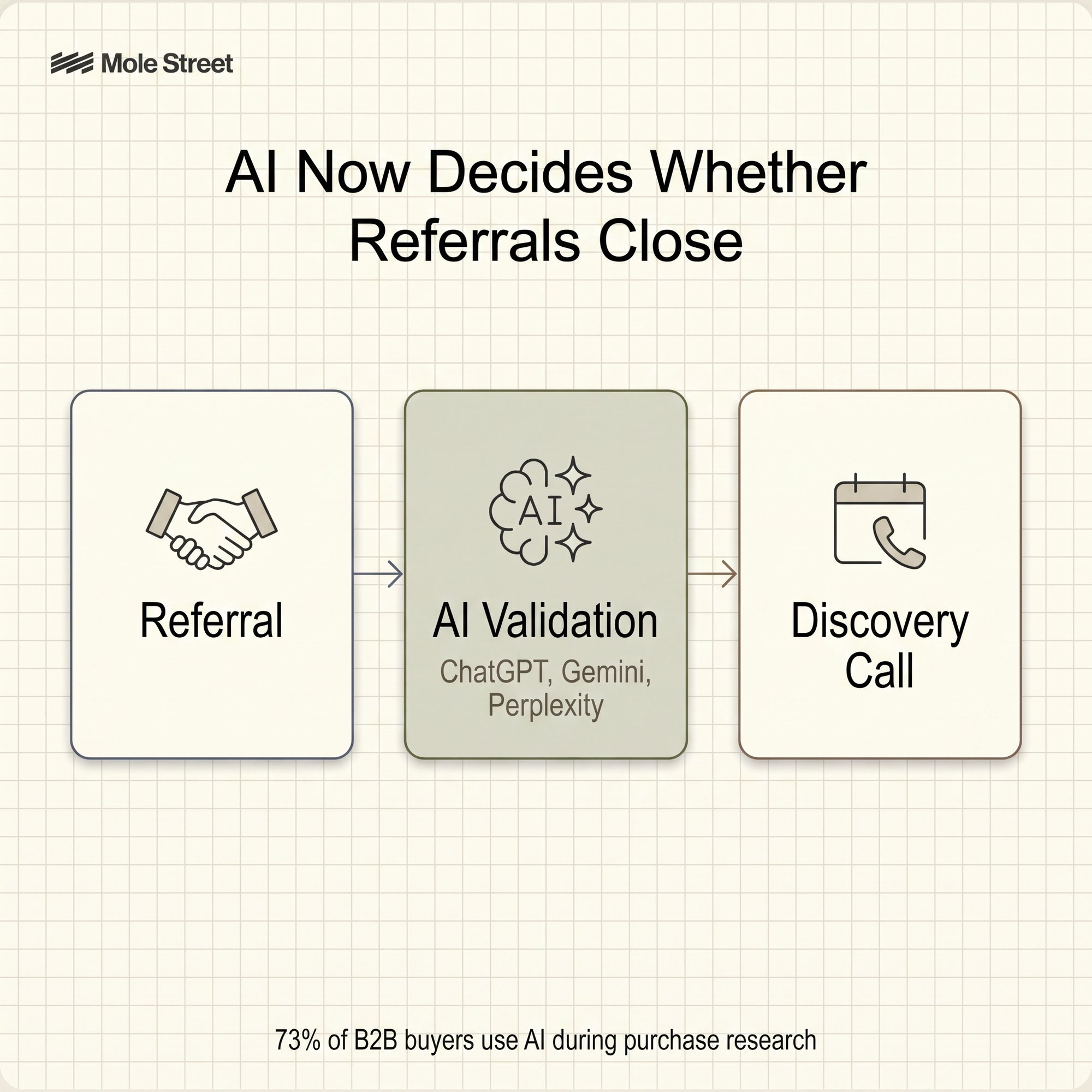
How is AI Search Different From Google for Accounting Firm Buyers?
Traditional search returned a list of options and let the buyer choose. AI search synthesizes one answer, picks a small set of named firms, and presents that set as the recommendation.
The shift has three implications for accounting firms specifically:
- Less control over discovery. If your specialization is not surfaced in the AI's first answer, you may never enter the consideration set. The buyer rarely scrolls past the synthesis to read the source links.
- Higher buyer intent on arrival. Visitors who reach your site through AI tools convert at significantly higher rates. According to Semrush (2025), the average AI search visitor is 4.4 times more valuable than a traditional organic search visitor, based on conversion rate. The buyer has already evaluated. The site visit is closer to a closing call than a research click.
- Specialization becomes a content question. Whether a firm is known for ESOP advisory, construction accounting, SaaS revenue recognition, or international tax now depends on whether AI has enough citable content to associate the firm with that work.
The buyer arrives qualified, with the question of who to hire already half answered.
Why Are Accounting Firms Especially Exposed in AI Search?
Three structural factors make accounting firms more vulnerable to AI visibility gaps than most industries: Big Four citation dominance, the way AI flattens specialization, and the elevated trust threshold buyers apply to advisory work.
The Big Four Dominate AI's Picture of Accounting
The Big Four (Deloitte, PwC, EY, and KPMG) audit more than 80% of U.S. public companies and posted a combined $219 billion in revenue in 2025, according to Statista. That dominance carries directly into AI citation patterns. LLMs trained on the open web disproportionately surface brand names with decades of press, SEC filings, academic citations, and Wikipedia presence. Deloitte, PwC, EY, and KPMG have all four.
The Big Four don't dominate accounting. They dominate AI's picture of accounting.
For mid-market and specialist firms, the picture is even sharper. A regional firm that is the leading R&D tax credit specialist in its market may have done more original work in its niche than any Big Four firm, and still not be cited, because the AI does not have enough referenceable content to draw from.
AI Strips Out the Specialization That Drives Accounting Firm Growth
Specialization is the entire growth engine for most mid-market accounting firms. A firm known for ESOP transactions wins ESOP work. A firm known for construction accounting wins construction work. The brand is the niche.
AI summarization works against this. When asked "the best accounting firm for [vertical]," LLMs frequently flatten the answer into a list of generalist names recognizable from training data. The specialist gets cut. The generalist who once won a single high-profile engagement in that vertical gets surfaced.
Trust and Compliance Framing Carry More Weight in This Industry
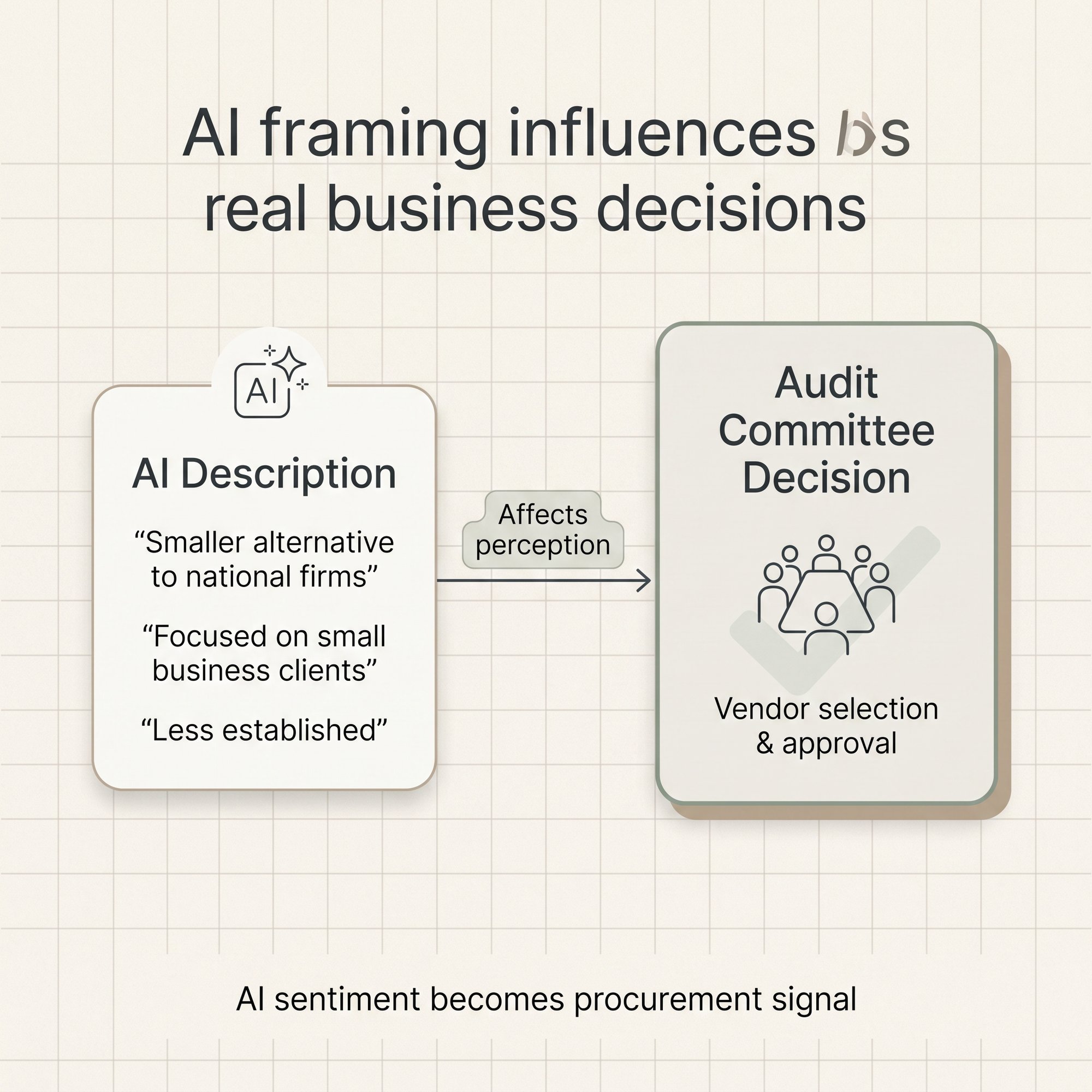
Accounting firms operate under regulated trust. Engagement letters require partner approval, audit committees vet new providers, and large clients run procurement processes. The way AI describes your firm matters more than a sentiment score on a marketing dashboard.
If ChatGPT frames your firm as "a smaller alternative to national firms," "primarily focused on small business clients," or "less established," that framing reaches the audit committee before your team does. In this industry, AI sentiment is procurement signal, not a vanity metric.
How to Use HubSpot's AEO Tool to Show Up When Buyers Ask ChatGPT
HubSpot AEO measures how often and how favorably your firm appears in ChatGPT, Gemini, and Perplexity, then uses your CRM data to recommend the prompts and content most likely to move the needle.
HubSpot AEO launched at the Spring 2026 Spotlight on April 14. Four features map directly to accounting firm growth.
Brand Visibility and Sentiment: Track AI Mentions and Framing
The tool tracks how often your firm appears in AI-generated responses and how it is described when it does. A regional firm specializing in not-for-profit audits might learn it appears in only 12% of relevant AI responses, and when it does, the framing positions it as a smaller alternative to national firms. That insight tells the partner team exactly what story the content needs to tell.
Competitive Share-of-Voice: Benchmark Against Named Competitors
AEO benchmarks your AI presence against named competitors. A firm specializing in R&D tax credits might discover that AI engines cite Big Four firms in 80% of R&D credit queries, even though the firm has published more original content on the topic than any of them. That gap becomes the content roadmap for the next two quarters.
Prompt Tracking Tied to Your CRM: Monitor Pipeline-Driving Queries
This is HubSpot's actual differentiator. Most AEO tools force teams to start from a blank page when defining which prompts to monitor. HubSpot uses the products, target industries (construction, manufacturing, professional services, healthcare), and competitive context already in the CRM to surface the prompts that map to real pipeline. Partners stop guessing at queries and start tracking the ones tied to engagement letters.
Citation and Content Gap Analysis: Find Publications to Break Into
The tool shows which sources AI engines pull from when answering relevant queries. If responses on construction accounting consistently cite Construction Executive, AGC of America, and three competitor firms, the firm sees exactly which publications and content types it needs to break into.
In HubSpot's beta, customers using AEO and prioritizing answer engines saw referral traffic grow 20% compared to brands not using the tool. Brands cited as sources within AI Overviews receive 35% more organic clicks than non-cited brands.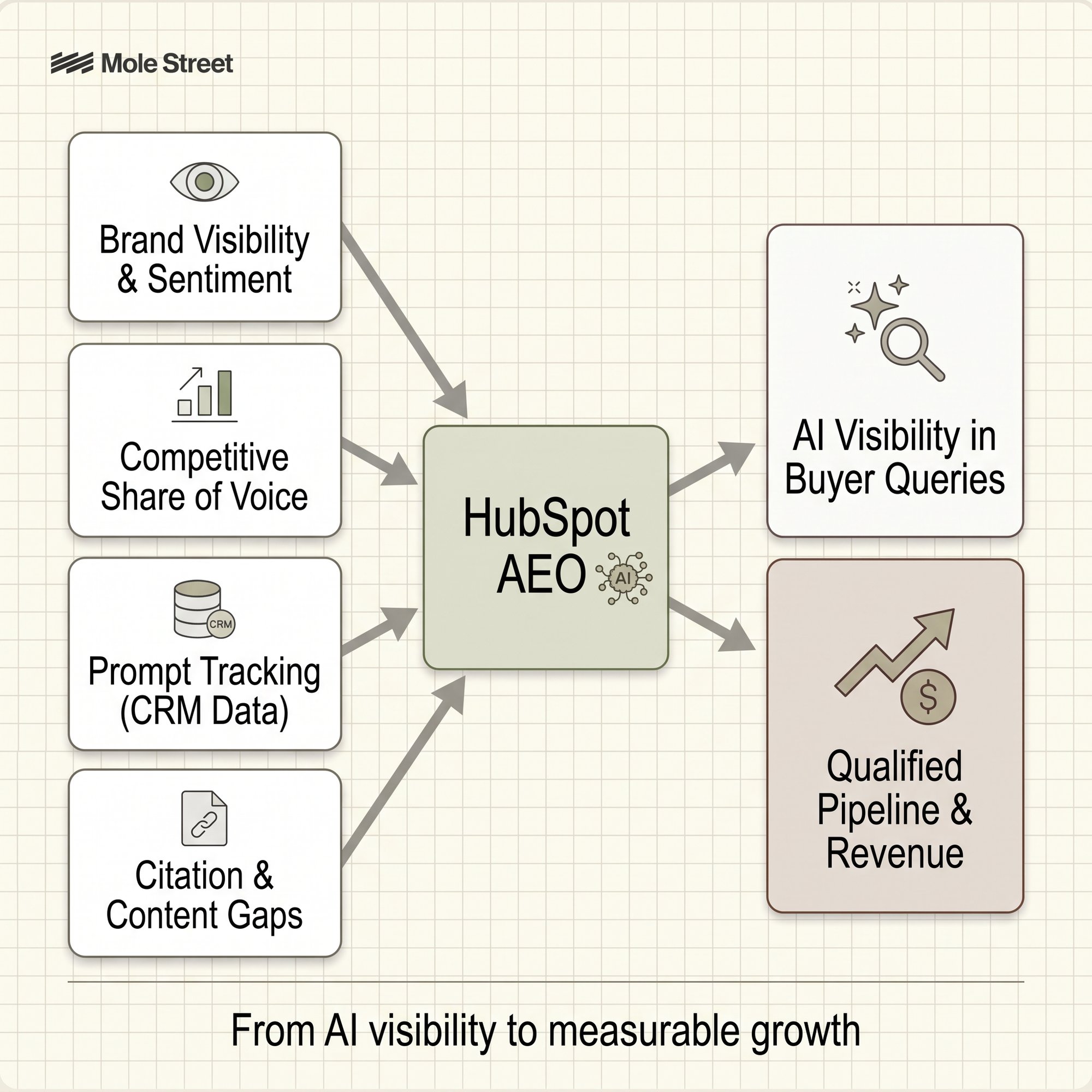
How Does Connecting AEO to Your CRM Generate New Business?
Standalone AEO tools tell you whether you appear in AI answers. CRM-integrated AEO tells you whether those appearances are actually turning into new business.
Three reasons this matters disproportionately for accounting firms:
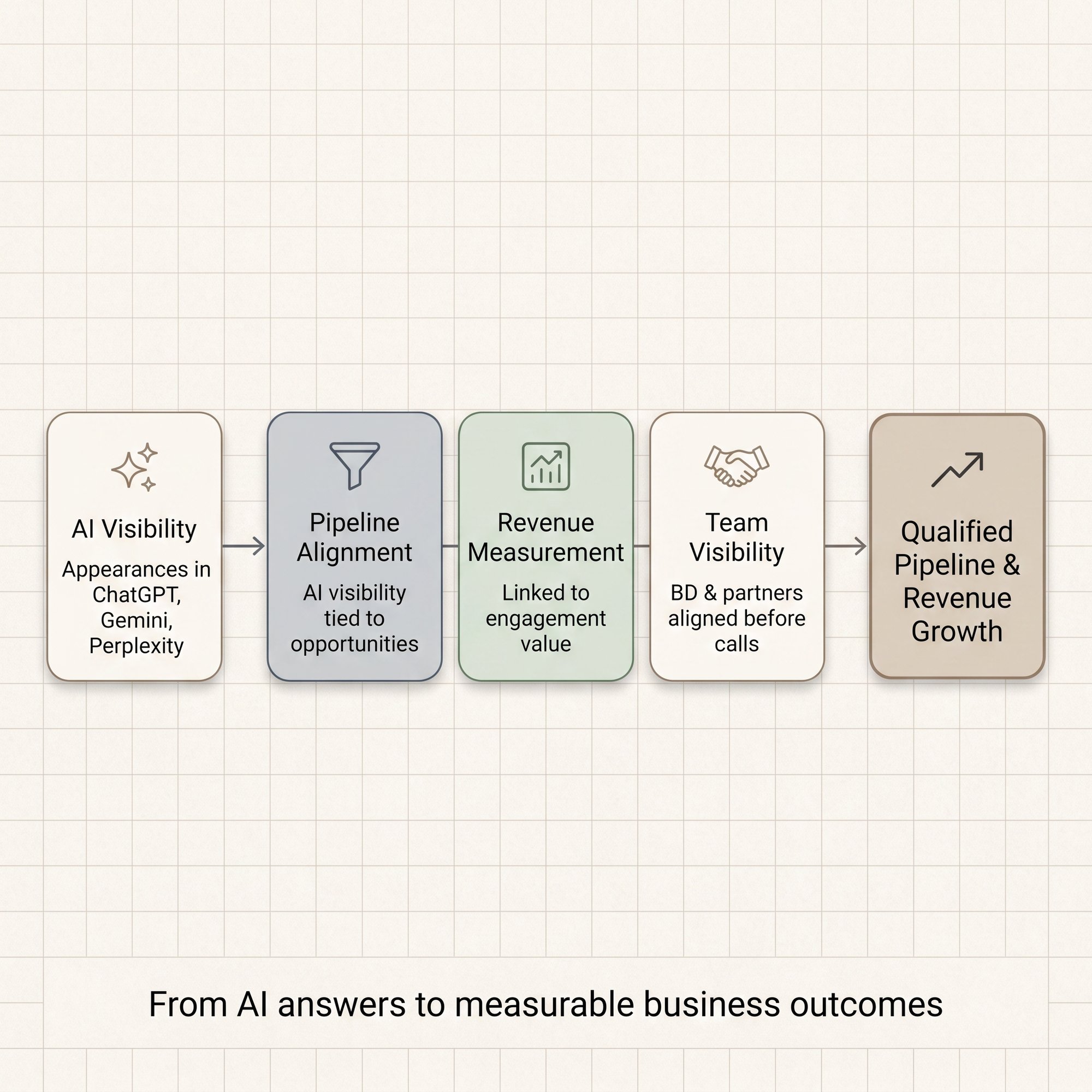
Pipeline alignment
Accounting firm sales cycles are long and engagements are high-value. Connecting AI visibility data to opportunity creation in the CRM lets the firm see whether AI presence is generating real pipeline, not vanity traffic.
Revenue Measurement
Tying AI source data to engagement letter value is the metric a managing partner cares about. Without it, AEO is a marketing report. With it, AEO becomes a partner-level decision input.
Cross-functional handoff
When a CFO arrives via AI, the BD team needs to know what AI said about the firm before the first call. CRM integration makes that visible to the partner running the meeting.
How Accountants Can Win Business From ChatGPT This Quarter
Each action below closes one gap between your firm and the AI answers your prospects already trust. Partners can assign them this week.
1. Audit how your firm appears in ChatGPT, Gemini, and Perplexity for your top 10 specialization queries
Run the queries today. Document which responses include your firm, which competitors get cited, and how each is framed. This becomes your baseline.
2. Identify the citation sources AI engines pull from in your specializations
AEO citation analysis surfaces the publications, directories, and competitor blogs that shape the answers. Decide which three you can realistically earn placement in over the next two quarters.
3. Build content density around your single most differentiated service
Three deep, partner-authored pieces on one specialization will earn more AI citations than thirty generic blog posts. Specialist firms win when they go narrower than the Big Four can afford to.
4. Connect AI visibility data to your CRM
Use HubSpot AEO to map AI prompts to your service lines and target industries, then track whether AI-sourced traffic generates qualified opportunities, not just sessions.
5. Treat AEO as a partner-led initiative
The partners hold the specialization stories AI needs to learn. A marketing team alone cannot manufacture the credibility signal that makes ChatGPT name your firm. Partners need to be on the byline, on the podcast, and quoted in the trade press.
AI Search Visibility Is the New Growth Engine for Accounting Firms
AEO is now front and center in how accounting firms win new business. Yes, accounting is a referral-heavy industry, but the latest updates in AI have increased its importance in client acquisition.
Here’s the reality - buyers are using AI to validate referrals before the first call, and AI search synthesizes one answer instead of a list. The Big Four dominate AI's default citation set for accounting. Specialists get flattened out of generalist queries. Trust, specialization, and reputation still drive the work, but they now get evaluated inside ChatGPT, Gemini, and Perplexity, in a window the firm cannot see without the right tools.
The firms that build their AI presence in 2026 will define how the next decade of buyers sees the accounting industry. That advantage does not appear in a quarterly report. It appears in the new business that arrives three years from now, when a CFO asks ChatGPT for a recommendation and your firm is the answer.
By: Harry Maule