6 Due Diligence Areas That Determine What Your Accounting Firm Is Worth to Private Equity

Private equity (PE) activity in the accounting sector surged 73.5% year-over-year in 2024, according to Capstone Partners. Micro-private equity firms now target practices as small as $5M in revenue.
For managing partners planning an exit in the next decade, one of their biggest challenges is whether their firm can survive the diligence process. A big part of this boils down to their ability to prove that revenue is predictable, clients are diversified, retention is measurable, and operations can scale.
This is something that can be achieved with a centralized data infrastructure, and doing so can often lead to bigger exits. In this blog, you will discover:
- The six questions PE buyers ask during accounting firm due diligence
- Why documented, exportable CRM data preserves your negotiating position
- How a properly configured HubSpot environment becomes the proof layer that separates premium closes from contentious ones
- The 18-month pre-exit playbook for building the data infrastructure buyers want to see

Why Is Private Equity Acquiring So Many Accounting Firms?
Private equity acquisitions in accounting are accelerating because the sector offers recurring revenue, high client retention, and fragmented ownership, all conditions that favor roll-up strategies.
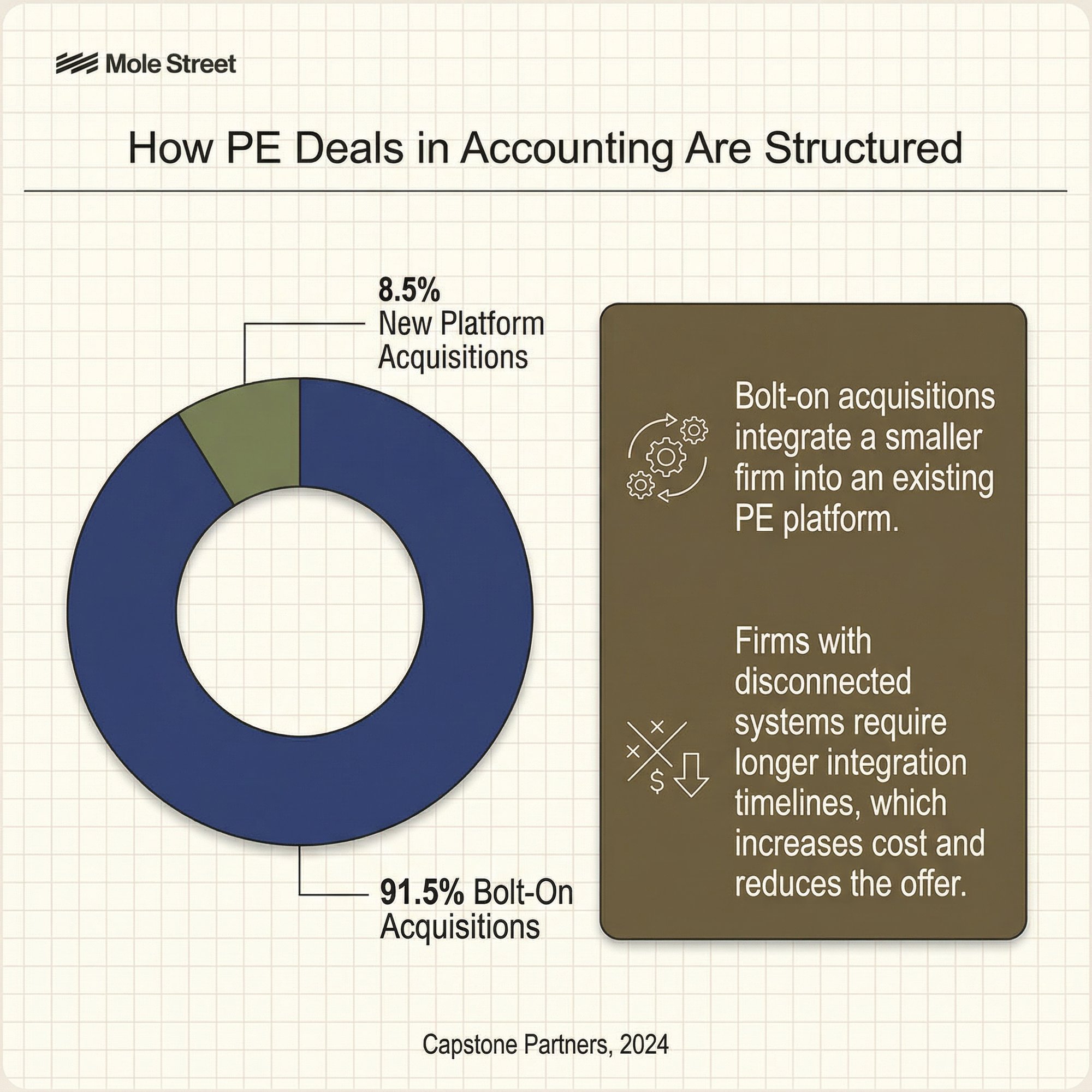
Capstone Partners reports that 91.5% of PE deals in accounting were bolt-on acquisitions in 2024, where a buyer purchases a smaller firm and integrates it into a larger platform they already own.
Purchase multiples for the sector jumped from 7.9x to 9.0x EBITDA in the same period, with accounting services exceeding that benchmark.
The implication is straightforward. PE buyers are specifically looking for firms they can integrate quickly into an existing platform. A firm with disconnected systems that require a 12-month technology overhaul before integration is a harder, more expensive bolt-on. That complexity gets priced into the offer.
The Citrin Cooperman transaction marked the inflection point. In January 2025, Blackstone acquired the firm from New Mountain Capital in a deal valued at over $2 billion at approximately 15 times EBITDA (Private Equity Wire, 2025). The firm had grown from $350 million in revenue in 2021 to $850 million by 2024.
According to the Journal of Accountancy, this was the first accounting firm "flipped" from one major sponsor to another. That matters because it proves accounting firms are now being treated like portfolio assets, bought, grown, and resold on a timeline.
The firms that can demonstrate documented, scalable operations command the premium. The firms that require a multi-year overhaul before resale get discounted on entry.
FirmLever's 2026 M&A analysis projects a sharp expansion downstream, with micro-PE firms and search funds now targeting practices in the $5M to $20M revenue range.
For managing partners at mid-market firms, this means the PE conversation is no longer theoretical. A buyer could approach within the next 12 to 24 months, and the firm's readiness at that moment determines the terms of the deal.
PE buyers acquire accounting firms for the revenue, the margins, and the client base. But the firms that can prove those things with documented data walk into negotiations with a fundamentally different outcome than the firms still assembling spreadsheets.
What Areas Do PE Buyers Evaluate During Accounting Firm Due Diligence?
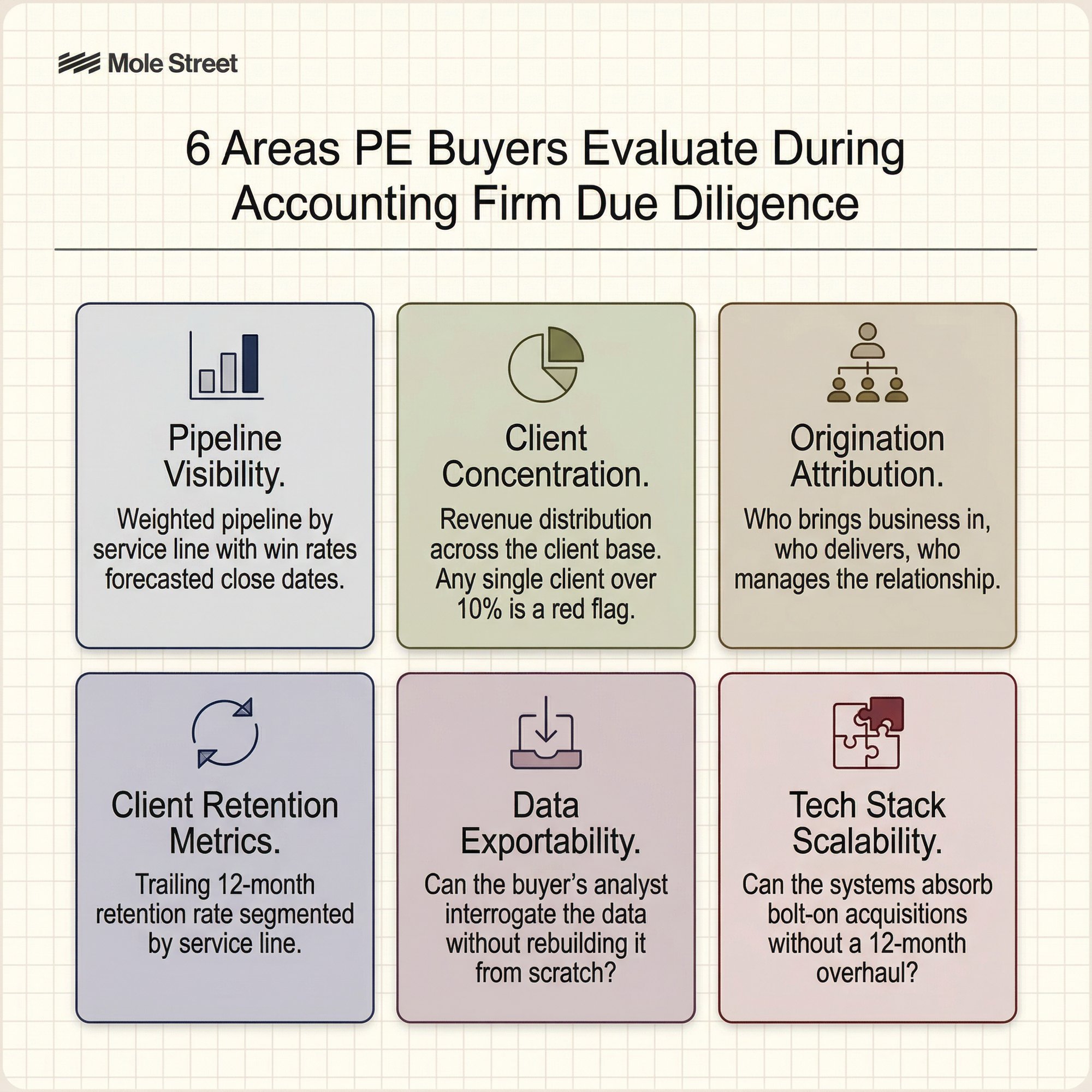
PE buyers evaluate six core areas that test whether a firm's revenue, pipeline, retention, and client data are documented, exportable, and verifiable. The CPA Journal's April 2026 analysis confirms that buyers prioritize "consistent and strong revenue growth, solid profit margins, and a stable client base." The six areas below are how they verify it.
For each area, three things matter: what buyers want to see, what most firms actually have, and what a properly configured HubSpot environment produces.
1. Pipeline Visibility
- What buyers want: A weighted pipeline by service line, with win rates, deal cycles, and forecasted close dates.
- What most firms have: A partner who says "we're growing" and a quarter-old spreadsheet.
- What HubSpot produces: A live pipeline view with deals tagged by service line, partner owner, expected close date, and probability. One click. One export. Handed to the buyer's analyst before the first coffee is finished.
Pipeline visibility is the proxy for revenue predictability. A buyer that cannot model future cash flow cannot price the deal with confidence.
2. Client Concentration
- What buyers want: A clean revenue distribution report across the entire client base.
- What most firms have: A gut sense that the firm is "pretty diversified."
- What HubSpot produces: A custom report that ranks clients by revenue, flags concentration risks (any single client over 10% of total revenue), and exports the entire distribution as a CSV the buyer's team can interrogate independently.
A single client over 10% of revenue is a red flag buyers model directly into the accounting firm valuation.
3. Origination and Service Delivery Attribution
- What buyers want: A documented attribution model showing who brings business in, who delivers it, and who maintains the relationship.
- What most firms have: Arguments at compensation meetings.
- What HubSpot produces: Custom contact and deal properties that tag every client with an originating partner, a service partner, and a relationship manager. The buyer asks the question. The partner pulls the report. The answer is institutional, not anecdotal.
If client relationships exist primarily in one rainmaker partner's head, that is key-person risk. Key-person risk depresses multiples because PE buyers want revenue that is institutional, never personal.
4. Client Retention Metrics
- What buyers want: A trailing 12-month retention rate, segmented by service line, with engagement signals that flag at-risk clients before they leave.
- What most firms have: A confident "we don't lose many clients."
- What HubSpot produces: An engagement scoring model that tracks every client interaction (emails, meetings, project activity, response timing) and flags accounts whose engagement has dropped. A retention dashboard shows trailing renewal rates by service line, partner, and industry vertical.
Retention is the foundation of recurring revenue, and recurring revenue is what PE buyers actually pay for.
5. Data Exportability
- What buyers want: Clean, exportable data from a centralized CRM data infrastructure that their own analysts can interrogate.
- What most firms have: Data scattered across Outlook, Excel, partner notebooks, and the office manager who "knows everything."
- What HubSpot produces: Every conversation, every contract, every engagement logged in one system. The buyer's analyst gets read-only access and pulls everything needed without a single follow-up email to the partners.
Due diligence on a firm without exportable data takes six to eight weeks of forensic spreadsheet-building. With a centralized system, it takes two days.
6. Tech Stack Scalability for Bolt-On Acquisitions
- What buyers want: Integrated systems that can absorb add-on transactions without a 12-month overhaul.
- What most firms have: A patchwork of tools that do not talk to each other.
- What HubSpot produces: A single platform connecting CRM, marketing automation, client engagement, and reporting through native integrations.
When the PE platform acquires three more firms next year, the data model already exists. The bolt-on acquisition takes weeks, not quarters.
Why Do Most Accounting Firms Fail These Due Diligence Areas?
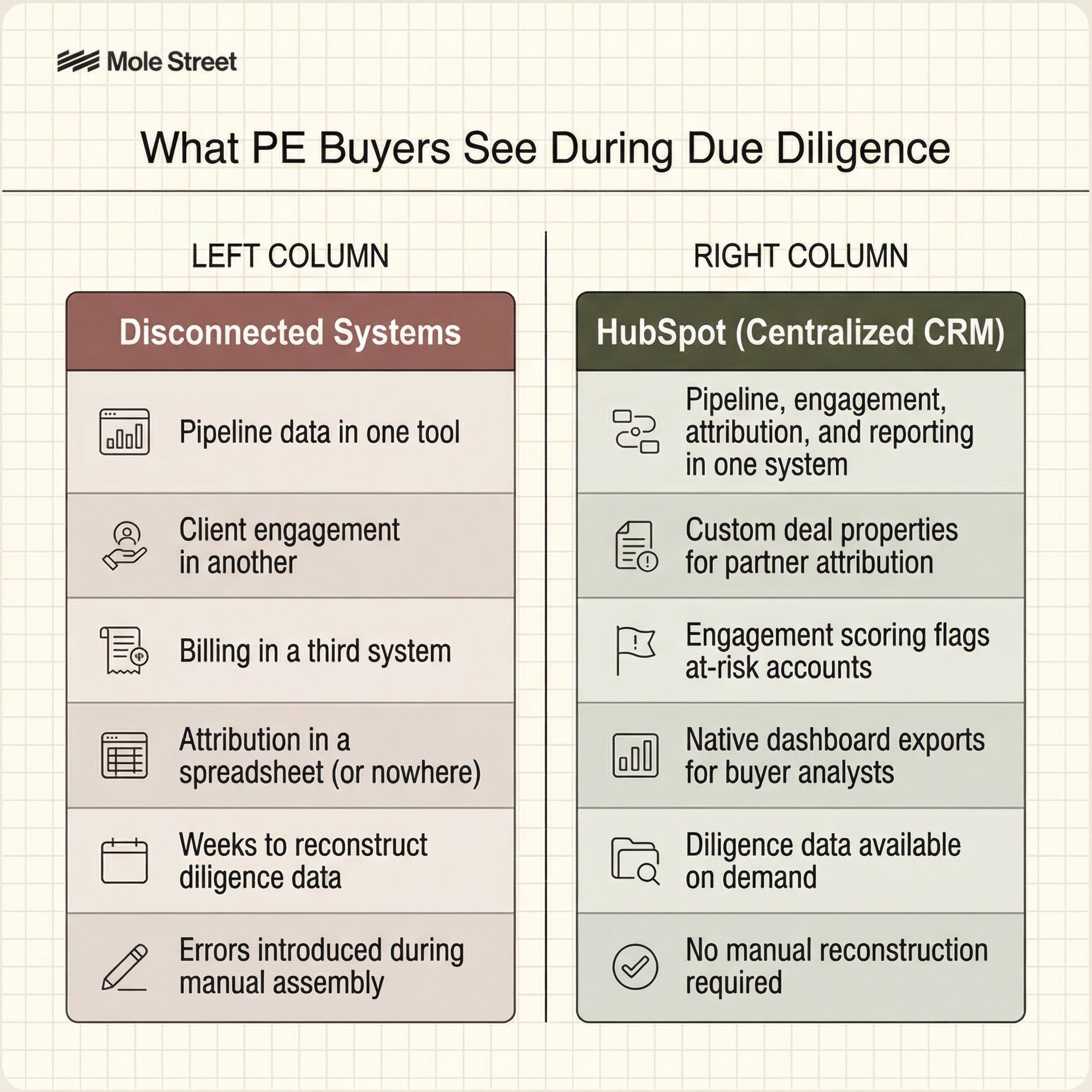
Most accounting firms fail private equity due diligence because they manage client data across too many disconnected systems with no centralized CRM. Pipeline data lives in one tool. Client engagement lives in another. Partner attribution lives in a spreadsheet, or in no system at all.
When a buyer evaluates any of the six diligence areas, the managing partner has to manually reconstruct the answer from multiple sources. That reconstruction takes weeks, introduces errors, and erodes the buyer's confidence in the data.
HubSpot consolidates pipeline tracking, client engagement, marketing automation, and reporting into a single data model. Three capabilities directly address the six diligence areas:
- Custom deal and contact properties tag every client with an originating partner, a service partner, and a relationship manager. Attribution becomes institutional and exportable, not personal and anecdotal. Key-person risk drops.
- Engagement scoring tracks every client interaction (emails opened, meetings booked, project milestones, response timing) and flags accounts whose activity has dropped. This produces the trailing retention data private equity buyers demand, segmented by service line, partner, and industry.
- Native reporting and dashboard exports produce pipeline forecasts, client concentration analyses, and revenue breakdowns in a format the buyer's analyst can interrogate independently. No manual spreadsheet assembly. No six-week reconstruction.
A firm running disconnected tools takes weeks to reconstruct diligence data. A firm running HubSpot exports the answers on demand. Buyers notice the difference, and they price it into the deal.
How Does CRM Data Affect Accounting Firm Valuations?
CRM data affects accounting firm valuations indirectly by giving the firm negotiating leverage that protects the EBITDA multiple from erosion during due diligence, not by earning a higher number on a buyer's spreadsheet.
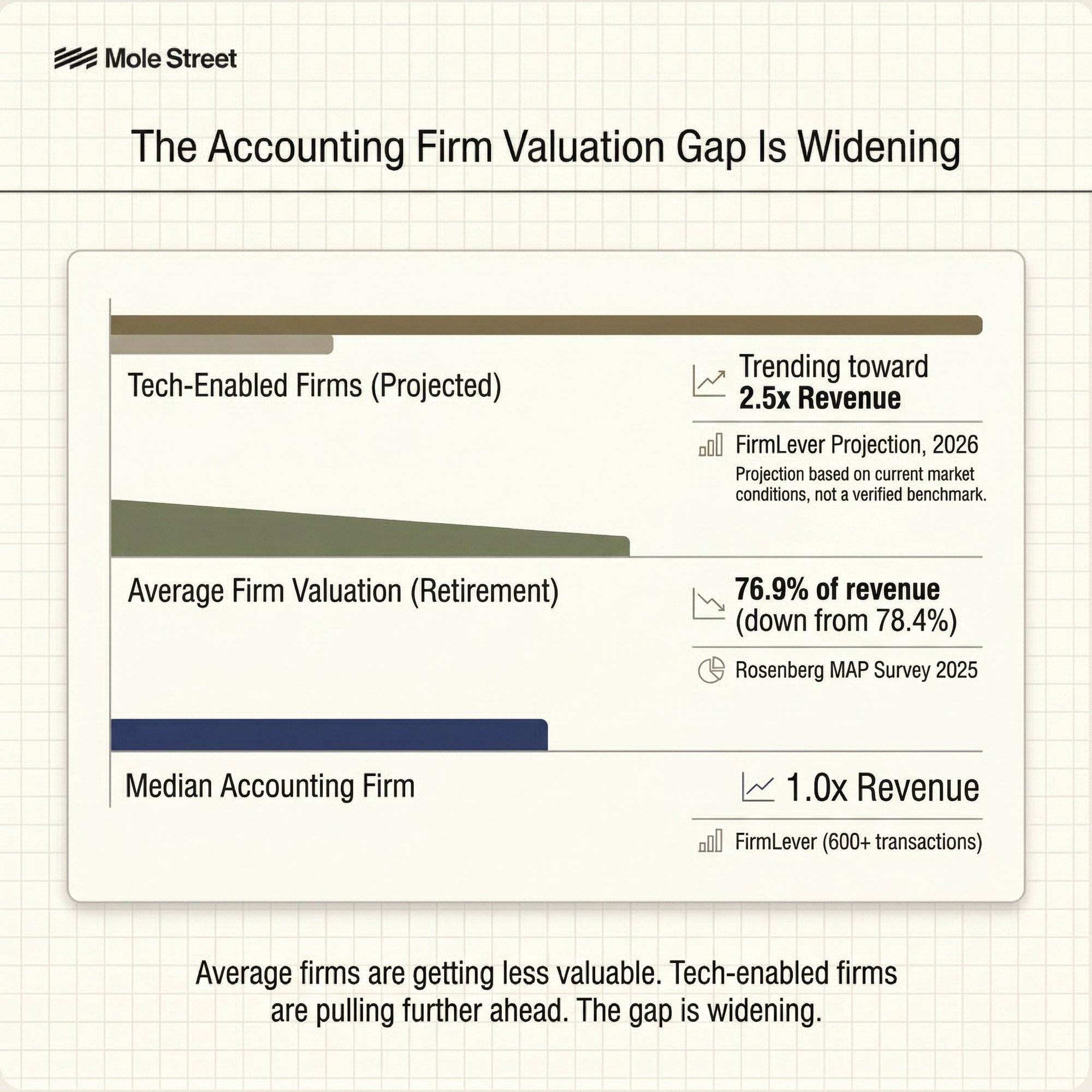
FirmLever's analysis of more than 600 transactions shows the median accounting firm still selling for approximately 1.0x revenue or 2.75x SDE. That is the baseline. But the baseline is starting to look more like a floor than a benchmark.
The 2025 Rosenberg MAP Survey, based on data from 296 firms, reports that the average firm valuation multiple for retirement payments dropped from 78.4% of revenue in 2024 to 76.9% in 2025. Average firms are getting less valuable every year.
Meanwhile, FirmLever projects that firms with proprietary technology and documented data infrastructure could trend toward 2.5x revenue, a multiple they describe as "unheard of for a traditional firm." This is a projection based on FirmLever's analysis of current market conditions, not a verified benchmark.
But the direction is clear: the gap between the floor and the ceiling is widening, and the speed of due diligence is the mechanism that determines which side a firm lands on.
A firm that walks into the diligence room with documented pipeline data, retention reports, and clean attribution earns something more valuable than a revised multiplier: leverage. It earns the ability to push back on offers. It earns a faster timeline that prevents the buyer from negotiating downward as new questions surface week after week.
Faster diligence preserves momentum. Preserved momentum preserves price.
What Should Managing Partners Do 18 Months Before a Private Equity Acquisition?
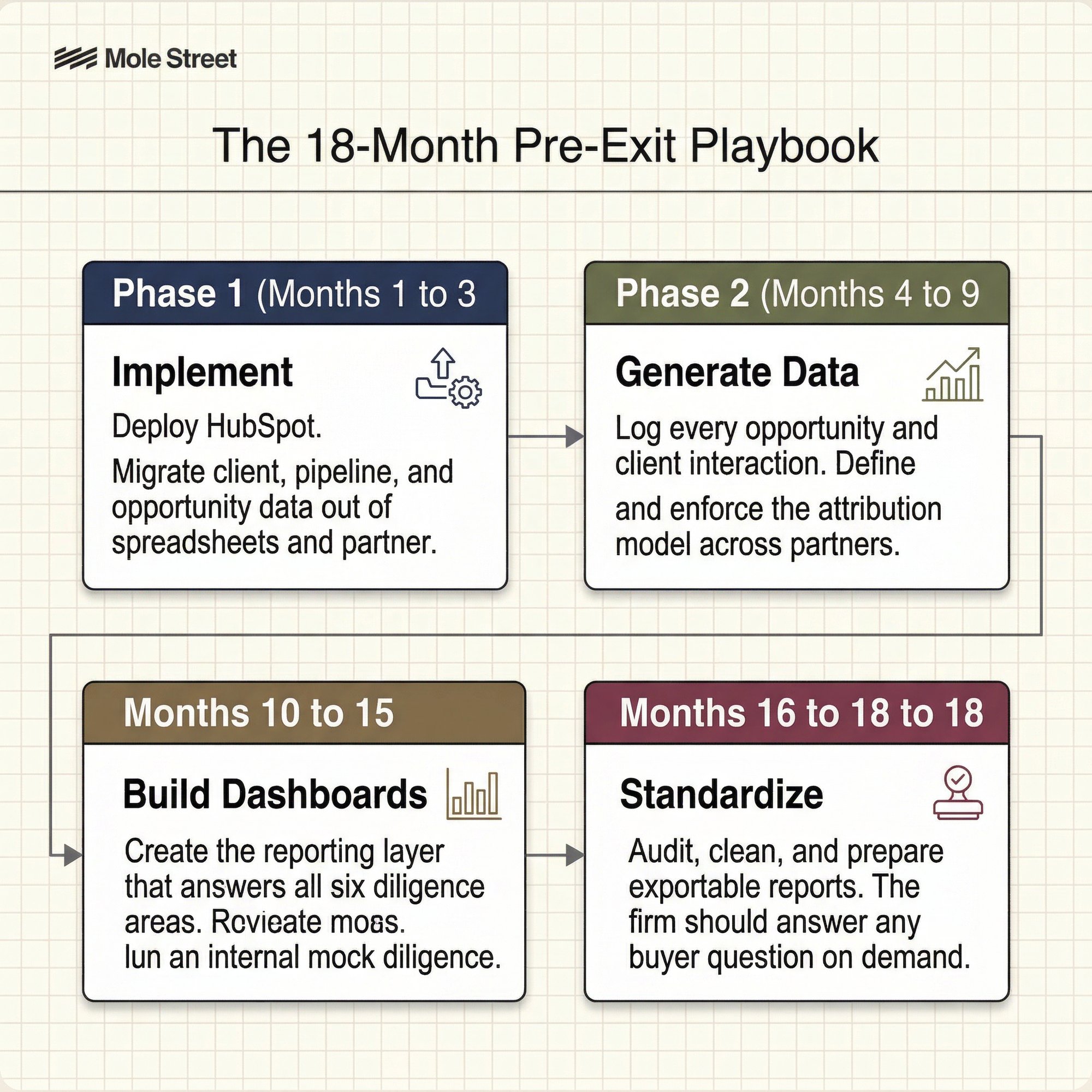
For managing partners more than 18 months out from a contemplated transaction, the path forward requires building a documented data layer that answers the six diligence areas on demand.
- Months 1 to 3: Implement HubSpot. Migrate historical client, opportunity, and pipeline data out of spreadsheets and partner inboxes. Define the data model with the exit conversation in mind.
- Months 4 to 9: Generate clean trailing data. Every opportunity logged. Every client interaction tracked. Attribution model defined and enforced across partners.
- Months 10 to 15: Build the dashboards that answer the six diligence areas. Run an internal mock diligence and identify every gap.
- Months 16 to 18: Standardize, audit, and prepare exportable reports. The firm should be able to answer any buyer question within 48 hours.
When the buyer arrives, the conversation leads with data. Pipeline. Concentration. Retention. Attribution. All documented. All defensible. All exportable.
Your Data Infrastructure Determines Whether Your Valuation Holds During Due Diligence
Private equity buyers are here to stay. They are moving downstream, moving faster, and asking sharper questions every quarter. With acquisition activity up 73.5% year-over-year and 91.5% of deals structured as bolt-on integrations, the firms being evaluated next are not the Top 50. They are the $5M to $20M practices that have never faced this level of scrutiny before.
The six due diligence areas covered in this article all come down to one thing: can the firm prove its revenue, retention, pipeline, and client relationships with documented, exportable data? The firms that can answer on demand hold their price. The firms that need weeks to reconstruct the data watch it erode with every follow-up question.
For managing partners planning an exit in the next decade, the work starts now. Implement a centralized CRM. Build 12 to 18 months of clean trailing data. Run a mock diligence against the six areas before a buyer does it for real.
And what does this lead to? Faster closes. Stronger negotiating positions. And a managing partner who controls the exit story instead of explaining it.
By: Harry Maule